







Question: Assuming that transactions receive shared locks to read database objects, exclusive locks to write database objects and release locks when they commit or are
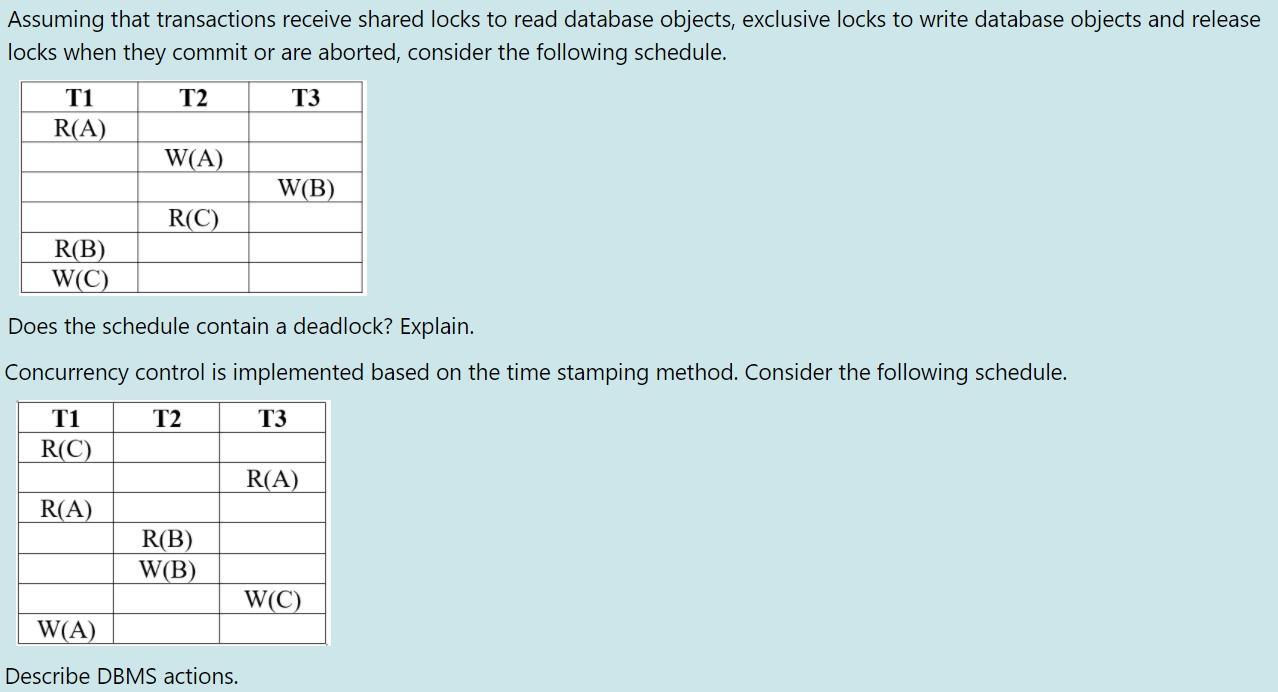
Assuming that transactions receive shared locks to read database objects, exclusive locks to write database objects and release locks when they commit or are aborted, consider the following schedule. T2 T3 T1 R(A) W(A) R(C) R(A) R(B) W(C) Does the schedule contain a deadlock? Explain. Concurrency control is implemented based on the time stamping method. Consider the following schedule. T1 T2 T3 R(C) R(B) W(B) W(B) W(A) Describe DBMS actions. R(A) W(C)
Step by Step Solution
3.50 Rating (157 Votes )
There are 3 Steps involved in it
Yes the schedule contains a deadlock At t3 T2 locks resource A with a shared lock At t5 T1 locks res... View full answer

Get step-by-step solutions from verified subject matter experts
 Study Help