







Question: Assuming that your computer can perform 10 billion operations per second, what is the largest value of n such that you can complete the following
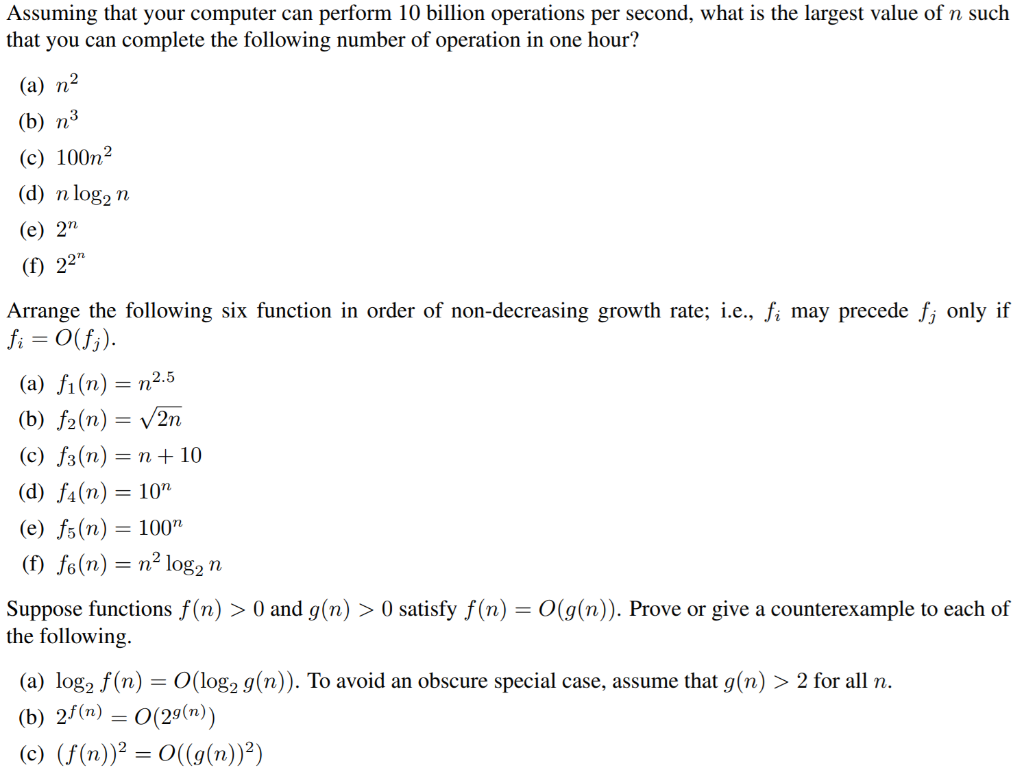
Assuming that your computer can perform 10 billion operations per second, what is the largest value of n such that you can complete the following number of operation in one hour? (a) na (b) n3 (c) 100n2 (d) n log2 n (e) 2n (f) 22" = Arrange the following six function in order of non-decreasing growth rate; i.e., fi may precede fj only if fi = 0(f;). (a) fi(n) = n2.5 (b) f2(n) = 2n (c) f3(n) = n + 10 (d) f4(n) = 10" (e) fs(n) = 100" (f) f6(n) = n log2 n = Suppose functions f(n) > 0 and g(n) >0 satisfy f(n) = 0(g(n)). Prove or give a counterexample to each of the following: (a) log2 f(n) = O(log2 g(n)). To avoid an obscure special case, assume that g(n) > 2 for all n. (b) 2f(n) = 0(29(n)) (c) (f(n))2 = (((g(n)))
Step by Step Solution
There are 3 Steps involved in it

Get step-by-step solutions from verified subject matter experts
 Study Help