







Question: Assuming the following code: int x = myfunction (); /* arbitrary value */ int y = myfunction2(); /* arbitrary value */ int z =
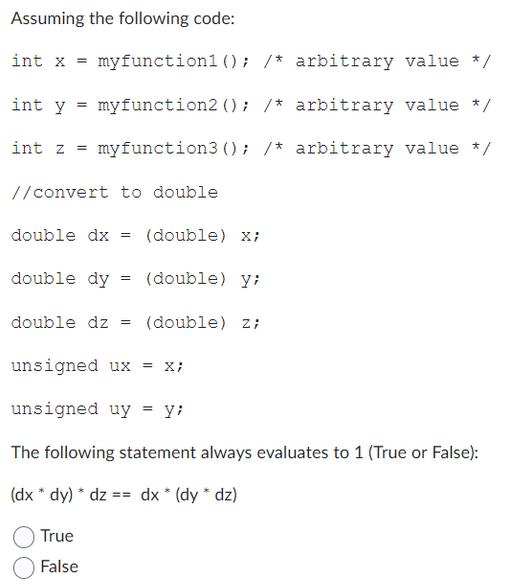
Assuming the following code: int x = myfunction (); /* arbitrary value */ int y = myfunction2(); /* arbitrary value */ int z = myfunction3 (); /* arbitrary value */ //convert to double double dx = (double) x; double dy = (double) y; double dz = (double) z; True False unsigned ux = x; unsigned uy = y; The following statement always evaluates to 1 (True or False): (dx *dy) * dz == dx * (dydz)
Step by Step Solution
There are 3 Steps involved in it
1 Expert Approved Answer
Step: 1 Unlock

The detailed answer for the above question is provided below The provided code snippet appears to ha... View full answer
Question Has Been Solved by an Expert!
Get step-by-step solutions from verified subject matter experts
Step: 2 Unlock
Step: 3 Unlock
 Study Help