







Question: Assumptions for problems 1-6: A pension fund manager is considering three mutual funds. The first is a stock fund, the second is a long-term government
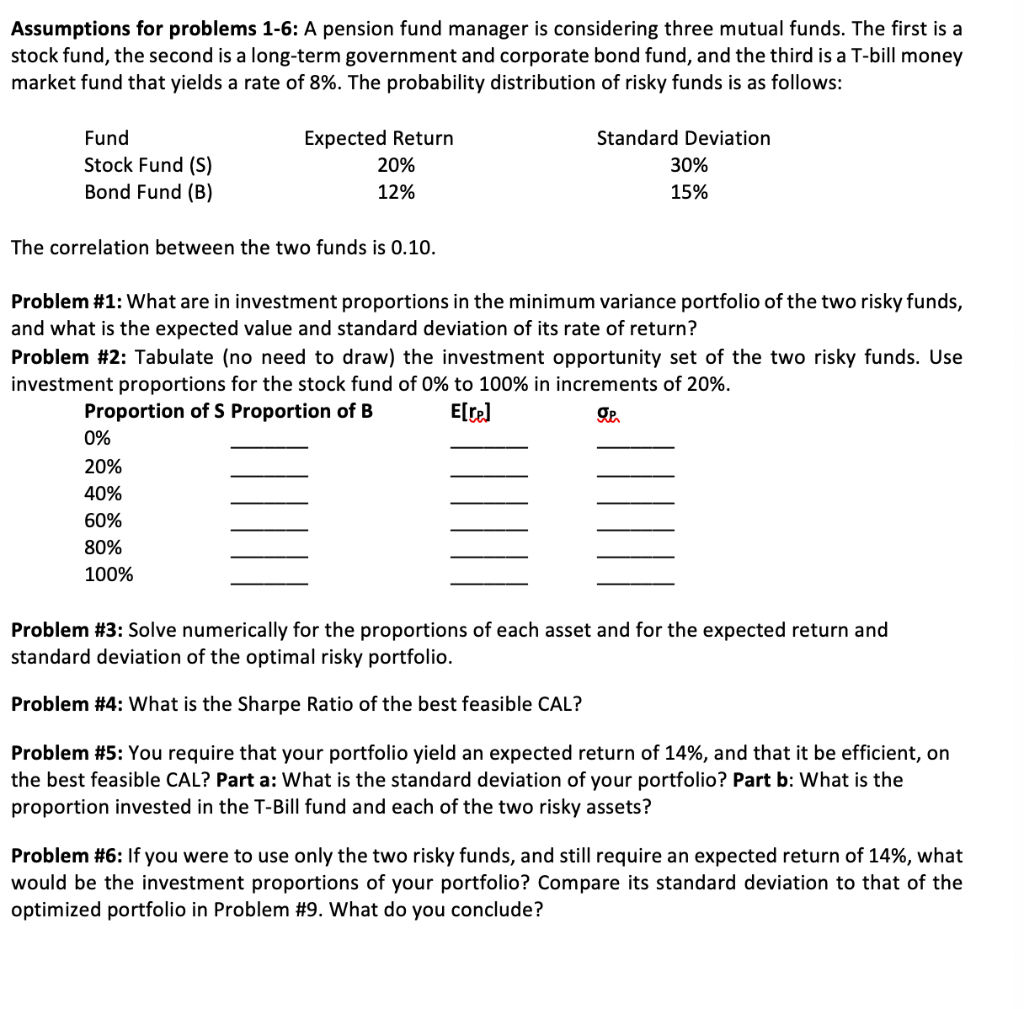
Assumptions for problems 1-6: A pension fund manager is considering three mutual funds. The first is a stock fund, the second is a long-term government and corporate bond fund, and the third is a T-bill money market fund that yields a rate of 8%. The probability distribution of risky funds is as follows: Fund Stock Fund (S) Bond Fund (B) Expected Return 20% 12% Standard Deviation 30% 15% The correlation between the two funds is 0.10. Problem #1: What are in investment proportions in the minimum variance portfolio of the two risky funds, and what is the expected value and standard deviation of its rate of return? Problem #2: Tabulate (no need to draw) the investment opportunity set of the two risky funds. Use investment proportions for the stock fund of 0% to 100% in increments of 20%. Proportion of S Proportion of B E[re] OP 0% 20% 40% 60% 80% 100% Problem #3: Solve numerically for the proportions of each asset and for the expected return and standard deviation of the optimal risky portfolio. Problem #4: What is the Sharpe Ratio of the best feasible CAL? Problem #5: You require that your portfolio yield an expected return of 14%, and that it be efficient, on the best feasible CAL? Part a: What is the standard deviation of your portfolio? Part b: What is the proportion invested in the T-Bill fund and each of the two risky assets? Problem #6: If you were to use only the two risky funds, and still require an expected return of 14%, what would be the investment proportions of your portfolio? Compare its standard deviation to that of the optimized portfolio in Problem #9. What do you conclude
Step by Step Solution
There are 3 Steps involved in it

Get step-by-step solutions from verified subject matter experts
 Study Help