Question: At least two page answer. 1. THE E-COMMERCE DIMENSION - If Rohr could have monitored his condition and regimen through a cell phone or other
At least two page answer.
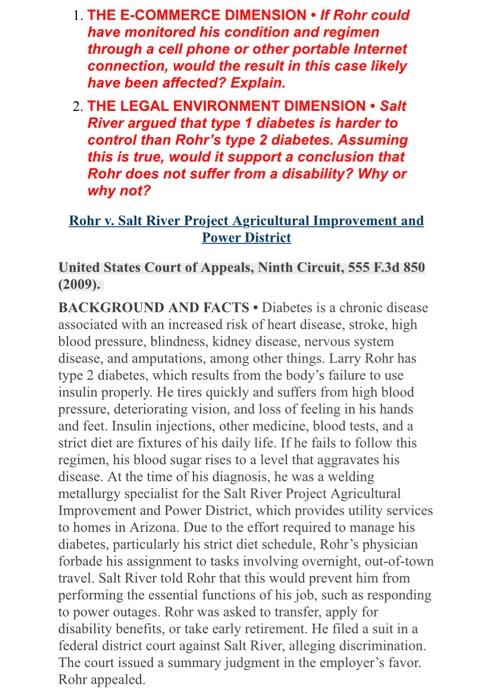
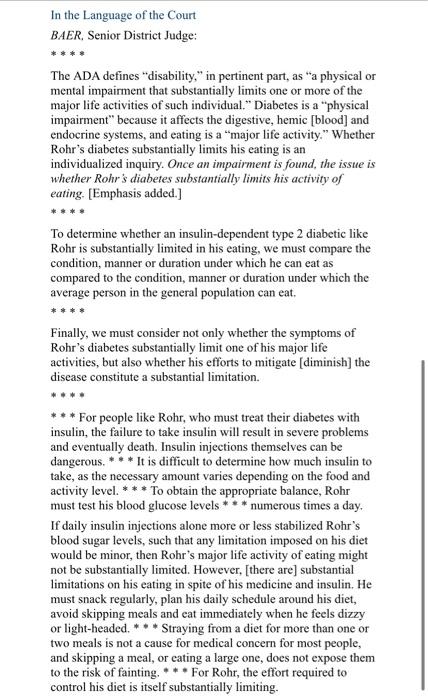
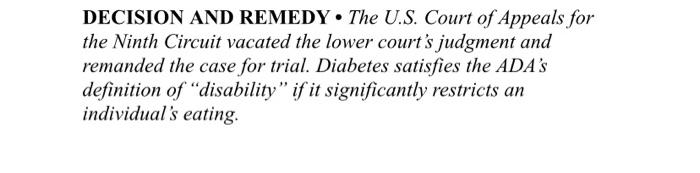
1. THE E-COMMERCE DIMENSION - If Rohr could have monitored his condition and regimen through a cell phone or other portable Internet connection, would the result in this case likely have been affected? Explain. 2. THE LEGAL ENVIRONMENT DIMENSION - Salt River argued that type 1 diabetes is harder to control than Rohr's type 2 diabetes. Assuming this is true, would it support a conclusion that Rohr does not suffer from a disability? Why or why not? Rohr v. Salt River Project Agricultural Improvement and Power District United States Court of Appeals, Ninth Circuit, 555 F.3d 850 (2009). BACKGROUND AND FACTS - Diabetes is a chronic disease associated with an increased risk of heart disease, stroke, high blood pressure, blindness, kidney disease, nervous system disease, and amputations, among other things. Larry Rohr has type 2 diabetes, which results from the body's failure to use insulin properly. He tires quickly and suffers from high blood pressure, deteriorating vision, and loss of feeling in his hands and feet. Insulin injections, other medicine, blood tests, and a strict diet are fixtures of his daily life. If he fails to follow this regimen, his blood sugar rises to a level that aggravates his disease. At the time of his diagnosis, he was a welding metallurgy specialist for the Salt River Project Agricultural Improvement and Power District, which provides utility services to homes in Arizona. Due to the effort required to manage his diabetes, particularly his strict diet schedule, Rohr's physician forbade his assignment to tasks involving overnight, out-of-town travel. Salt River told Rohr that this would prevent him from performing the essential functions of his job, such as responding to power outages. Rohr was asked to transfer, apply for disability benefits, or take early retirement. He filed a suit in a federal district court against Salt River, alleging discrimination. The court issued a summary judgment in the employer's favor. Rohr appealed. BAER, Senior District Judge: The ADA defines "disability," in pertinent part, as "a physical or mental impairment that substantially limits one or more of the major life activities of such individual." Diabetes is a "physical impairment" because it affects the digestive, hemic [blood] and endocrine systems, and eating is a "major life activity." Whether Rohr's diabetes substantially limits his eating is an individualized inquiry. Once an impairment is found, the issue is whether Rohr's diabetes substantially limits his activity of eating. [Emphasis added.] To determine whether an insulin-dependent type 2 diabetic like Rohr is substantially limited in his eating, we must compare the condition, manner or duration under which he can eat as compared to the condition, manner or duration under which the average person in the general population can eat. Finally, we must consider not only whether the symptoms of Rohr's diabetes substantially limit one of his major life activities, but also whether his efforts to mitigate [diminish] the disease constitute a substantial limitation. *** For people like Rohr, who must treat their diabetes with insulin, the failure to take insulin will result in severe problems and eventually death. Insulin injections themselves can be dangerous. * ** It is difficult to determine how much insulin to take, as the necessary amount varies depending on the food and activity level. To obtain the appropriate balance, Rohr must test his blood glucose levels * * * numerous times a day. If daily insulin injections alone more or less stabilized Rohr's blood sugar levels, such that any limitation imposed on his diet would be minor, then Rohr's major life activity of eating might not be substantially limited. However, [there are] substantial limitations on his eating in spite of his medicine and insulin. He must snack regularly, plan his daily schedule around his diet, avoid skipping meals and eat immediately when he feels dizzy or light-headed. *** Straying from a diet for more than one or two meals is not a cause for medical concern for most people, and skipping a meal, or eating a large one, does not expose them to the risk of fainting. For Rohr, the effort required to control his diet is itself substantially limiting. DECISION AND REMEDY The U.S. Court of Appeals for the Ninth Circuit vacated the lower court's judgment and remanded the case for trial. Diabetes satisfies the ADA's definition of "disability" if it significantly restricts an individual's eating









 Study Help