



Question: At what value are held-to-maturity debt securities reported on the balance sheet? Acquisition cost Market value Amortized cost Historical cost adjusted for a proportionate share
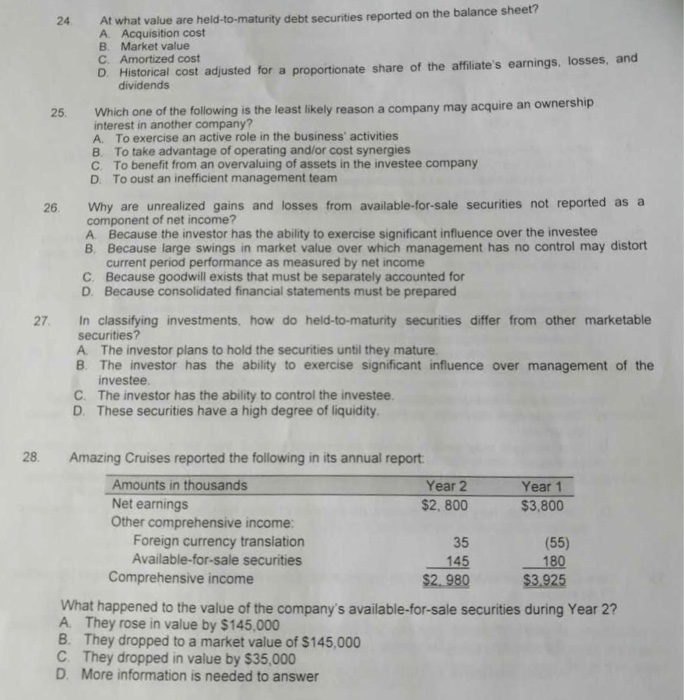
At what value are held-to-maturity debt securities reported on the balance sheet? Acquisition cost Market value Amortized cost Historical cost adjusted for a proportionate share of the affiliate's earnings, losses, and dividends Which one of the following is the least likely reason a company may acquire an ownership interest in another company? To exercise an active role in the business' activities To take advantage of operating and/or cost synergies To benefit from an overvaluing of assets in the investee company To oust an inefficient management team Why are unrealized gains and losses from available-for-sale securities not reported as a component of net income? Because the investor has the ability to exercise significant influence over the investee Because large swings in market value over which management has no control may distort current period performance as measured by net income Because goodwill exists that must be separately accounted for Because consolidated financial statements must be prepared In classifying investments how do held-to-maturity securities differ from other marketable securities? The investor plans to hold the securities until they mature. The investor has the ability to exercise significant influence over management of the investee. The investor has the ability to control the investee. These securities have a high degree of liquidity. Amazing Cruises reported the following in its annual report: What happened to the value of the company's available-for-sale securities during Year 2? They rose in value by $145,000 They dropped to a market value of $145,000 They dropped in value by $35,000 More information is needed to
Step by Step Solution
There are 3 Steps involved in it

Get step-by-step solutions from verified subject matter experts