





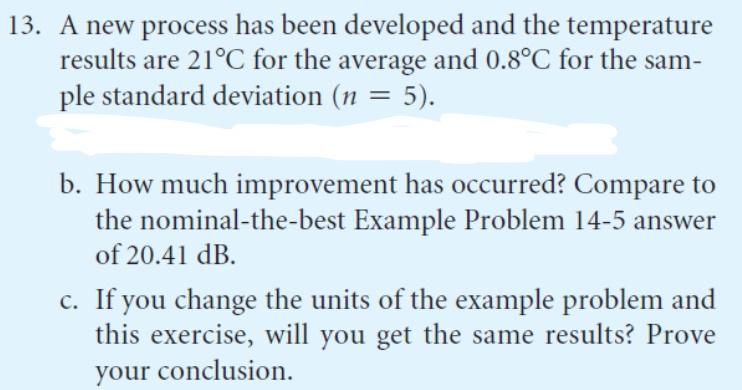
Question: Attached below is the Nominal-The-Best example for part B: 13. A new process has been developed and the temperature results are 21C for the average
Attached below is the Nominal-The-Best example

Attached below is the Nominal-The-Best example for part B:
Attached below is the Nominal-The-Best example

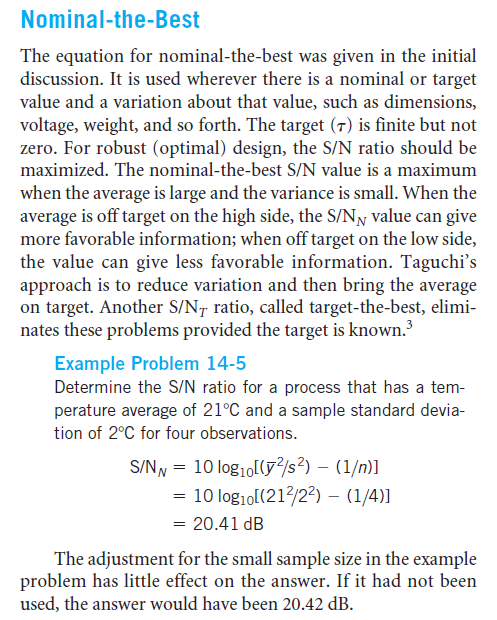
13. A new process has been developed and the temperature results are 21C for the average and 0.8C for the sam- ple standard deviation (n = 5). = b. How much improvement has occurred? Compare to the nominal-the-best Example Problem 14-5 answer of 20.41 dB. c. If you change the units of the example problem and this exercise, will you get the same results? Prove your conclusion. Nominal-the-Best The equation for nominal-the-best was given in the initial discussion. It is used wherever there is a nominal or target value and a variation about that value, such as dimensions, voltage, weight, and so forth. The target (T) is finite but not zero. For robust (optimal) design, the S/N ratio should be maximized. The nominal-the-best S/N value is a maximum when the average is large and the variance is small. When the average is off target on the high side, the S/Ny value can give more favorable information; when off target on the low side, the value can give less favorable information. Taguchi's approach is to reduce variation and then bring the average on target. Another S/N, ratio, called target-the-best, elimi- nates these problems provided the target is known. Example Problem 14-5 Determine the S/N ratio for a process that has a tem- perature average of 21C and a sample standard devia- tion of 2C for four observations. S/N, = 10 log10[(74/52) (1)] = 10 log10[(212/22) - (1/4)] = 20.41 dB The adjustment for the small sample size in the example problem has little effect on the answer. If it had not been used, the answer would have been 20.42 dB. =

Step by Step Solution

There are 3 Steps involved in it

1 Expert Approved Answer
Step: 1 Unlock blur-text-image

Question Has Been Solved by an Expert!

Get step-by-step solutions from verified subject matter experts

Step: 2 Unlock
Step: 3 Unlock

Students Have Also Explored These Related General Management Questions!