







Question: Attempts: ttention: Due to a bug in Google Chrome, this page may not function correctly. Click here to learn more. 13. Semiannual and other compounding
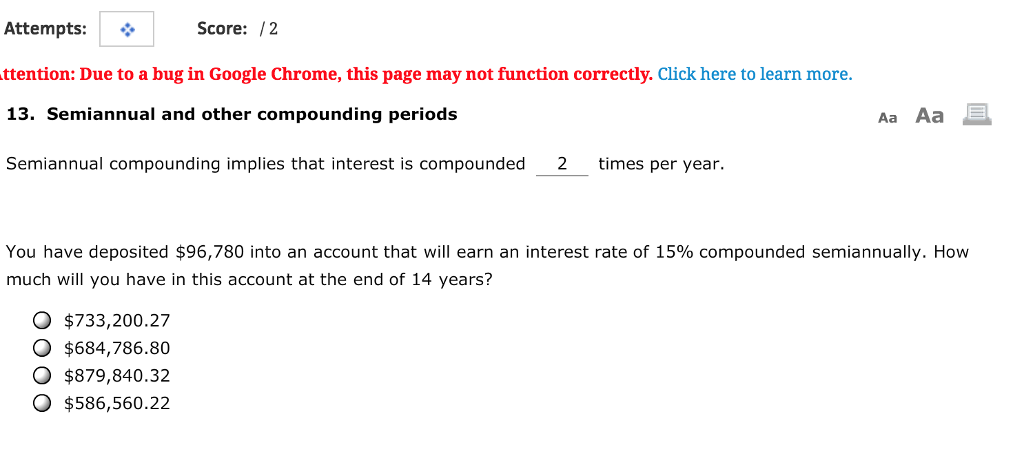
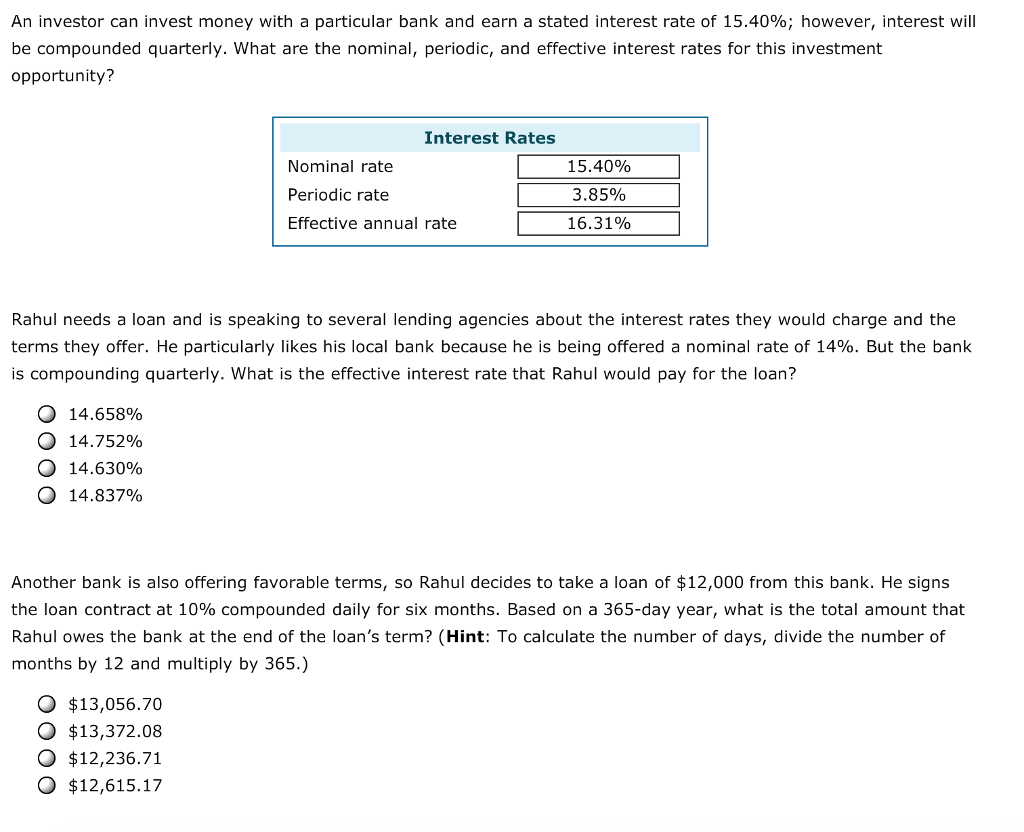
Attempts: ttention: Due to a bug in Google Chrome, this page may not function correctly. Click here to learn more. 13. Semiannual and other compounding periods Semiannual compounding implies that interest is compounded 2 times per year. Score: /2 Aa Aa You have deposited $96,780 into an account that will earn an interest rate of 15% compounded semiannually. How much will you have in this account at the end of 14 years? O $733,200.27 $684,786.80 O $879,840.32 O $586,560.22 An investor can invest money with a particular bank and earn a stated interest rate of 15.40%; however, interest will be compounded quarterly. What are the nominal, periodic, and effective interest rates for this investment opportunity? Interest Rates Nominal rate Periodic rate Effective annual rate 15.40% 3.85% 16.31% | Rahul needs a loan and is speaking to several lending agencies about the interest rates they would charge and the terms they offer. He particularly likes his local bank because he is being offered a nominal rate of 14%. But the bank is compounding quarterly. What is the effective interest rate that Rahul would pay for the loan? o 14.658% o 14.752% O 14.630% 0 14.837% Another bank is also offering favorable terms, so Rahul decides to take a loan of $12,000 from this bank. He signs the loan contract at 10% compounded daily for six months. Based on a 365-day year, what is the total amount that Rahul owes the bank at the end of the loan's term? (Hint: To calculate the number of days, divide the number of months by 12 and multiply by 365.) O $13,056.70 O $13,372.08 O $12,236.71 O $12,615.17
Step by Step Solution
There are 3 Steps involved in it

Get step-by-step solutions from verified subject matter experts
 Study Help