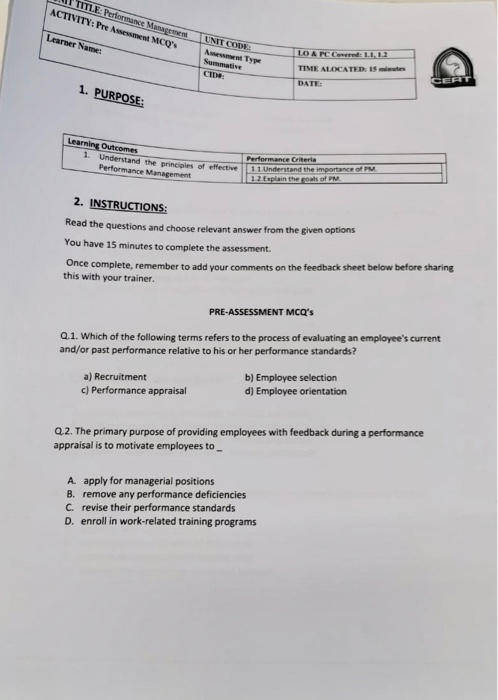
Question: ATTITLE: Performance Management ACTIVITY: Pre Assessment MCQ's Learner Names UNIT CODE A l Type Summative LO A P red: 11.1.2 TIME ALECATED: 15 1. PURPOSE:
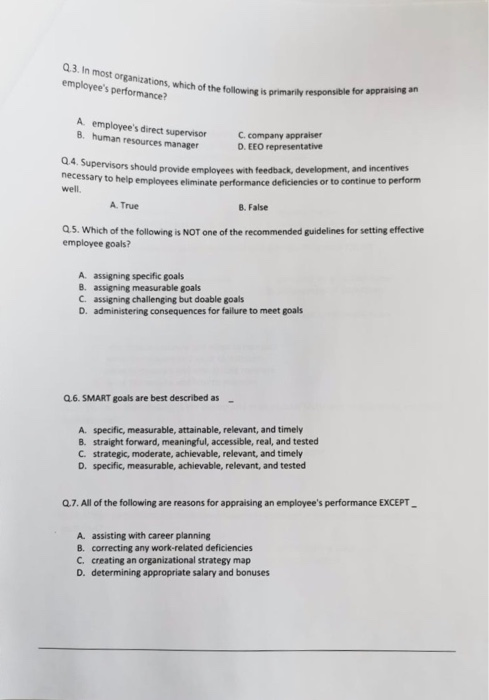
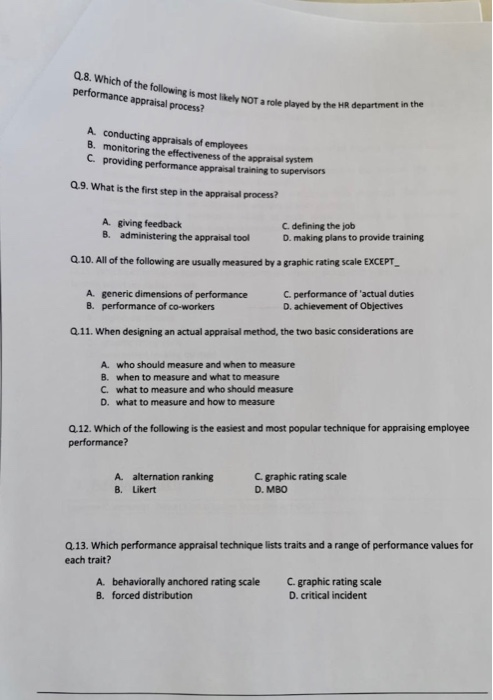
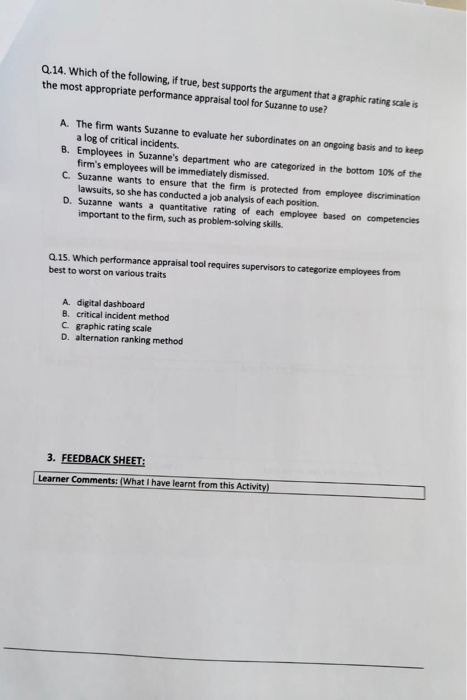
ATTITLE: Performance Management ACTIVITY: Pre Assessment MCQ's Learner Names UNIT CODE A l Type Summative LO A P red: 11.1.2 TIME ALECATED: 15 1. PURPOSE: Learning Outcomes 1 Understand the principles of effective Performance Management | 1 1 Understand the importance of 1 2 Explain the goals of PM 2. INSTRUCTIONS: Read the questions and choose relevant answer from the given options You have 15 minutes to complete the assessment. Once complete, remember to add your comments on the feedback sheet below before sharing this with your trainer. PRE-ASSESSMENT MCQ's Q.1. Which of the following terms refers to the process of evaluating an employee's current and/or past performance relative to his or her performance standards? a) Recruitment c) Performance appraisal b) Employee selection d) Employee orientation Q.2. The primary purpose of providing employees with feedback during a performance appraisal is to motivate employees to _ A. apply for managerial positions B. remove any performance deficiencies C. revise their performance standards D. enroll in work-related training programs Q3. In most organizations, which of the to employee's performance? hich of the following is primarily responsible for appraising an A employee's direct supervisor human resources manager C. company appraiser DEEO representative 4. Supervisors should provide employees with feedback, development, and incentives sary to help employees eliminate performance deficiencies or to continue to perform well. A True B. False Q.5. Which of the following is NOT one of the recommended guidelines for setting effective employee goals? A. assigning specific goals B. assigning measurable goals C. assigning challenging but doable goals D. administering consequences for failure to meet goals Q.6. SMART goals are best described as - A. specific, measurable, attainable, relevant, and timely B. straight forward, meaningful, accessible, real, and tested C. strategic, moderate, achievable, relevant, and timely D. specific, measurable, achievable, relevant, and tested Q.7. All of the following are reasons for appraising an employee's performance EXCEPT- A. assisting with career planning B. correcting any work-related deficiencies C. creating an organizational strategy map D. determining appropriate salary and bonuses Q.8. Which of the following is most likely NOT a role performance appraisal process? most likely NOT a role the HR department in the A conducting appraisals of employees 3. monitoring the effectiveness of the appraisal system C. providing performance appraisal training to supervisors 0.9. What is the first step in the appraisal process? B A. giving feedback administering the appraisal tool C. defining the job D. making plans to provide training Q.10. All of the following are usually measured by a graphic rating scale EXCEPT_ A. generic dimensions of performance B. performance of co-workers C performance of 'actual duties D. achievement of Objectives Q.11. When designing an actual appraisal method, the two basic considerations are A. who should measure and when to measure B. when to measure and what to measure c. what to measure and who should measure D. what to measure and how to measure Q.12. Which of the following is the easiest and most popular technique for appraising employee performance? A. alternation ranking B. Likert C. graphic rating scale D. MBO Q.13. Which performance appraisal technique lists traits and a range of performance values for each trait? A. behaviorally anchored rating scale C. graphic rating scale B. forced distribution D. critical incident Q.14. Which of the following, if true, best supports the argument that a graphic rating scale is the most appropriate performance appraisal tool for Suzanne to use? A. The firm wants Suzanne to evaluate her subordinates on an ongoing basis and to keep a log of critical incidents. B. Employees in Suzanne's department who are categorized in the bottom 10% of the firm's employees will be immediately dismissed. C. Suzanne wants to ensure that the firm is protected from employee discrimination lawsuits, so she has conducted a job analysis of each position. D. Suzanne wants a quantitative rating of each employee based on competencies important to the firm, such as problem-solving skills. Q.15. Which performance appraisal tool requires supervisors to categorize employees from best to worst on various traits A. digital dashboard B critical incident method C graphic rating scale D. alternation ranking method 3. FEEDBACK SHEET: Learner Comments: (What I have learnt from this Activity)









 Study Help