







Question: Authenication and Key Exchange Consider the following protocol for a secret-key exchange between two users A and B that involves a trusted party, say C
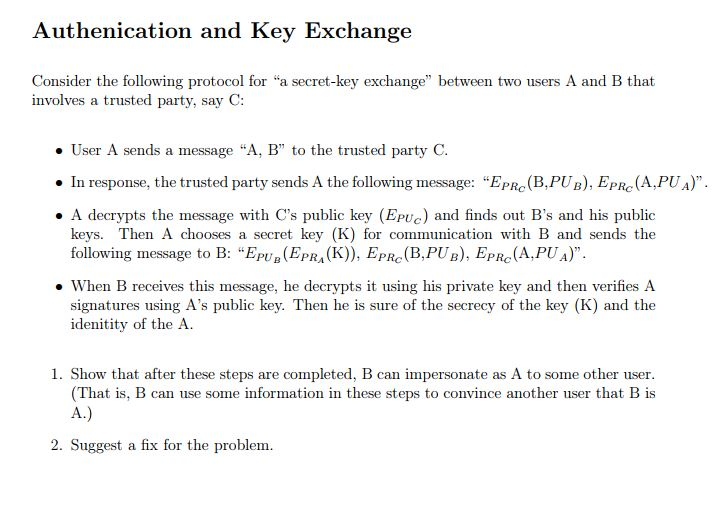
Authenication and Key Exchange Consider the following protocol for "a secret-key exchange" between two users A and B that involves a trusted party, say C e User A sends a message "A, B" to the trusted party C. In response, the trusted party sends A the following message: "EPR (B,PUB), EPRe (A,PUA)" . A decrypts the message with C's public key (EPUc) and finds out B's and his public keys. Then A chooses a secret key (K) for communication with B and sends the following message to B: "EPU (EPRA (K)), EPRe (B,PUB), EPR (A,PUA)". . When B receives this message, he decrypts it using his private key and then verifies A signatures using A's public key. Then he is sure of the secrecy of the key (K) and the idenitity of the A 1. Show that after these steps are completed, B can impersonate as A to some other user (That is, B can use some information in these steps to convince another user that B is 2. Suggest a fix for the
Step by Step Solution
There are 3 Steps involved in it

Get step-by-step solutions from verified subject matter experts
 Study Help