


Question: Autonomy Reflection Questions Please read the following case first. (Note: You do not need to copy and paste this entire case into your assignment) In
Autonomy Reflection Questions Please read the
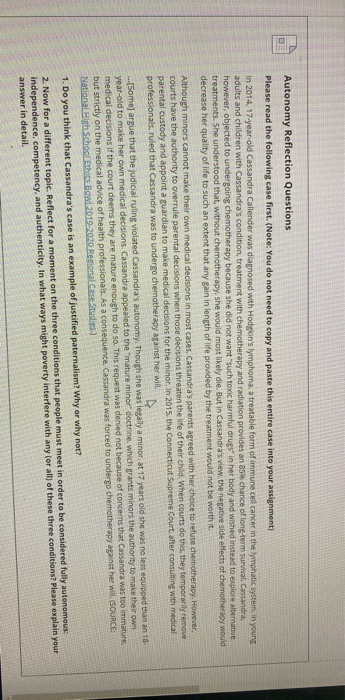
Autonomy Reflection Questions Please read the following case first. (Note: You do not need to copy and paste this entire case into your assignment) In 2014, 17-year-old Cassandra Callender was diagnosed with Hodgkin's lymphoma, a treatable form of immune cell cancer in the lymphatic system. In young adults and children with Cassandra's condition, treatment with chemotherapy and radiation provides an 85% chance of long-term survival. Cassandra however, objected to undergoing chemotherapy because she did not want "such toxic harmful drugs in her body and wished instead to explore alternative treatments. She understood that, without chemotherapy, she would most likely die. But in Cassandra's view, the negative side effects of chemotherapy would decrease her quality of life to such an extent that any gain in length of life provided by the treatment would not be worth it. Although minors cannot make their own medical decisions in most cases. Cassandra's parents agreed with her choice to refuse chemotherapy. However, courts have the authority to overrule parental decisions when those decisions threaten the life of their child. When courts do this, they temporarily remove parental custody and appoint a guardian to make medical decisions for the minor. In 2015, the Connecticut Supreme Court after consulting with medical professionals, ruled that Cassandra was to undergo chemotherapy against her will ...[Somej argue that the judicial ruling violated Cassandra's autonomy. Though she was legally a minor, at 17 years old she was no less equipped than an 18 year-old to make her own medical decisions. Cassandra appealed to the mature minor doctrine, which grants minors the authority to make their own medical decisions if the court deems they are mature enough to do so. This request was denied not because of concerns that Cassandra was too immature. but strictly on the medical advice of health professionals. As a consequence. Cassandra was forced to undergo chemotherapy against her will. (SOURCE: National High School Ethics Bowl 2019-2020 Regional Case Studies.) 1. Do you think that Cassandra's case is an example of justified paternalism? Why or why not? 2. Now for a different topic. Reflect for a moment on the three conditions that people must meet in order to be considered fully autonomous independence, competency, and authenticity. In what ways might poverty interfere with any (or all) of these three conditions? Please explain your answer in detail

Step by Step Solution

There are 3 Steps involved in it

1 Expert Approved Answer
Step: 1 Unlock blur-text-image

Question Has Been Solved by an Expert!

Get step-by-step solutions from verified subject matter experts

Step: 2 Unlock
Step: 3 Unlock

Students Have Also Explored These Related General Management Questions!