Question: AutoSave . Off) ISC104 - Project A - Trucking.V2 - Protected View . Saved to this PC v Search Jasbir Kaur Bhogal JK X File
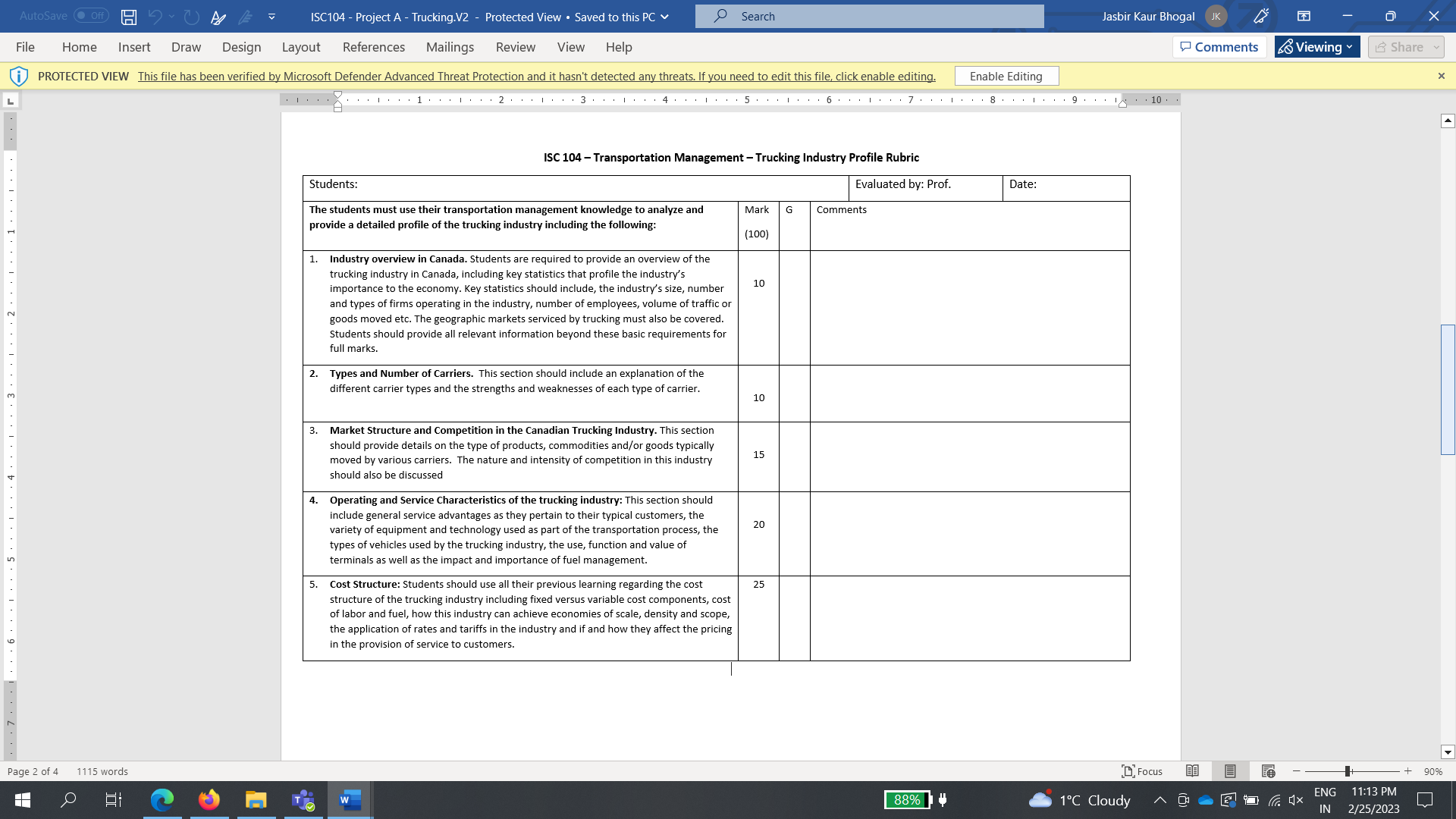
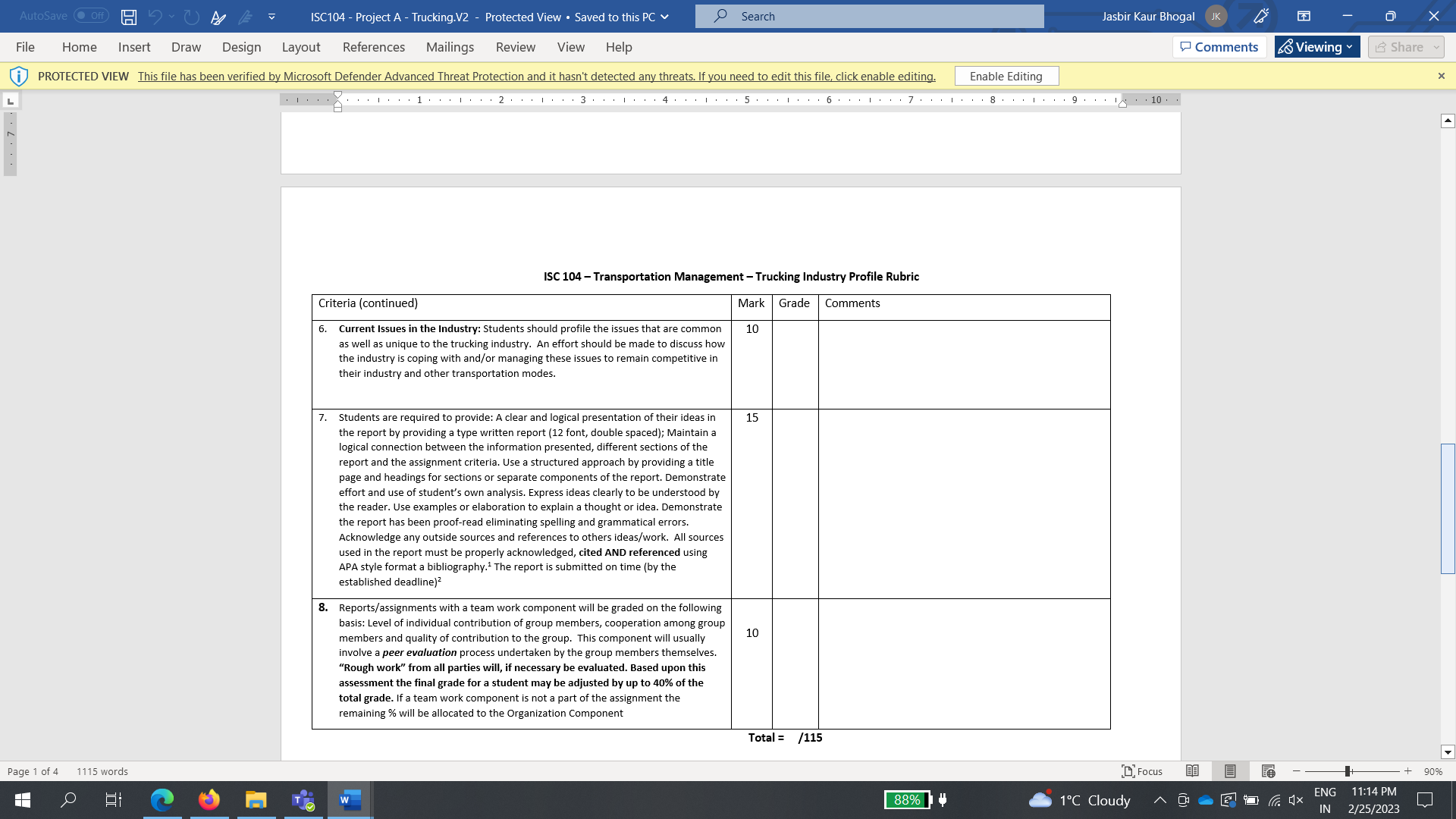
AutoSave . Off) ISC104 - Project A - Trucking.V2 - Protected View . Saved to this PC v Search Jasbir Kaur Bhogal JK X File Home Insert Draw Design Layout References Mailings Review View Help Comments Viewing Share PROTECTED VIEW This file has been verified by Microsoft Defender Advanced Threat Protection and it hasn't detected any threats. If you need to edit this file, click enable editing. Enable Editing X . I . . . 5 . . . I . . . 1 . . . 1 . . . 2 . . . 1 . . . . 5 . . . 1 . . . 6 . . . 1 . . .76 . . 1 . . ISC 104 - Transportation Management Project A - Trucking Background: The Canadian trucking or motor carrier industry, is an important part of the transportation industry, especially in the current environment driven by the Just-In-Time requirements of many industries and the growth of consumer e-commerce. According to the Canadian Encyclopedia, the trucking industry consists of persons and firms engaged in the business of owning and operating motor trucks to transport goods and is composed mainly of 3 elements: contract, private and common carriage. The Canadian Encyclopedia also differentiates the trucking industry as follows: A contract carrier transports goods for one or a limited number of consignors, according to contractual agreements specifying rates of compensation and other terms. A private carrier transports his own goods by his own motor vehicle, E.g, raw materials to processing, finished products to market. It is estimated that private carriage is at least as large as common carriage in tonnage moved. The common-carrier (or for-hire) industry is composed of individuals and establishments that own and operate for-hire motor trucks for the transportation, by road, of any and all goods. Thus, unlike the private or contract carrier, the common carrier serves the general-shipping public. The common-carrier industry provides shippers with full-service, door-to-door delivery, with an enforceable legal obligation to provide service at a published rate to even the smallest hamlet in N America. It is estimated that 70% of manufactured goods moving between Canada and the US are carried by truck. On any given day, a look at the Ambassador Bridge, the current crossing between Canada and the US is clogged with trucks carrying a variety of goods between the two countries and is the busiest border crossing between any two countries in the world. Canadian carriers engaging in this international movement must, among other requirements, apply for US authorization and satisfy the requirements of both US and Canadian customs regulations. Assignment: The purpose of this assignment is to involve students in the development of a detailed profile of the trucking or motor carrier industry as outlined in the following rubric. Every mode of transportation involves transferring a product to where the customer wants or needs it or where they wish to purchase it in the distribution channel (at the right place), when they want it (the right time), for what they are willing to pay (at the right price), and finally, at the expected quality or specified quality, thus meeting all their requirements. . I . This assignment will be completed in groups of a minimum of 3 and a maximum of 4 students. Each group's completed assignment will be posted to Blackboard for other students to read, along with the Professor's assessment Page 1 of 4 1115 words FOCUS + 90% LO W 32% -6'C Cloudy ~ 9 0 0 64x ENG 11:58 PM IN 2/24/2023 EAutoSave . Off) ISC104 - Project A - Trucking.V2 - Protected View . Saved to this PC v Search Jasbir Kaur Bhogal JK X File Home Insert Draw Design Layout References Mailings Review View Help Comments Lo Viewing Share PROTECTED VIEW This file has been verified by Microsoft Defender Advanced Threat Protection and it hasn't detected any threats. If you need to edit this file, click enable editing. Enable Editing X . 1 . . . . . . 1 . . . 1 . . . I . . . 2 . . . 1 . . . 3 . . . 1 . . . 4 . . . 1 . . . 5 . . . 1 . . . 6 . . . 1 . . . 7 . . . 1 . . . 8 . . . 1 . . . 9 . . . 14 . . 10 . . ISC 104 - Transportation Management - Trucking Industry Profile Rubric Students: Evaluated by: Prof. Date: The students must use their transportation management knowledge to analyze and Mark G Comments provide a detailed profile of the trucking industry including the following: (100) 1. Industry overview in Canada. Students are required to provide an overview of the trucking industry in Canada, including key statistics that profile the industry's importance to the economy. Key statistics should include, the industry's size, number 10 and types of firms operating in the industry, number of employees, volume of traffic or goods moved etc. The geographic markets serviced by trucking must also be covered. Students should provide all relevant information beyond these basic requirements for full marks. 2. Types and Number of Carriers. This section should include an explanation of the different carrier types and the strengths and weaknesses of each type of carrier. 10 3. Market Structure and Competition in the Canadian Trucking Industry. This section should provide details on the type of products, commodities and/or goods typically moved by various carriers. The nature and intensity of competition in this industry 15 should also be discussed 4. Operating and Service Characteristics of the trucking industry: This section should include general service advantages as they pertain to their typical customers, the variety of equipment and technology used as part of the transportation process, the 20 types of vehicles used by the trucking industry, the use, function and value of terminals as well as the impact and importance of fuel management. 5. Cost Structure: Students should use all their previous learning regarding the cost 25 structure of the trucking industry including fixed versus variable cost components, cost of labor and fuel, how this industry can achieve economies of scale, density and scope, the application of rates and tariffs in the industry and if and how they affect the pricing in the provision of service to customers. Page 2 of 4 1115 words " Focus - + 90% LO w 88% I Y 1'C Cloudy ~ - 0 4x ENG 11:13 PM IN 2/25/2023AutoSave . Off) ISC104 - Project A - Trucking.V2 - Protected View . Saved to this PC v Search Jasbir Kaur Bhogal JK X File Home Insert Draw Design Layout References Mailings Review View Help Comments go Viewing Share PROTECTED VIEW This file has been verified by Microsoft Defender Advanced Threat Protection and it hasn't detected any threats. If you need to edit this file, click enable editing. Enable Editing X . 1 . . . . . . 1 . . . 1 . . . I . . . 2 . . . 1 . . . 3 . . . 1 . . . 4 . . . 1 . . . 5 . . . 1 . . . 6 . . . 1 . . . 7 . . . 1 . . . 8 . . . 1 . . . 9 . . . 1 . . 10 . . ISC 104 - Transportation Management - Trucking Industry Profile Rubric Criteria (continued) Mark Grade Comments 6. Current Issues in the Industry: Students should profile the issues that are common 10 as well as unique to the trucking industry. An effort should be made to discuss how the industry is coping with and/or managing these issues to remain competitive in their industry and other transportation modes. 7. Students are required to provide: A clear and logical presentation of their ideas in 15 the report by providing a type written report (12 font, double spaced); Maintain a logical connection between the information presented, different sections of the report and the assignment criteria. Use a structured approach by providing a title page and headings for sections or separate components of the report. Demonstrate effort and use of student's own analysis. Express ideas clearly to be understood by the reader. Use examples or elaboration to explain a thought or idea. Demonstrate the report has been proof-read eliminating spelling and grammatical errors. Acknowledge any outside sources and references to others ideas/work. All sources used in the report must be properly acknowledged, cited AND referenced using APA style format a bibliography.' The report is submitted on time (by the established deadline) 8. Reports/assignments with a team work component will be graded on the following basis: Level of individual contribution of group members, cooperation among group members and quality of contribution to the group. This component will usually 10 involve a peer evaluation process undertaken by the group members themselves. "Rough work" from all parties will, if necessary be evaluated. Based upon this assessment the final grade for a student may be adjusted by up to 40% of the total grade. If a team work component is not a part of the assignment the remaining % will be allocated to the Organization Component Total = /115 Page 1 of 4 1115 words FOCUS - + 90% O W 88% I Y 1'C Cloudy ~ 9 - 0 1 1x ENG 11:14 PM IN 2/25/2023
Step by Step Solution
There are 3 Steps involved in it
1 Expert Approved Answer
Step: 1 Unlock
Question Has Been Solved by an Expert!
Get step-by-step solutions from verified subject matter experts
Step: 2 Unlock
Step: 3 Unlock
Students Have Also Explored These Related Mathematics Questions!