







Question: a-What is the main topic of study? b-Which quality method have been used? c-What did you learn from the last part? Turn Around or Shut
a-What is the main topic of study?
b-Which quality method have been used?
c-What did you learn from the last part?
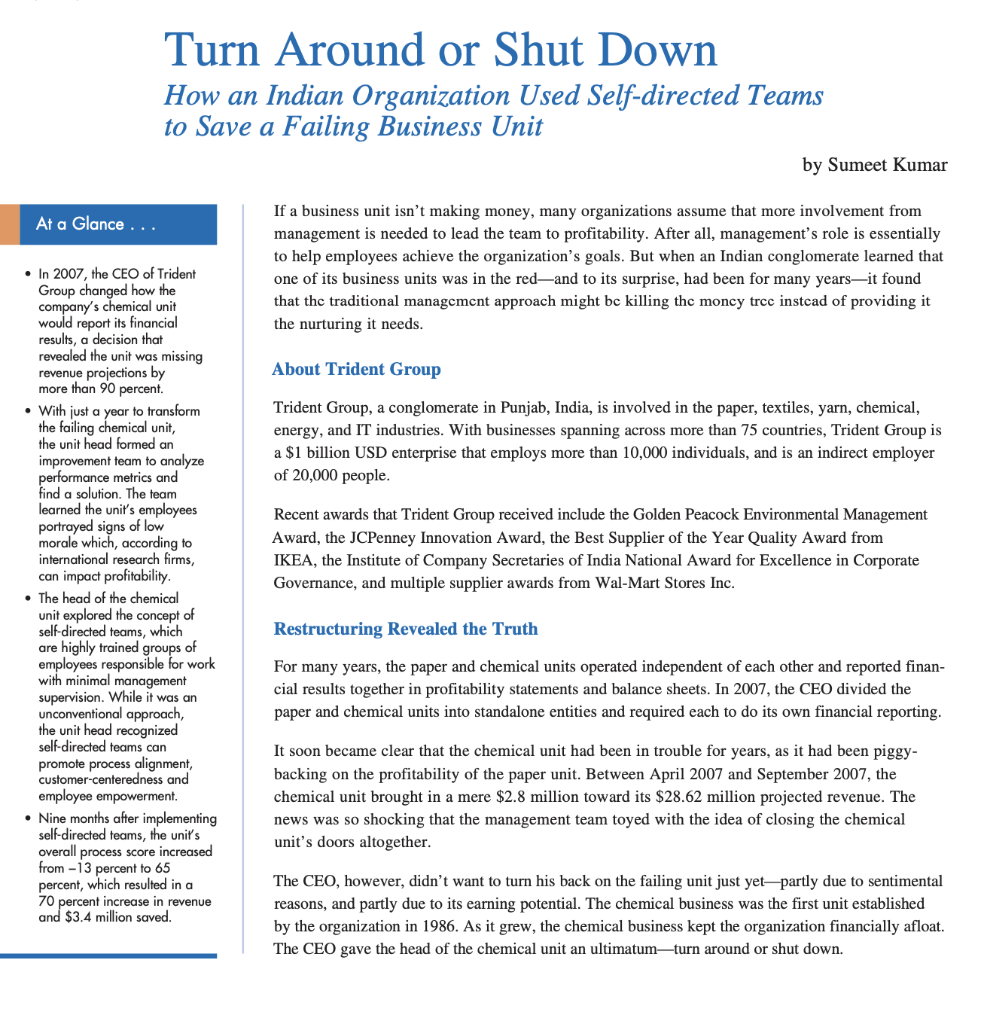
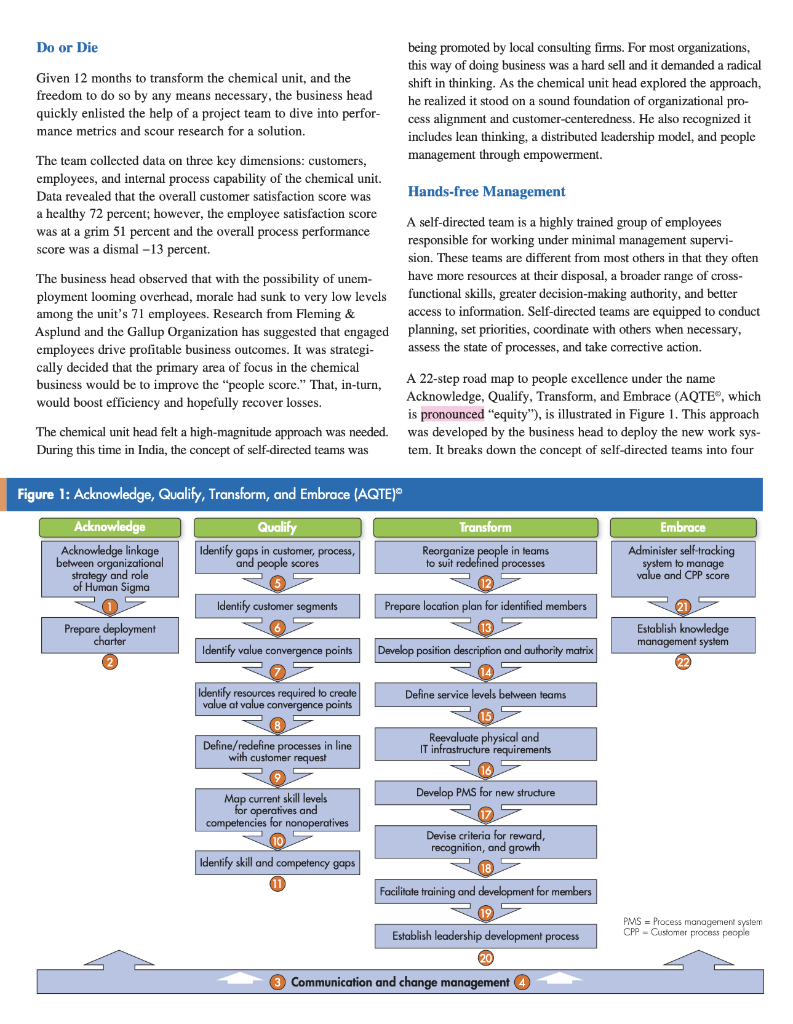
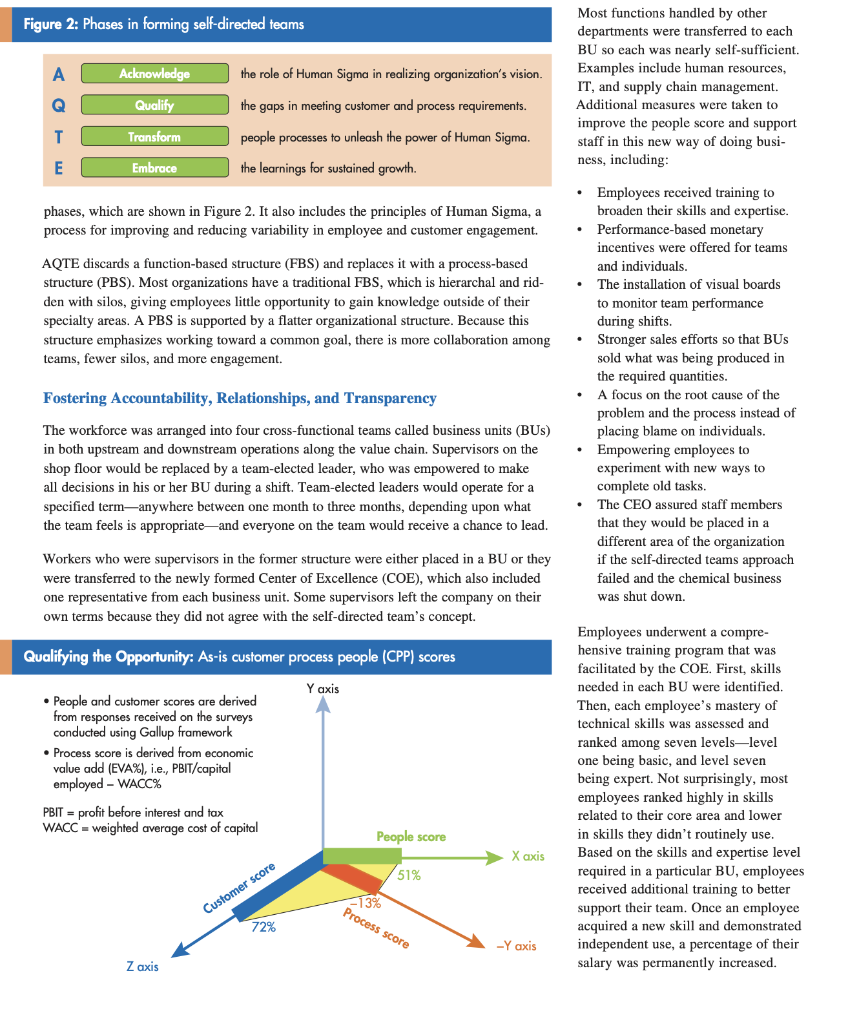
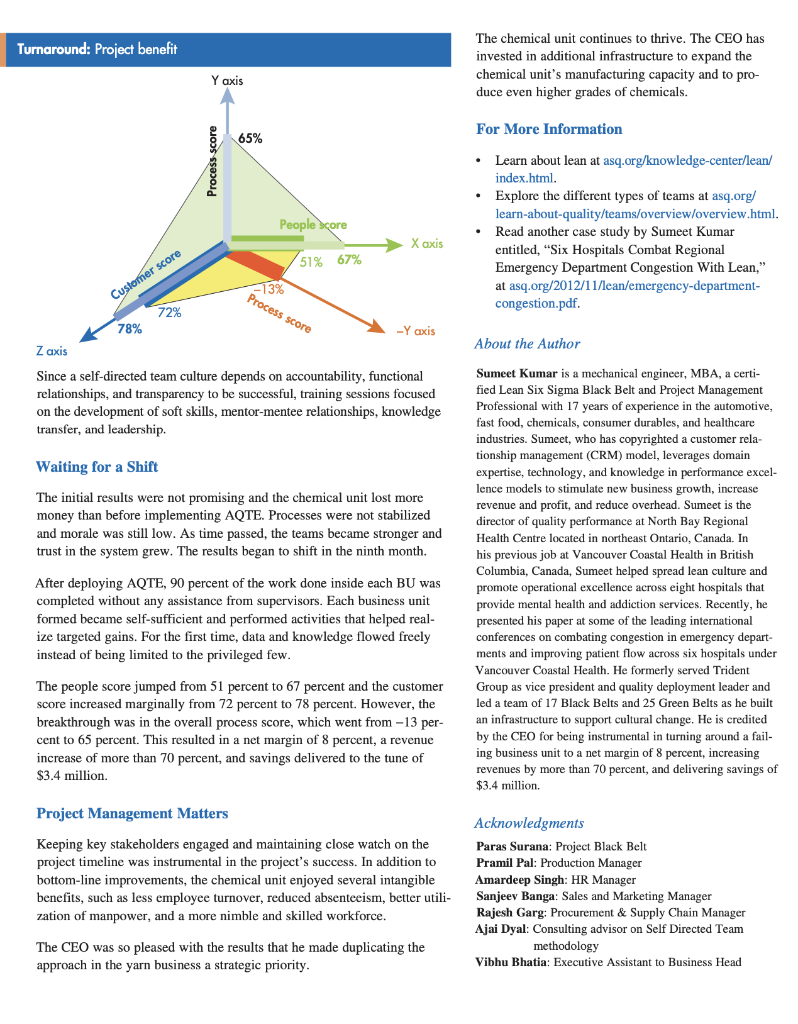
Turn Around or Shut Down How an Indian Organization Used Self-directed Teams to Save a Failing Business Unit by Sumeet Kumar At a Glance ... If a business unit isn't making money, many organizations assume that more involvement from management is needed to lead the team to profitability. After all, management's role is essentially to help employees achieve the organization's goals. But when an Indian conglomerate learned that one of its business units was in the redand to its surprise, had been for many yearsit found that the traditional management approach might be killing the moncy trec instcad of providing it the nurturing it needs. About Trident Group Trident Group, a conglomerate in Punjab, India, is involved in the paper, textiles, yarn, chemical, energy, and IT industries. With businesses spanning across more than 75 countries, Trident Group is a $1 billion USD enterprise that employs more than 10,000 individuals, and is an indirect employer of 20,000 people. In 2007, the CEO of Trident Group changed how the company's chemical unit would report its financial results, a decision that revealed the unit was missing revenue projections by more than 90 percent. With just a year to transform the failing chemical unit, the unit head formed an improvement team to analyze performance metrics and find a solution. The team learned the unit's employees portrayed signs of low morale which, according to international research firms, can impact profitability The head of the chemical unit explored the concept of self-directed teams, which are highly trained groups of employees responsible for work with minimal management supervision. While it was an unconventional approach the unit head recognized self-directed teams can promote process alignment, customer-centeredness and employee empowerment Nine months after implementing self-directed teams, the unit's overall process score increased from-13 percent to 65 percent, which resulted in a 70 percent increase in revenue and $3.4 million saved. Recent awards that Trident Group received include the Golden Peacock Environmental Management Award, the JCPenney Innovation Award, the Best Supplier of the Year Quality Award from IKEA, the Institute of Company Secretaries of India National Award for Excellence in Corporate Governance, and multiple supplier awards from Wal-Mart Stores Inc. Restructuring Revealed the Truth For many years, the paper and chemical units operated independent of each other and reported finan- cial results together in profitability statements and balance sheets. In 2007, the CEO divided the paper and chemical units into standalone entities and required each to do its own financial reporting. It soon became clear that the chemical unit had been in trouble for years, as it had been piggy- backing on the profitability of the paper unit. Between April 2007 and September 2007, the chemical unit brought in a mere $2.8 million toward its $28.62 million projected revenue. The news was so shocking that the management team toyed with the idea of closing the chemical unit's doors altogether. The CEO, however, didn't want to turn his back on the failing unit just yet-partly due to sentimental reasons, and partly due to its earning potential. The chemical business was the first unit established by the organization in 1986. As it grew, the chemical business kept the organization financially afloat. The CEO gave the head of the chemical unit an ultimatumturn around or shut down. a Do or Die being promoted by local consulting firms. For most organizations, this way of doing business was a hard sell and it demanded a radical Given 12 months to transform the chemical unit, and the shift in thinking. As the chemical unit head explored the approach, freedom to do so by any means necessary, the business head he realized it stood on a sound foundation of organizational pro- quickly enlisted the help of a project team to dive into perfor- cess alignment and customer-centeredness. He also recognized it mance metrics and scour research for a solution. includes lean thinking, a distributed leadership model, and people The team collected data on three key dimensions: customers, management through empowerment employees, and internal process capability of the chemical unit. Data revealed that the overall customer satisfaction score was Hands-free Management a healthy 72 percent; however, the employee satisfaction score A self-directed team is a highly trained group of employees was at a grim 51 percent and the overall process performance responsible for working under minimal management supervi- score was a dismal -13 percent. sion. These teams are different from most others in that they often The business head observed that with the possibility of unem- have more resources at their disposal, a broader range of cross- ployment looming overhead, morale had sunk to very low levels functional skills, greater decision-making authority, and better among the unit's 71 employees. Research from Fleming & access to information. Self-directed teams are equipped to conduct Asplund and the Gallup Organization has suggested that engaged planning, set priorities, coordinate with others when necessary, employees drive profitable business outcomes. It was strategi- assess the state of processes, and take corrective action. cally decided that the primary area of focus in the chemical business would be to improve the people score." That, in-turn, A 22-step road map to people excellence under the name would boost efficiency and hopefully recover losses. Acknowledge, Qualify, Transform, and Embrace (AQTE", which is pronounced "equity"), is illustrated in Figure 1. This approach The chemical unit head felt a high-magnitude approach was needed. was developed by the business head to deploy the new work sys- During this time in India, the concept of self-directed teams was tem. It breaks down the concept of self-directed teams into four Figure 1: Acknowledge, Qualify, Transform, and Embrace (AQTE) Qualify Identify gaps in customer, process, and people scores Transform Reorganize people in teams to suit redefined processes Embrace Administer self-tracking system to manage value and CPP score Acknowledge Acknowledge linkage between organizational strategy and role of Human Sigma 07 Prepare deployment charter Identify customer segments Prepare location plan for identified members Establish knowledge management system Identify value convergence points Develop position description and authority matrix Identify resources required to create value at value convergence points Define service levels between teams 05 Define/redefine processes in line with customer request Reevaluate physical and IT infrastructure requirements Map current skill levels for operatives and competencies for nonoperatives Develop PMS for new structure (17 S Devise criteria for reward, recognition, and growth Identify skill and competency gaps Facilitate training and development for members PMS = Process management system CPP - Customer process people Establish leadership development process Communication and change management 2 Figure 2: Phases in forming self-directed teams Acknowledge the role of Human Sigma in realizing organization's vision. Most functions handled by other departments were transferred to each BU so each was nearly self-sufficient. Examples include human resources, IT, and supply chain management. Additional measures were taken to improve the people score and support staff in this new way of doing busi- ness, including: Q Qualify the gaps in meeting customer and process requirements. T Transform people processes to unleash the power of Human Sigma. the learnings for sustained growth. E Embrace phases, which are shown in Figure 2. It also includes the principles of Human Sigma, a process for improving and reducing variability in employee and customer engagement. AQTE discards a function-based structure (FBS) and replaces it with a process-based structure (PBS). Most organizations have a traditional FBS, which is hierarchal and rid- den with silos, giving employees little opportunity to gain knowledge outside of their specialty areas. A PBS is supported by a flatter organizational structure. Because this structure emphasizes working toward a common goal, there is more collaboration among teams, fewer silos, and more engagement. Fostering Accountability, Relationships, and Transparency The workforce was arranged into four cross-functional teams called business units (BUS) in both upstream and downstream operations along the value chain. Supervisors on the shop floor would be replaced by a team-elected leader, who was empowered to make all decisions in his or her BU during a shift. Team-elected leaders would operate for a specified termanywhere between one month to three months, depending upon what the team feels is appropriateand everyone on the team would receive a chance to lead. Employees received training to broaden their skills and expertise. Performance-based monetary incentives were offered for teams and individuals. The installation of visual boards to monitor team performance during shifts. Stronger sales efforts so that BUS sold what was being produced in the required quantities. A focus on the root cause of the problem and the process instead of placing blame on individuals. Empowering employees to experiment with new ways to complete old tasks. The CEO assured staff members that they would be placed in a different area of the organization if the self-directed teams approach failed and the chemical business was shut down. Workers who were supervisors in the former structure were either placed in a BU or they were transferred to the newly formed Center of Excellence (COE), which also included one representative from each business unit. Some supervisors left the company on their own terms because they did not agree with the self-directed team's concept. Qualifying the opportunity: As-is customer process people (CPP) scores Y axis People and customer scores are derived from responses received on the surveys conducted using Gallup framework Process score derived from economic value add (EVA%), i.e., PBIT/capital employed - WACC% PBIT = profit before interest and tax WACC = weighted average cost of capital Employees underwent a compre- hensive training program that was facilitated by the COE. First, skills needed in each BU were identified. Then, each employee's mastery of technical skills was assessed and ranked among seven levels-level one being basic, and level seven being expert. Not surprisingly, most employees ranked highly in skills related to their core area and lower in skills they didn't routinely use. Based on the skills and expertise level required in a particular BU, employees received additional training to better support their team. Once an employee acquired a new skill and demonstrated independent use, a percentage of their salary was permanently increased. People score X axis 51% 13% Customer score Process score 72% -Y axis Z axis Turnaround: Project benefit The chemical unit continues to thrive. The CEO has invested in additional infrastructure to expand the chemical unit's manufacturing capacity and to pro- duce even higher grades of chemicals. Y axis For More Information 65% Process score People Score Learn about lean at asq.org/knowledge-center/lean/ index.html. Explore the different types of teams at asq.org/ learn-about-quality/teams/overview/overview.html. Read another case study by Sumeet Kumar entitled, "Six Hospitals Combat Regional Emergency Department Congestion With Lean," at asq.org/2012/11/lean/emergency department- congestion.pdf. Xaxis 51% 67% 13% Customer score Process score 72% 78% -Yaxis Z axis About the Author Since a self-directed team culture depends on accountability, functional relationships, and transparency to be successful, training sessions focused on the development of soft skills, mentor-mentee relationships, knowledge transfer, and leadership. Waiting for a Shift The initial results were not promising and the chemical unit lost more money than before implementing AQTE. Processes were not stabilized and morale was still low. As time passed, the teams became stronger and trust in the system grew. The results began to shift in the ninth month. After deploying AQTE, 90 percent of the work done inside each BU was completed without any assistance from supervisors. Each business unit formed became self-sufficient and performed activities that helped real- ize targeted gains. For the first time, data and knowledge flowed freely instead of being limited to the privileged few. Sumeet Kumar is a mechanical engineer, MBA, a certi- fied Lean Six Sigma Black Belt and Project Management Professional with 17 years of experience in the automotive, fast food, chemicals, consumer durables, and healthcare industries. Sumeet, who has copyrighted a customer rela- tionship management (CRM) model, leverages domain expertise, technology, and knowledge in performance excel- lence models to stimulate new business growth, increase revenue and profit, and reduce overhead. Sumeet is the director of quality performance at North Bay Regional Health Centre located in northeast Ontario, Canada. In his previous job at Vancouver Coastal Health in British Columbia, Canada, Sumeet helped spread lean culture and promote operational excellence across eight hospitals that provide mental health and addiction services. Recently, he presented his paper at some of the leading international conferences on combating in emergency depart- ments and improving patient flow across six hospitals under Vancouver Coastal Health. He formerly served Trident Group as vice president and quality deployment leader and led a team of 17 Black Belts and 25 Green Belts as he built an infrastructure to support cultural change. He is credited by the CEO for being instrumental in turning around a fail- ing business unit to a net margin of 8 percent, increasing revenues by more than 70 percent, and delivering savings of $3.4 million congestion in The people score jumped from 51 percent to 67 percent and the customer score increased marginally from 72 percent to 78 percent. However, the breakthrough was in the overall process score, which went from -13 per- cent to 65 percent. This resulted in a net margin of 8 percent, a revenue increase of more than 70 percent, and savings delivered to the tune of $3.4 million. Project Management Matters Keeping key stakeholders engaged and maintaining close watch on the project timeline was instrumental in the project's success. In addition to bottom-line improvements, the chemical unit enjoyed several intangible benefits, such as less employee turnover, reduced absenteeism, better utili- zation of manpower, and a more nimble and skilled workforce. Acknowledgments Paras Surana: Project Black Belt Pramil Pal: Production Manager Amardeep Singh: HR Manager Sanjeev Banga: Sales and Marketing Manager Rajesh Garg: Procurement & Supply Chain Manager Ajai Dyal: Consulting advisor on Self Directed Team methodology Vibhu Bhatia: Executive Assistant Business Head The CEO was so pleased with the results that he made duplicating the approach in the yarn business a strategic priorityStep by Step Solution
There are 3 Steps involved in it
1 Expert Approved Answer
Step: 1 Unlock

Question Has Been Solved by an Expert!
Get step-by-step solutions from verified subject matter experts
Step: 2 Unlock
Step: 3 Unlock
 Study Help