







Question: B 6 5 3 F 1 D G E Apply Dijkstra's algorithm on the above graph to find the shortest paths using vertex A as
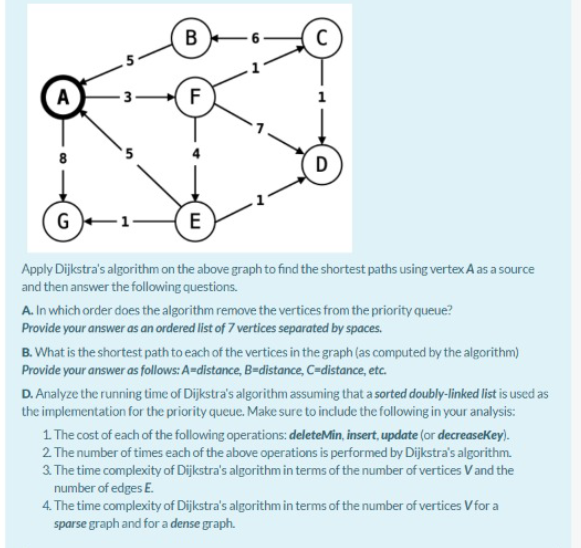
B 6 5 3 F 1 D G E Apply Dijkstra's algorithm on the above graph to find the shortest paths using vertex A as a source and then answer the following questions. A. In which order does the algorithm remove the vertices from the priority queue? Provide your answer as an ordered list of 7 vertices separated by spaces. B. What is the shortest path to each of the vertices in the graph (as computed by the algorithm) Provide your answer as follows:A-distance, B-distance, C-distance, etc. D. Analyze the running time of Dijkstra's algorithm assuming that a sorted doubly-linked list is used as the implementation for the priority queue. Make sure to include the following in your analysis: 1. The cost of each of the following operations: deleteMin, insert, update (or decreaseKey). 2 The number of times each of the above operations is performed by Dijkstra's algorithm. 3. The time complexity of Dijkstra's algorithm in terms of the number of vertices and the number of edges E. 4. The time complexity of Dijkstra's algorithm in terms of the number of vertices V for a sparse graph and for a dense graph
Step by Step Solution
There are 3 Steps involved in it

Get step-by-step solutions from verified subject matter experts
 Study Help