







Question: b) A computer cannot calculate the DTFT -- it can only approximate it using the DFT (or more specifically, the Fast Fourier Transform or FFT)
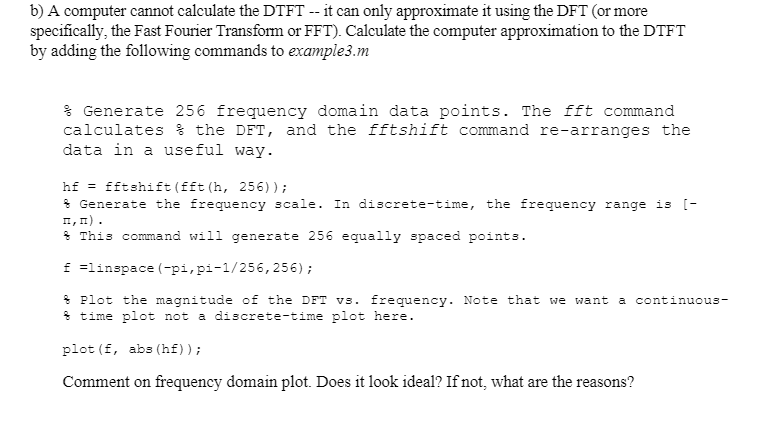
b) A computer cannot calculate the DTFT -- it can only approximate it using the DFT (or more specifically, the Fast Fourier Transform or FFT) Calculate the computer approximation to the DTFT by adding the following commands to example3.m Generate 256 frequency domain data points. The fft command calculates & the DFT, and the fftshift command re-arranges the data in a useful way. hf = Eftshift (ifth, 256)); # Generate the frequency scale. In discrete-time, the frequency range is [- 1,1). This command will generate 256 equally spaced points. f =linspace (-pi,pi-1/256, 256); Plot the magnitude of the DFT vs. frequency. Note that we want a continuous- time plot not a discrete-time plot here. plot (, abs (hf)); Comment on frequency domain plot. Does it look ideal? If not, what are the reasons? b) A computer cannot calculate the DTFT -- it can only approximate it using the DFT (or more specifically, the Fast Fourier Transform or FFT) Calculate the computer approximation to the DTFT by adding the following commands to example3.m Generate 256 frequency domain data points. The fft command calculates & the DFT, and the fftshift command re-arranges the data in a useful way. hf = Eftshift (ifth, 256)); # Generate the frequency scale. In discrete-time, the frequency range is [- 1,1). This command will generate 256 equally spaced points. f =linspace (-pi,pi-1/256, 256); Plot the magnitude of the DFT vs. frequency. Note that we want a continuous- time plot not a discrete-time plot here. plot (, abs (hf)); Comment on frequency domain plot. Does it look ideal? If not, what are the reasons
Step by Step Solution
There are 3 Steps involved in it

Get step-by-step solutions from verified subject matter experts
 Study Help