







Question: (b) A TCP connection is required between a process at station A and an http server located at station B. The process at station A
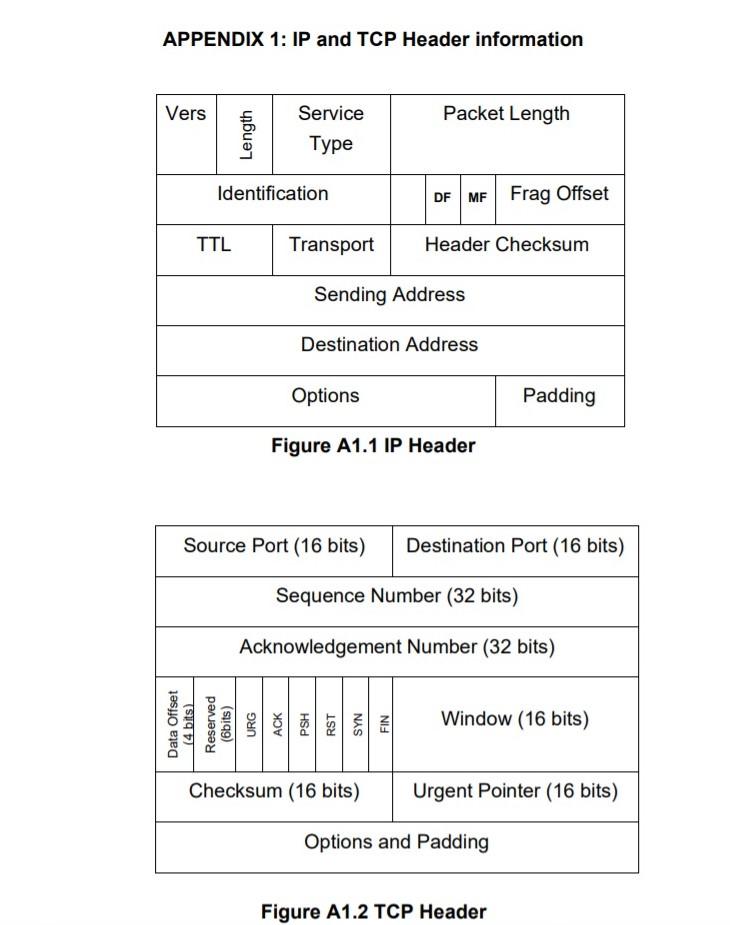
(b) A TCP connection is required between a process at station A and an http server located at station B. The process at station A initiates the connection-sequence process by sending a TCP segment with a sequence number of 2400, a source port of 350, the data offset is 6 and a window size of 1000. (0) Sketch a data signal-flow diagram of all of the segments required for the connection set-up phase of the TCP connection, showing the values of the Sequence numbers as well as any FLAGS used. Marks will be given for the explanation of the choice of numbers and FLAGS for each segment. Diagram with appropriate numbers (4 marks) Explanation of the numbers and Flags (7 marks) (ii) Complete the TCP header for each of the segments used with appropriate rationale, focussing only on the first four rows of the header as illustrated in Appendix A1. (8 marks) Your answer should include all workings and assumptions made. The following are standard port addresses (in brackets) for typical application layer protocols which may be assumed for the purposes of this question. HTTP (80), FTP (21), SMTP (25), Telnet (23) You may refer to the TCP header in Appendix 1 on page 8. APPENDIX 1: IP and TCP Header information Vers Packet Length Length Service Type Identification DF MF Frag Offset TTL Transport Header Checksum Sending Address Destination Address Options Padding Figure A1.1 IP Header Source Port (16 bits) Destination Port (16 bits) Sequence Number (32 bits) Acknowledgement Number (32 bits) Data Offset (4 bits) Reserved (6bits) URG ACK PSH RST NAS FIN Window (16 bits) Checksum (16 bits) Urgent Pointer (16 bits) Options and Padding Figure A1.2 TCP Header (b) A TCP connection is required between a process at station A and an http server located at station B. The process at station A initiates the connection-sequence process by sending a TCP segment with a sequence number of 2400, a source port of 350, the data offset is 6 and a window size of 1000. (0) Sketch a data signal-flow diagram of all of the segments required for the connection set-up phase of the TCP connection, showing the values of the Sequence numbers as well as any FLAGS used. Marks will be given for the explanation of the choice of numbers and FLAGS for each segment. Diagram with appropriate numbers (4 marks) Explanation of the numbers and Flags (7 marks) (ii) Complete the TCP header for each of the segments used with appropriate rationale, focussing only on the first four rows of the header as illustrated in Appendix A1. (8 marks) Your answer should include all workings and assumptions made. The following are standard port addresses (in brackets) for typical application layer protocols which may be assumed for the purposes of this question. HTTP (80), FTP (21), SMTP (25), Telnet (23) You may refer to the TCP header in Appendix 1 on page 8. APPENDIX 1: IP and TCP Header information Vers Packet Length Length Service Type Identification DF MF Frag Offset TTL Transport Header Checksum Sending Address Destination Address Options Padding Figure A1.1 IP Header Source Port (16 bits) Destination Port (16 bits) Sequence Number (32 bits) Acknowledgement Number (32 bits) Data Offset (4 bits) Reserved (6bits) URG ACK PSH RST NAS FIN Window (16 bits) Checksum (16 bits) Urgent Pointer (16 bits) Options and Padding Figure A1.2 TCP Header
Step by Step Solution
There are 3 Steps involved in it

Get step-by-step solutions from verified subject matter experts
 Study Help