







Question: b. c. When a company conducts a stock split, it exchanges new shares for old ones according to some ratio. For example, in March 2018,
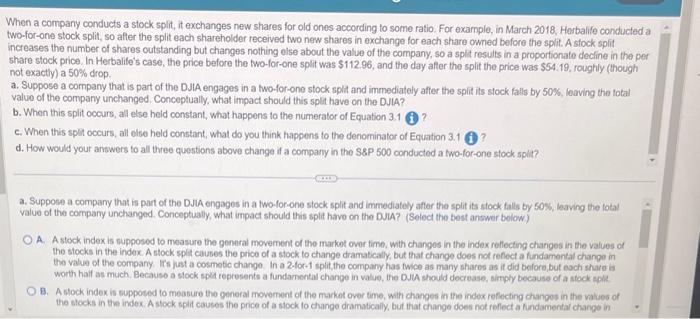
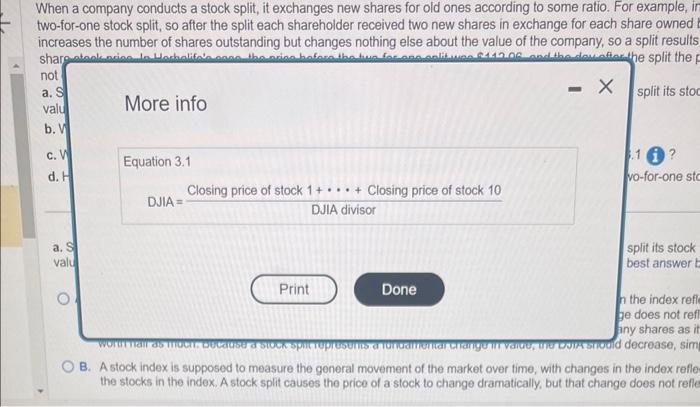
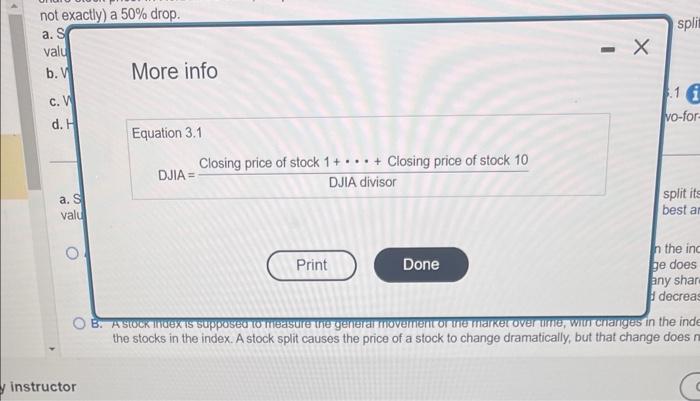
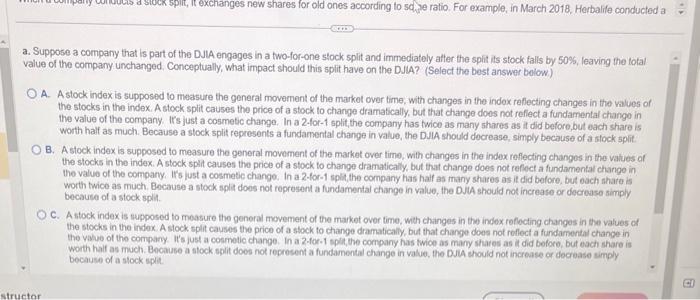
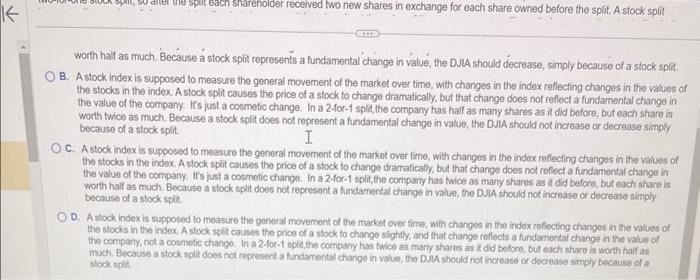
When a company conducts a stock split, it exchanges new shares for old ones according to some ratio. For example, in March 2018, Herbalife conducted a two-for-one stock split, so after the split each shareholder received two new shares in exchange for each share owned before the split. A stock split increases the number of shares cutstanding but changes nothing else about the value of the company, so a splt results in a proporfionate decline in the per share stock price. In Herbalife's case, the price before the two-for-one split was $112.96, and the day alter the split the price was $54.19, roughly (though not exactly) a 50% drop. a. Suppose a company that is part of the DJIA engages in a two-for-one stock spit and immediately after the spit its stock falls by 50%, leaving the total value of the company unchanged Conceptually, what impact should this spla have on the D.JIA? b. When this split occurs, al else held constant, what happens to the numerator of Equation 3.1 (i)? c. When this splt occurs, all olse held constant, what do you think happens to the denominator of Equation 3.1? d. How would your answers to all three questions above change if a company in the S8P 500 conducted a two-for-one stock spit? a. Suppose a company that is part of the DJLA engages in a two-for-one stock split and immediately after the split its stock falls by sos, ieaving the lotal value of the company unchanged. Conceptually, What impact should this split havo on the DVIA? (Select the best answer below) A. A stock index is nupposed to measure the general movement of the market ovor time, with changos in the index reffecting changes in the values of the stocks in the index. A stock split causes the price of a stock to change dramatically, but that change does not refect a findamental change in the value of the company. Its ust a cosmebic change. In a 2-for-1 split, the compary has twice as many shares as it did before, but eoch sharo is worth haif as much. Becauso a slock sple represents a fundamental change in value, the DJA should decrease, sinply bocause of a stock sple 8. A slock index is supposed to measure tho general movement of the markot over time. wath changes in the index refecting changes in the values of the stocks in the indox. A stock spit causes the price of a slock to change dramatically, but that change does not reflect a handamental change in When a company conducts a stock split, it exchanges new shares for old ones according to some ratio. For example, in two-for-one stock split, so after the split each shareholder received two new shares in exchange for each share owned increases the number of shares outstanding but changes nothing else about the value of the company, so a split results not a. Salu More info split its stor b. V c. Vquation 3.1 d. H DJIA=DJIAdivisorClosingpriceofstock1++Closingpriceofstock10 a. S valu B. A stock index is supposed to measure the general movement of the market over time, with changes in the index refle the stocks in the index. A stock split causes the price of a stock to change dramatically, but that change does not refle b. V More info c. V d. Equation 3.1 DJIA=DJIAdivisorClosingpriceofstock1++Closingpriceofstock10 a. S valu the stocks in the index. A stock split causes the price of a stock to change dramatically, but that change does n a. Suppose a company that is part of the DJLA engages in a fwo-for-one stock split and immediately atter the spit its stock falls by 50%, leaving the lofal value of the company unchanged. Conceptually, what impact should this spit have on the DJLA? (Select the best answer bolow) A. A stock index is supposed to measure the general movernent of the markot over lime, with changes in the indox reflecting changes in the values of the stocks in the index. A stock split causes the price of a stock to change dramafically, but that change does not refiect a fundamental change in the value of the company. Irs just a cosmetic charge. In a 2-for-1 split the company has twice as many shares as it did before,but each share is worth half as much. Because a stock split represents a fundamental change in value, the D.lA should decrease, simply because of a stock spit. B. A stock index is supposed to measure the general movement of the market over time, with changes in the index roflecting changes in the values of the stocks in the index. A stock split causes the price of a stock to change dramatically, but that change does not refoct a fundamental chango in the value of the compary. Ir's just a cosmetie change. In a 2-for-1 spitithe company has hat as many shares as it did before, bet each share is worth twice as much. Because a stock split does not represent a fundamental change in value, the DJIA should not increase or decrease simply because of a stock split. C. A stock index is wepposed to measure the general movement of the market over time, with changes in the index rofocting changes in the values of the stocks in the index. A slock split causes the price of a stock to change dramatically, but that change does not reflect a fundamental change in the value of the company. Its just a cosmetic change. In a 2-for-1 spat, the company has twioe as many shares as it did bofore, but each share is. worth half as much. Because a stock split does not reprosent a fundamental change in value, the DJlA ehould not increase or decrease simply. because of a slock split. worth hali as much. Because a stock spit represents a fundamental change in value, the DJIA should decrease, simply because of a stock split. B. A stock index is supposed to measure the general movement of the market over time, with changes in the index reflecting changes in the values c the stocks in the index. A stock split causes the price of a stock to change dramatically, but that change does not reflect a fundamental change in the value of the company. Irs just a cosmetic change. In a 2-for-1 split, the company has half as many shares as it did before, but each share is worth twice as much. Because a stock split does not represent a fundamental change in value, the DUlA should not increase or decrease simply because of a stock split. C. A stock index is supposed to measure the general movement of the market over time, with changes in the index reflecting changes in the values of the stocks in the index. A stock split causes the price of a stock to change dramatically, but that change does not rofect a fundamental change in the value of the company. It's just a cosmetic change. In a 2 -for-1 split, the company has twice as many shares as it did before, but each sharo is worth half as much. Because a stock split does not represent a fundamental change in value, the DUIA should not increase or decrease simply because of a stock split. D. A stock index is supposed to measure the general movernent of the market over time, with changes in the index reflecting changos in the vatues of the slocks in the index A stock split causes the price of a slock to change sightly, and that change reflects a fundamentaf change in the value of. the company, not a cosmetic change. In a 2for1 split,the company has twice as many shares as it did bofore, but oach share is worth haif as much. Bocause a stock split does not represent a tundamental change in value, the DJlA should not increase or decrease simply because of a slock split
Step by Step Solution
There are 3 Steps involved in it

Get step-by-step solutions from verified subject matter experts
 Study Help