







Question: (b) Consider a two-period binomial model for a non-dividend paying stock whose current price is S = 100. Over each six-month period, the stock price
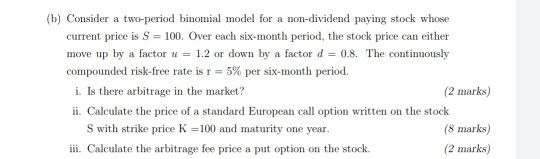
(b) Consider a two-period binomial model for a non-dividend paying stock whose current price is S = 100. Over each six-month period, the stock price can either move up by a factor u = 1.2 or down by a factor d = 0.8. The continuously compounded risk-free rate is r = 5% per six-month period. i. Is there arbitrage in the market? (2 marks) ii. Calculate the price of a standard European call option written on the stock S with strike price K =100 and maturity one year. (8 marks) ii. Calculate the arbitrage fee price a put option on the stock. (2 marks) (b) Consider a two-period binomial model for a non-dividend paying stock whose current price is S = 100. Over each six-month period, the stock price can either move up by a factor u = 1.2 or down by a factor d = 0.8. The continuously compounded risk-free rate is r = 5% per six-month period. i. Is there arbitrage in the market? (2 marks) ii. Calculate the price of a standard European call option written on the stock S with strike price K =100 and maturity one year. (8 marks) ii. Calculate the arbitrage fee price a put option on the stock. (2 marks)
Step by Step Solution
There are 3 Steps involved in it

Get step-by-step solutions from verified subject matter experts
 Study Help