







Question: b. Determine the critical value(s) for the hypothesis test. + Round to two decimal places if necessary Enter 0 if normal approximation to the
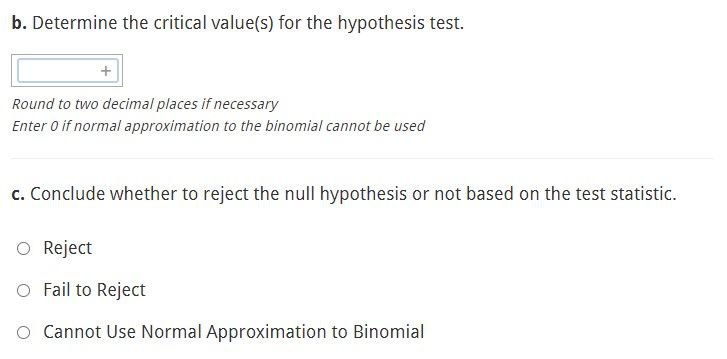
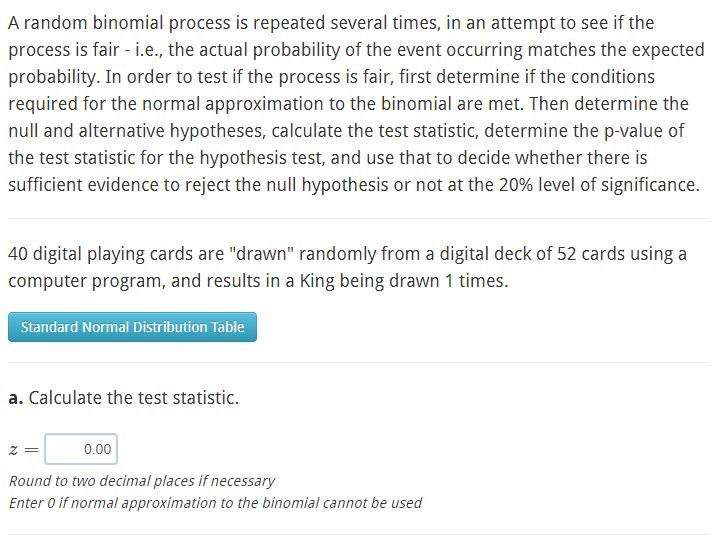
b. Determine the critical value(s) for the hypothesis test. + Round to two decimal places if necessary Enter 0 if normal approximation to the binomial cannot be used c. Conclude whether to reject the null hypothesis or not based on the test statistic. Reject Fail to Reject Cannot Use Normal Approximation to Binomial A random binomial process is repeated several times, in an attempt to see if the process is fair - i.e., the actual probability of the event occurring matches the expected probability. In order to test if the process is fair, first determine if the conditions required for the normal approximation to the binomial are met. Then determine the null and alternative hypotheses, calculate the test statistic, determine the p-value of the test statistic for the hypothesis test, and use that to decide whether there is sufficient evidence to reject the null hypothesis or not at the 20% level of significance. 40 digital playing cards are "drawn" randomly from a digital deck of 52 cards using a computer program, and results in a King being drawn 1 times. Standard Normal Distribution Table a. Calculate the test statistic. x = 0.00 Round to two decimal places if necessary Enter 0 if normal approximation to the binomial cannot be used
Step by Step Solution
There are 3 Steps involved in it

Get step-by-step solutions from verified subject matter experts
 Study Help