







Question: (b) (Extra credit) As in the sweeping trapezoidation algorithm, consider a set of active segments S, and a new vertex v that is reached by
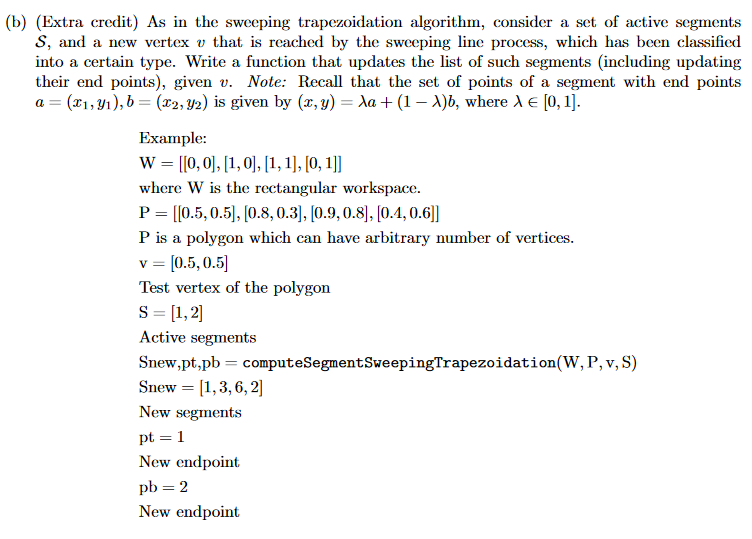
(b) (Extra credit) As in the sweeping trapezoidation algorithm, consider a set of active segments S, and a new vertex v that is reached by the sweeping line process, which has been classified into a certain type. Write a function that updates the list of such segments (including updating their end points), given v. Note: Recall that the set of points of a segment with end points a-(z, y ), b-(T2W2) is given by (z, y)- + (1-A)b, where E 10, 1] Example: where W is the rectangular workspace. P 0.5,0.5], [0.8,0.3], [0.9,0.8, [0.4,0.6 P is a polygon which can have arbitrary number of vertices v [0.5, 0.5 Test vertex of the polygon S [1,2 Active segments Snew,pt,pb- computeSegmentSweepingTrapezoidation(W, P, v, S) Stew = 11 , 3, 6, 21 New segments pt 1 New endpoint New endpoint (b) (Extra credit) As in the sweeping trapezoidation algorithm, consider a set of active segments S, and a new vertex v that is reached by the sweeping line process, which has been classified into a certain type. Write a function that updates the list of such segments (including updating their end points), given v. Note: Recall that the set of points of a segment with end points a-(z, y ), b-(T2W2) is given by (z, y)- + (1-A)b, where E 10, 1] Example: where W is the rectangular workspace. P 0.5,0.5], [0.8,0.3], [0.9,0.8, [0.4,0.6 P is a polygon which can have arbitrary number of vertices v [0.5, 0.5 Test vertex of the polygon S [1,2 Active segments Snew,pt,pb- computeSegmentSweepingTrapezoidation(W, P, v, S) Stew = 11 , 3, 6, 21 New segments pt 1 New endpoint New endpoint
Step by Step Solution
There are 3 Steps involved in it

Get step-by-step solutions from verified subject matter experts
 Study Help