





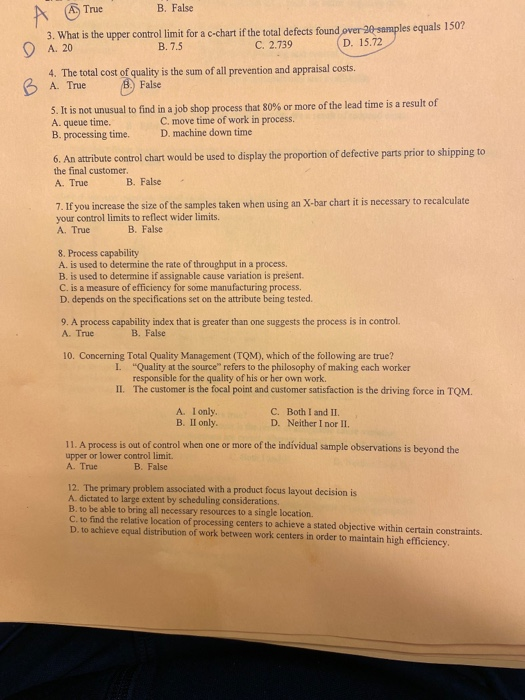
Question: B. False A True 3. What is the upper control limit for a c-chart if the total defects found over 20 samples equals 150? A.
B. False A True 3. What is the upper control
B. False A True 3. What is the upper control limit for a c-chart if the total defects found over 20 samples equals 150? A. 20 B. 7.5 C. 2.739 (D. 15.72 4. The total cost of quality is the sum of all prevention and appraisal costs. A True B) False 5. It is not unusual to find in a job shop process that 80% or more of the lead time is a result of A. queue time. C. move time of work in process. B. processing time. D. machine down time 6. An attribute control chart would be used to display the proportion of defective parts prior to shipping to the final customer. A. True B. False 7. If you increase the size of the samples taken when using an X-bar chart it is necessary to recalculate your control limits to reflect wider limits. A. True B. False 8. Process capability A. is used to determine the rate of throughput in a process. B. is used to determine if assignable cause variation is present. C. is a measure of efficiency for some manufacturing process. D. depends on the specifications set on the attribute being tested. 9. A process capability index that is greater than one suggests the process is in control. A. True B. False 10. Concerning Total Quality Management (TQM), which of the following are true? I. "Quality at the source" refers to the philosophy of making each worker responsible for the quality of his or her own work. II. The customer is the focal point and customer satisfaction is the driving force in TOM. A. I only. B. II only. C. Both I and II. D. Neither I nor II 11. A process is out of control when one or more of the individual sample observations is beyond the upper or lower control limit. A. True B. False 12. The primary problem associated with a product focus layout decision is A. dictated to large extent by scheduling considerations. B to be able to bring all necessary resources to a single location C. to find the relative location of processing centers to achieve a stated objective within certain constraints. D. to achieve equal distribution of work between work centers in order to maintain high efficiency

Step by Step Solution

There are 3 Steps involved in it

1 Expert Approved Answer
Step: 1 Unlock blur-text-image

Question Has Been Solved by an Expert!

Get step-by-step solutions from verified subject matter experts

Step: 2 Unlock
Step: 3 Unlock

Students Have Also Explored These Related General Management Questions!