



Question: (b) From Survey B (October), estimate the 95% upper confidence bound of the proportion of the U.S. adults that will spend more in this holiday
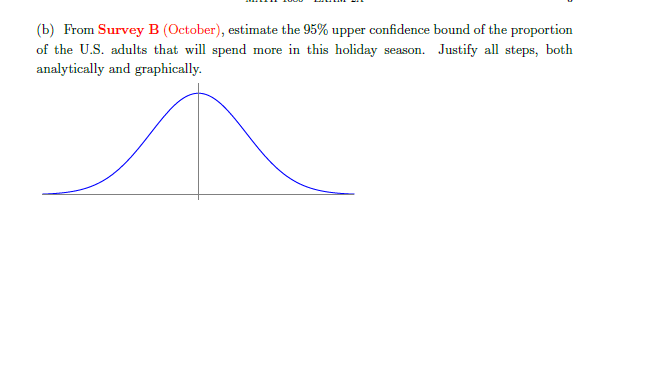
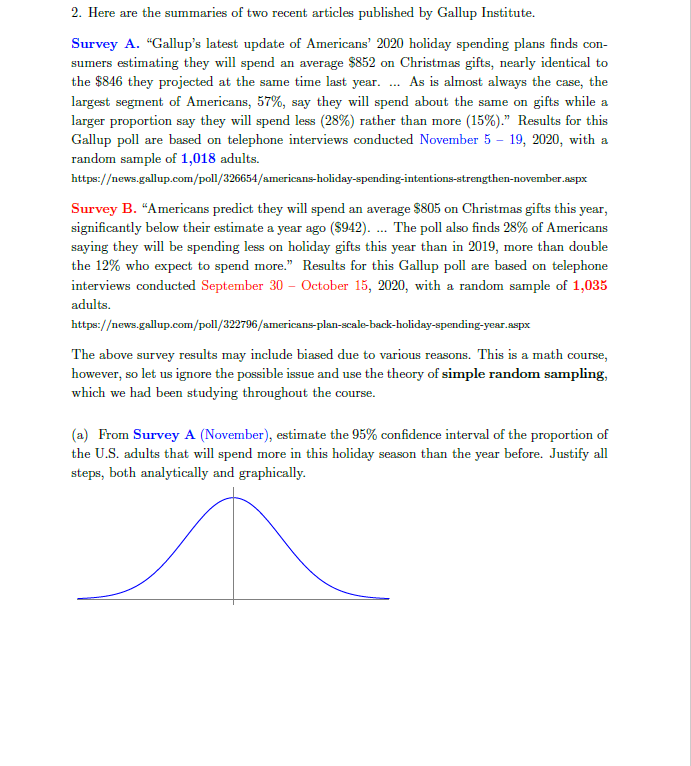
(b) From Survey B (October), estimate the 95% upper confidence bound of the proportion of the U.S. adults that will spend more in this holiday season. Justify all steps, both analytically and graphically.2. Here are the summaries of two recent articles published by Gallup Institute. Survey A. "Gallup's latest update of Americans' 2020 holiday spending plans finds con- sumers estimating they will spend an average $852 on Christmas gifts, nearly identical to the $846 they projected at the same time last year. ... As is almost always the case, the largest segment of Americans, 57%, say they will spend about the same on gifts while a larger proportion say they will spend less (28%) rather than more (15%)." Results for this Gallup poll are based on telephone interviews conducted November 5 - 19, 2020, with a random sample of 1,018 adults. https:/ews.gallup.com/poll/326654/americans-holiday-spending-intentions-strengthen-november.aspx Survey B. "Americans predict they will spend an average $805 on Christmas gifts this year, significantly below their estimate a year ago ($942). ... The poll also finds 28% of Americans saying they will be spending less on holiday gifts this year than in 2019, more than double the 12% who expect to spend more." Results for this Gallup poll are based on telephone interviews conducted September 30 - October 15, 2020, with a random sample of 1,035 adults. https:/ews.gallup.com/poll/322796/americans-plan-scale-back-holiday-spending-year.aspx The above survey results may include biased due to various reasons. This is a math course, however, so let us ignore the possible issue and use the theory of simple random sampling, which we had been studying throughout the course. (a) From Survey A (November), estimate the 95% confidence interval of the proportion of the U.S. adults that will spend more in this holiday season than the year before. Justify all steps, both analytically and graphically
Step by Step Solution
There are 3 Steps involved in it

Get step-by-step solutions from verified subject matter experts