





Question: b) Has the process been in control? Based on the developed control limits, the number of defectives has been c) If the sample size were
b) Has the process been in control? Based on the
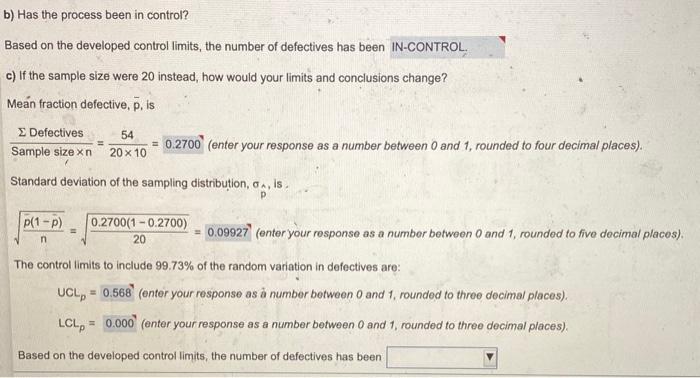
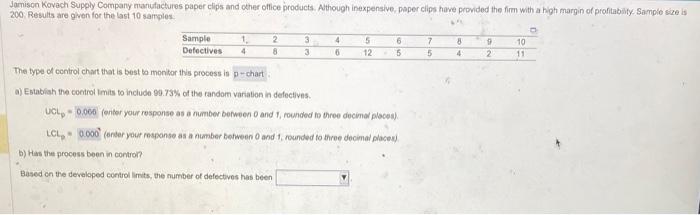
b) Has the process been in control? Based on the developed control limits, the number of defectives has been c) If the sample size were 20 instead, how would your limits and conclusions change? Men fraction defective, p, is SamplesizeDefectives=201054=0.2700 (enter your response as a number between 0 and 1, rounded to four decimal places). Standard deviation of the sampling distribution, p^, is . np(1p)=200.2700(10.2700)= (enter your response as a number between 0 and 1, rounded to five decimal places). The control limits to include 99.73% of the random variation in defectives are: UCLp=0.568 (enter your response as number between 0 and 1, rounded to three decimal places). LCLp= (enter your response as a number between 0 and 1, rounded to three decimal places). Based on the developed control limits, the number of defectives has been. The type of control chat that is best to monitor this process is a) Estabiah the control Imits to include 99.73% of the random variation in defectives. UCL 9=0.000 (enter your response as a number between 0 and 1, rounded to three decimar places.). LCLe 2=0.000 (enter your response as a number between 0 and 1 , rounded to three decind placesi) b) Has the process been in contro?? Based en the devaloped control limits, the number of defectives has been

Step by Step Solution

There are 3 Steps involved in it

1 Expert Approved Answer
Step: 1 Unlock blur-text-image

Question Has Been Solved by an Expert!

Get step-by-step solutions from verified subject matter experts

Step: 2 Unlock
Step: 3 Unlock

Students Have Also Explored These Related General Management Questions!