







Question: B Naive Bayesian classifier The Naive Bayesian Classifier algorithm is a classification algorithm based on calculating the probability of belonging to each class. That is
B Naive Bayesian classifier
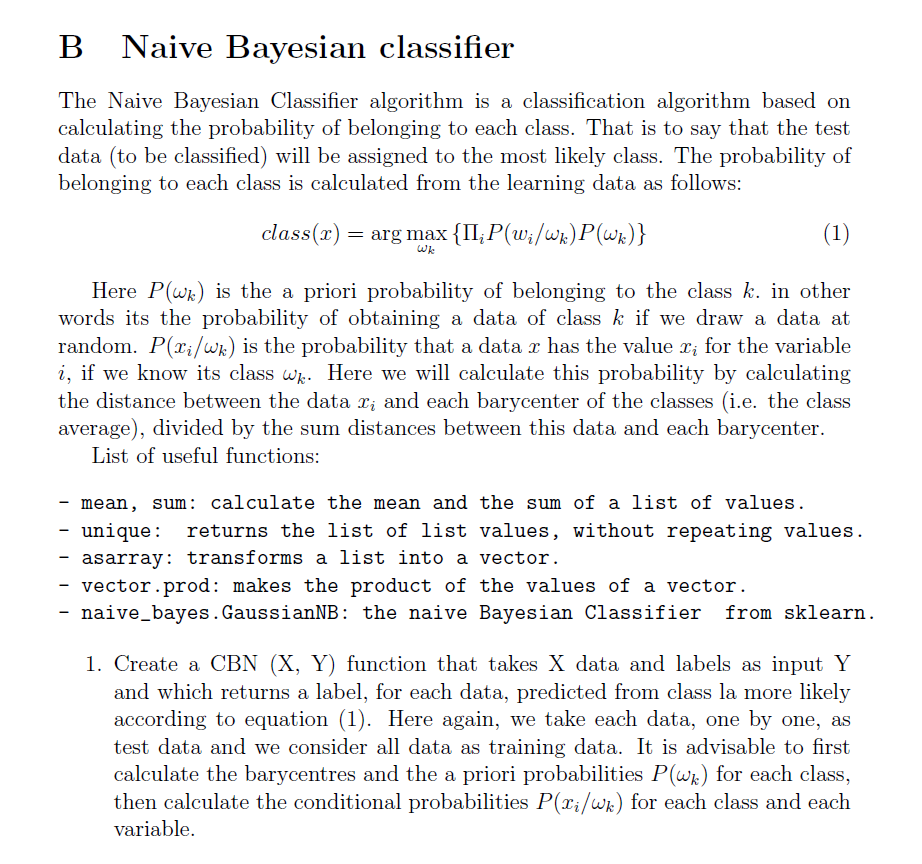
The Naive Bayesian Classifier algorithm is a classification algorithm based on
calculating the probability of belonging to each class. That is to say that the test
data to be classified will be assigned to the most likely class. The probability of
belonging to each class is calculated from the learning data as follows:
class
Here is the a priori probability of belonging to the class in other
words its the probability of obtaining a data of class if we draw a data at
random. is the probability that a data has the value for the variable
if we know its class Here we will calculate this probability by calculating
the distance between the data and each barycenter of the classes ie the class
average divided by the sum distances between this data and each barycenter.
List of useful functions:
mean, sum: calculate the mean and the sum of a list of values.
unique: returns the list of list values, without repeating values.
asarray: transforms a list into a vector.
vector.prod: makes the product of the values of a vector.
naivebayes.GaussianNB: the naive Bayesian Classifier from sklearn.
Create a CBN X Y function that takes data and labels as input
and which returns a label, for each data, predicted from class la more likely
according to equation Here again, we take each data, one by one, as
test data and we consider all data as training data. It is advisable to first
calculate the barycentres and the a priori probabilities for each class,
then calculate the conditional probabilities for each class and each
variable.
Step by Step Solution
There are 3 Steps involved in it
1 Expert Approved Answer
Step: 1 Unlock

Question Has Been Solved by an Expert!
Get step-by-step solutions from verified subject matter experts
Step: 2 Unlock
Step: 3 Unlock
 Study Help