







Question: B. Net force and 3 Newton's laws: 1) Net force is the resultant vector of all forces on an object. Its action is equivalent
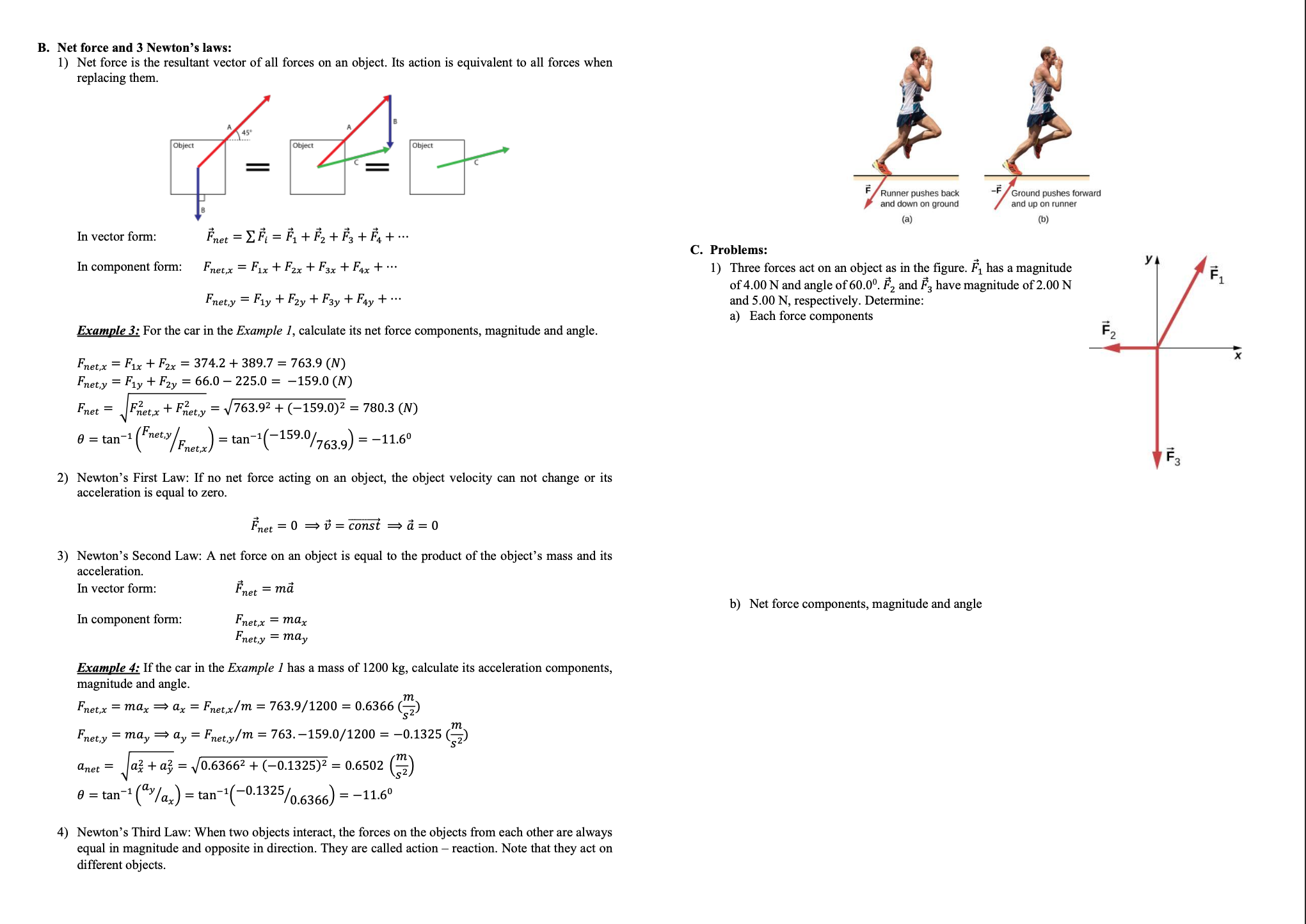
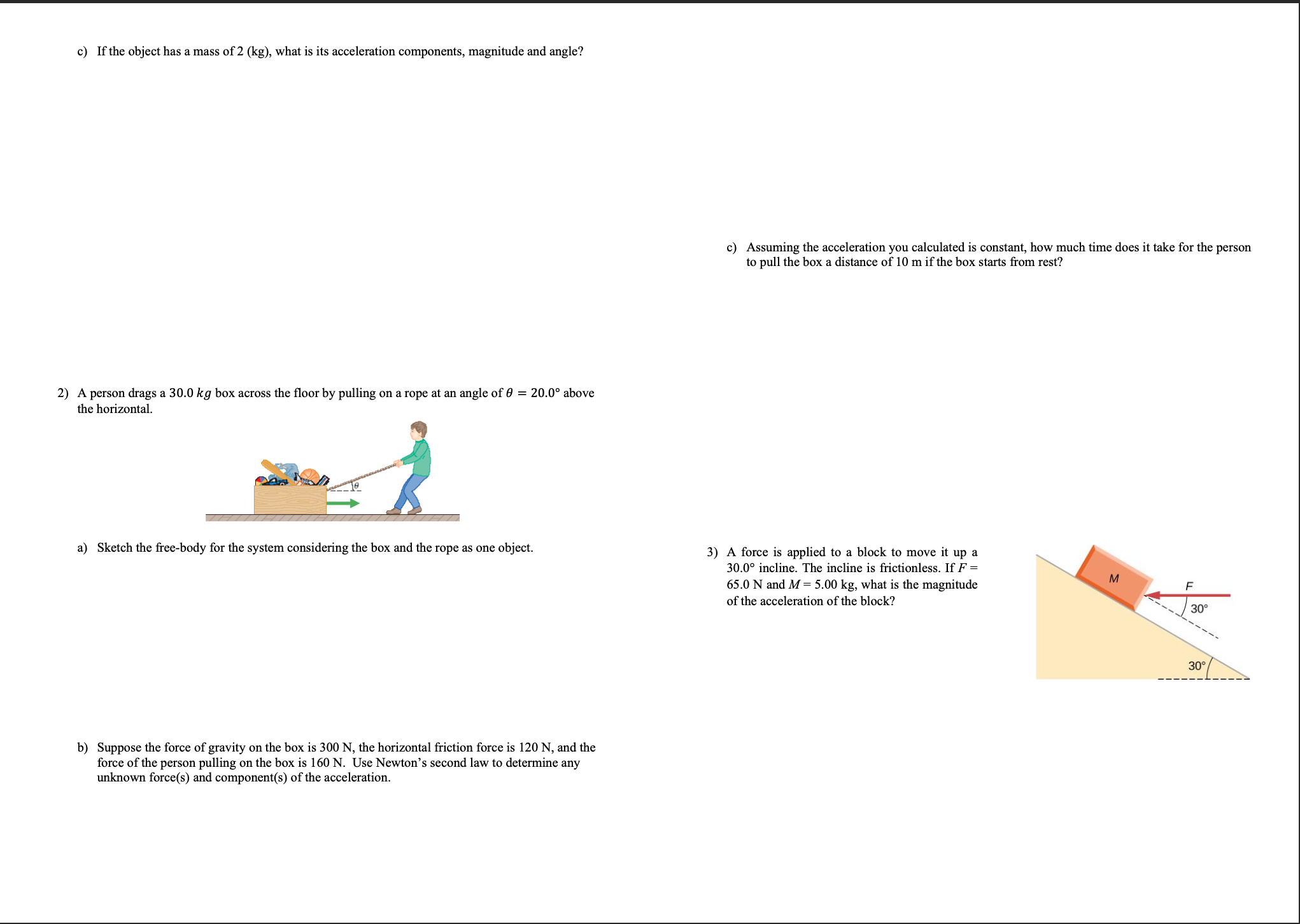
B. Net force and 3 Newton's laws: 1) Net force is the resultant vector of all forces on an object. Its action is equivalent to all forces when replacing them. 45 Object Object Object = Runner pushes back and down on ground (a) -F Ground pushes forward. and up on runner (b) In vector form: Fnet = In component form: + + Fnet,x Fix + F2x + F3x + F4x + ... Fnet,y Fly F2y + F3y+F4y+ ... Example 3: For the car in the Example 1, calculate its net force components, magnitude and angle. Fnet,x = F1x+F2x = 374.2 + 389.7 = 763.9 (N) Fnet,y Fly F2y = 66.0 225.0 = -159.0 (N) Fnet = 0 = tan-1 F2 +F nety net,x = 1 (Fnety/Fnetx) 763.92 + (-159.0) = 780.3 (N) -1(-159.0/763.9) = -11.6 = tan-1 2) Newton's First Law: If no net force acting on an object, the object velocity can not change or its acceleration is equal to zero. Fnet = 0 == const = 0 3) Newton's Second Law: A net force on an object is equal to the product of the object's mass and its acceleration. In vector form: Fnet = m In component form: Fnet,x = max C. Problems: 1) Three forces act on an object as in the figure. F has a magnitude of 4.00 N and angle of 60.0. F2 and F3 have magnitude of 2.00 N and 5.00 N, respectively. Determine: a) Each force components b) Net force components, magnitude and angle Fnet,y = may Example 4: If the car in the Example 1 has a mass of 1200 kg, calculate its acceleration components, magnitude and angle. Fnet,x = max ax = Fnet,x/m = 763.9/1200 = 0.6366 Fnet,y mayay = Fnet,y/m = 763.-159.0/1200 = -0.1325 m anet = a+az = -1 (ay/ax) = = tan In-1 (-0.1325/0.6366): 0.63662 + (-0.1325) = 0.6502 = 11.6 0 = tan 4) Newton's Third Law: When two objects interact, the forces on the objects from each other are always equal in magnitude and opposite in direction. They are called action - reaction. Note that they act on different objects. F2 F1 F3 c) If the object has a mass of 2 (kg), what is its acceleration components, magnitude and angle? 2) A person drags a 30.0 kg box across the floor by pulling on a rope at an angle of 0 = 20.0 above the horizontal. a) Sketch the free-body for the system considering the box and the rope as one object. b) Suppose the force of gravity on the box is 300 N, the horizontal friction force is 120 N, and the force of the person pulling on the box is 160 N. Use Newton's second law to determine any unknown force(s) and component(s) of the acceleration. c) Assuming the acceleration you calculated is constant, how much time does it take for the person to pull the box a distance of 10 m if the box starts from rest? 3) A force is applied to a block to move it up a 30.0 incline. The incline is frictionless. If F = 65.0 N and M = 5.00 kg, what is the magnitude of the acceleration of the block? M F 30 30
Step by Step Solution
There are 3 Steps involved in it

Get step-by-step solutions from verified subject matter experts
 Study Help