







Question: . (b points) Consider the ollowing pairs ol random variables, X anc Determine, in each pair, if one first order stochastically dominates other. If so,
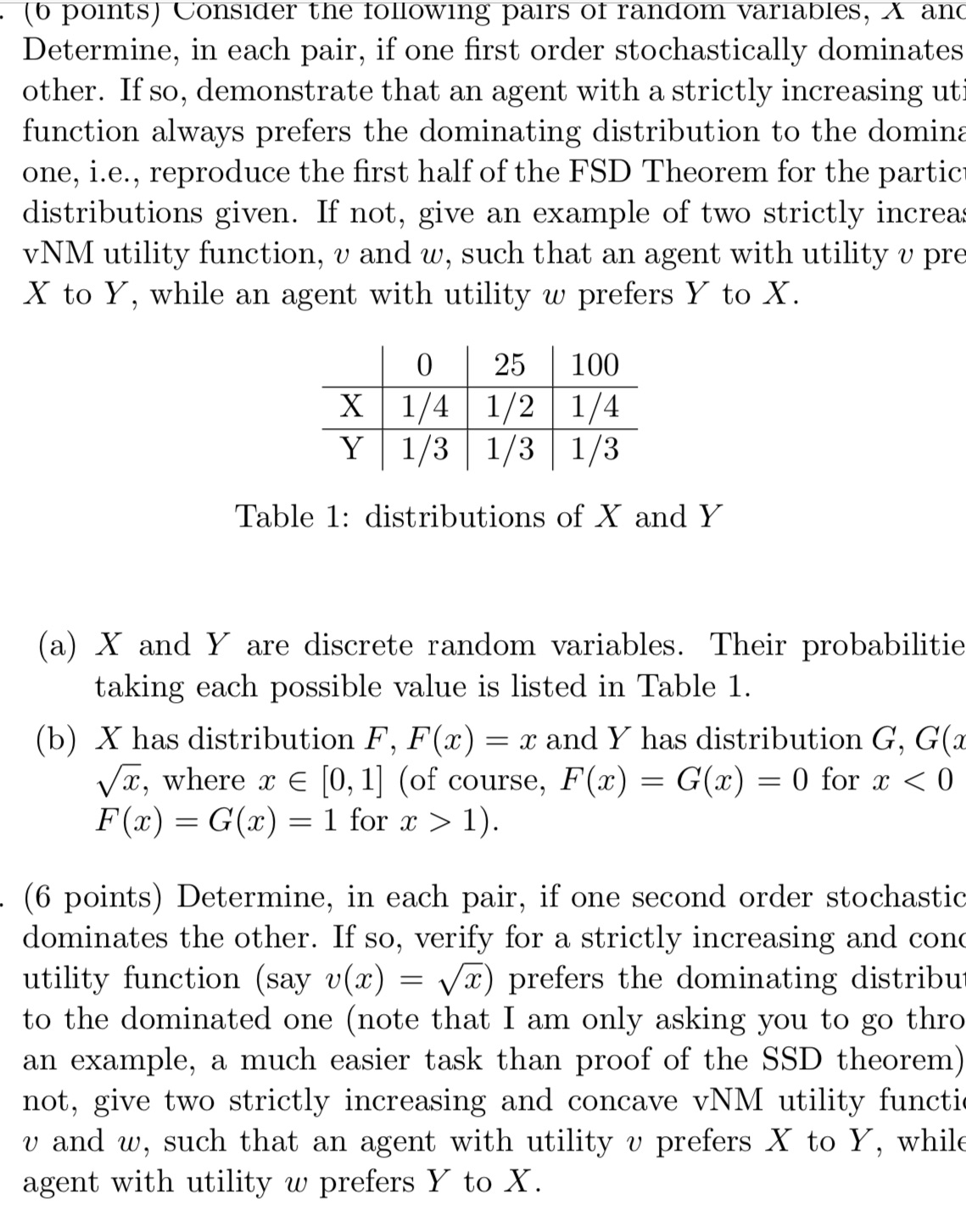
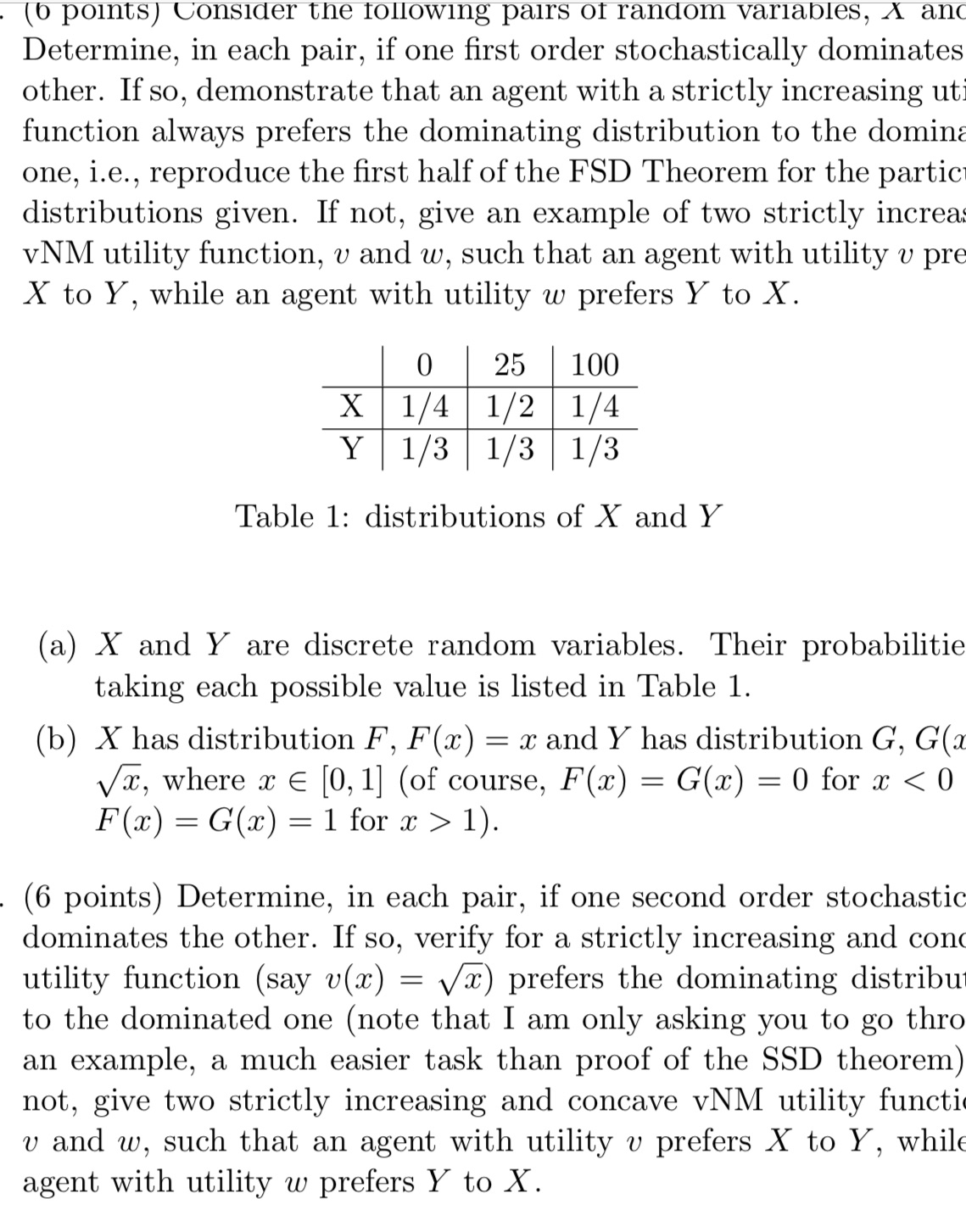
. (b points) Consider the ollowing pairs ol random variables, X anc Determine, in each pair, if one first order stochastically dominates other. If so, demonstrate that an agent with a strictly increasing ut; function always prefers the dominating distribution to the domine one, i.e., reproduce the first half of the FSD Theorem for the partic distributions given. If not, give an example of two strictly increa: vNM utility function, v and w, such that an agent with utility v pre X to Y, while an agent with utility w prefers Y to X. 100 0 25 1/ Y [1/3]1/3|1/3 Table 1: distributions of X and Y (a) X and Y are discrete random variables. Their probabilitie taking each possible value is listed in Table 1. (b) X has distribution F', F(z) = x and Y has distribution G, G(a vz, where z [0,1] (of course, F(z) = G(z) =0 for z 1). . (6 points) Determine, in each pair, if one second order stochastic dominates the other. If so, verify for a strictly increasing and conc utility function (say v(x) = /x) prefers the dominating distribu to the dominated one (note that I am only asking you to go thro an example, a much easier task than proof of the SSD theorem) not, give two strictly increasing and concave vINM utility functi v and w, such that an agent with utility v prefers X to Y, while agent with utility w prefers Y to X
Step by Step Solution
There are 3 Steps involved in it

Get step-by-step solutions from verified subject matter experts
 Study Help