







Question: Please answer question 4. Refer to Table 1 at the top of the screenshot. Thanks! Table 1: distributions of X and Y 1 3. (15
Please answer question 4. Refer to Table 1 at the top of the screenshot. Thanks! 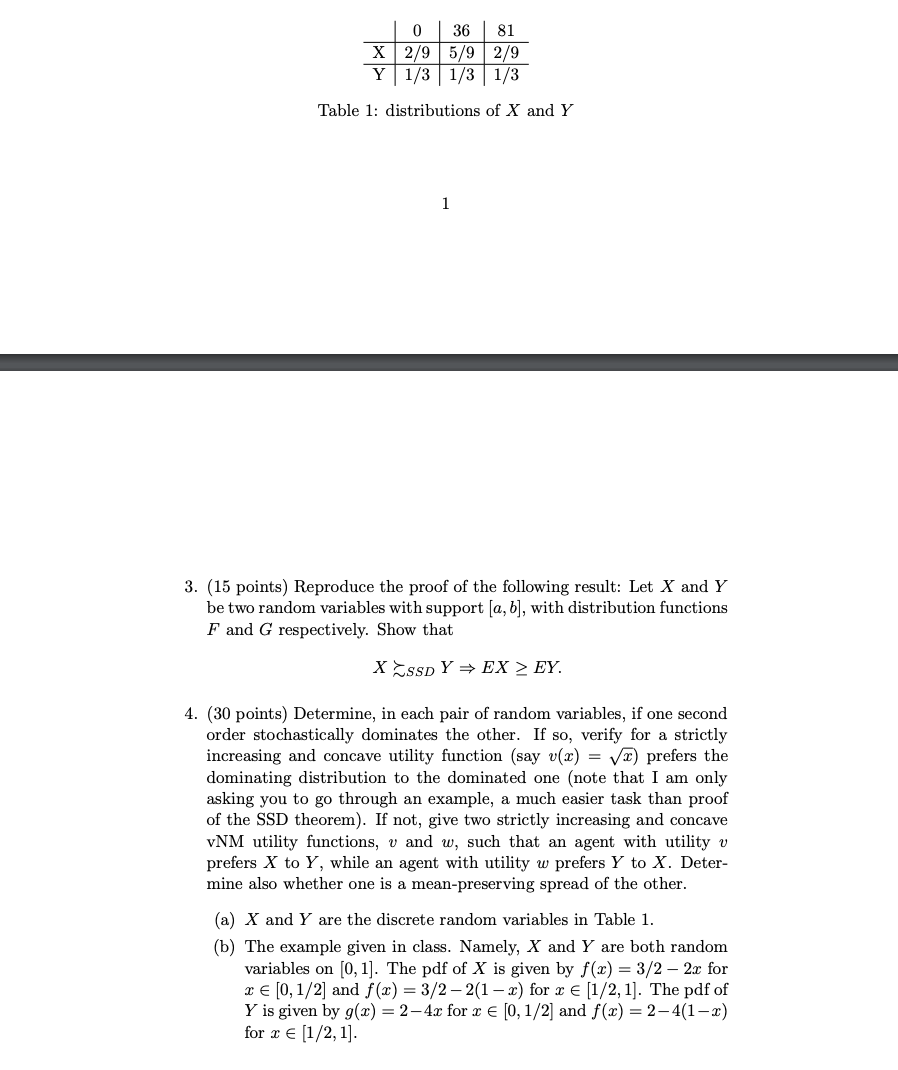
Table 1: distributions of X and Y 1 3. (15 points) Reproduce the proof of the following result: Let X and Y be two random variables with support [a,b], with distribution functions F and G respectively. Show that XSSDYEXEY. 4. (30 points) Determine, in each pair of random variables, if one second order stochastically dominates the other. If so, verify for a strictly increasing and concave utility function (say v(x)=x ) prefers the dominating distribution to the dominated one (note that I am only asking you to go through an example, a much easier task than proof of the SSD theorem). If not, give two strictly increasing and concave vNM utility functions, v and w, such that an agent with utility v prefers X to Y, while an agent with utility w prefers Y to X. Determine also whether one is a mean-preserving spread of the other. (a) X and Y are the discrete random variables in Table 1. (b) The example given in class. Namely, X and Y are both random variables on [0,1]. The pdf of X is given by f(x)=3/22x for x[0,1/2] and f(x)=3/22(1x) for x[1/2,1]. The pdf of Y is given by g(x)=24x for x[0,1/2] and f(x)=24(1x) for x[1/2,1]. Table 1: distributions of X and Y 1 3. (15 points) Reproduce the proof of the following result: Let X and Y be two random variables with support [a,b], with distribution functions F and G respectively. Show that XSSDYEXEY. 4. (30 points) Determine, in each pair of random variables, if one second order stochastically dominates the other. If so, verify for a strictly increasing and concave utility function (say v(x)=x ) prefers the dominating distribution to the dominated one (note that I am only asking you to go through an example, a much easier task than proof of the SSD theorem). If not, give two strictly increasing and concave vNM utility functions, v and w, such that an agent with utility v prefers X to Y, while an agent with utility w prefers Y to X. Determine also whether one is a mean-preserving spread of the other. (a) X and Y are the discrete random variables in Table 1. (b) The example given in class. Namely, X and Y are both random variables on [0,1]. The pdf of X is given by f(x)=3/22x for x[0,1/2] and f(x)=3/22(1x) for x[1/2,1]. The pdf of Y is given by g(x)=24x for x[0,1/2] and f(x)=24(1x) for x[1/2,1]
Step by Step Solution
There are 3 Steps involved in it

Get step-by-step solutions from verified subject matter experts
 Study Help