







Question: b) Prepare a statement ot operations tor 2019 . c) Prepare a statement of changes in net assets for 2019. d) Prepare a balance sheet
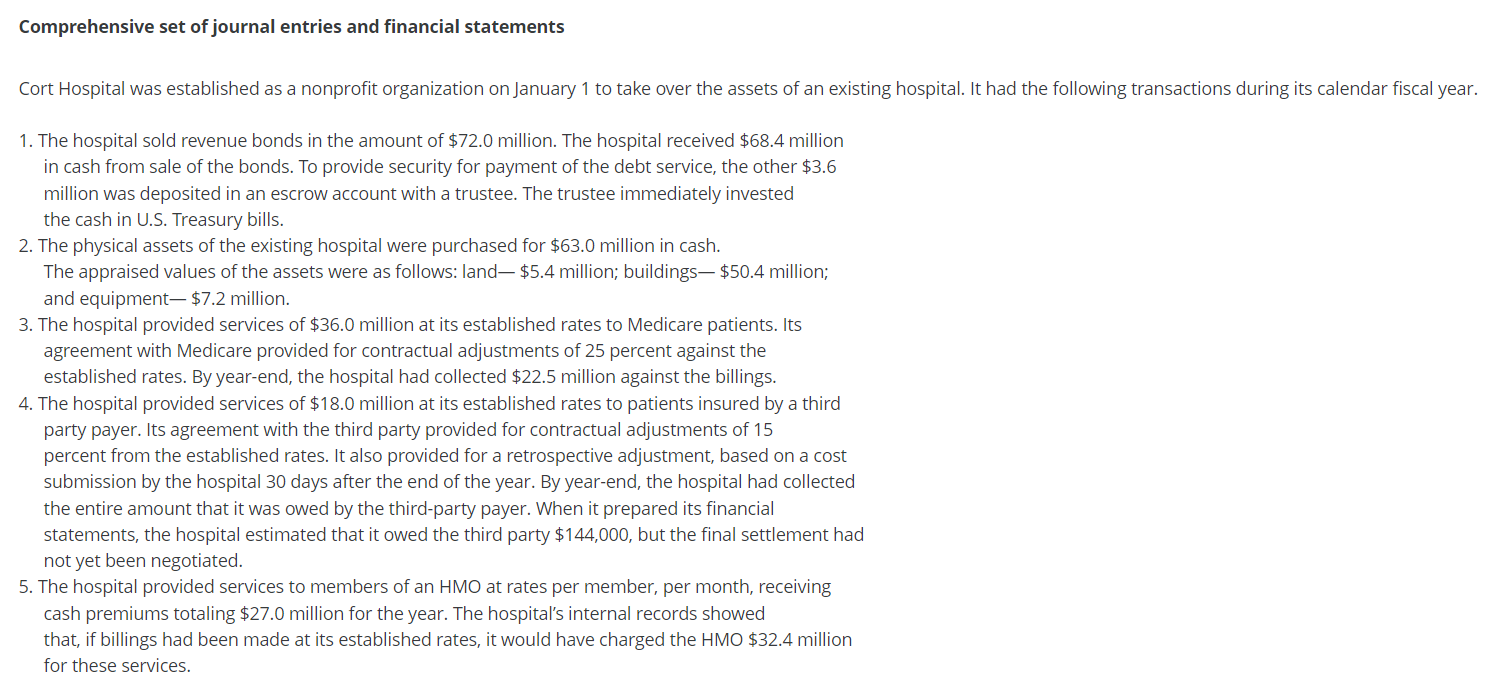
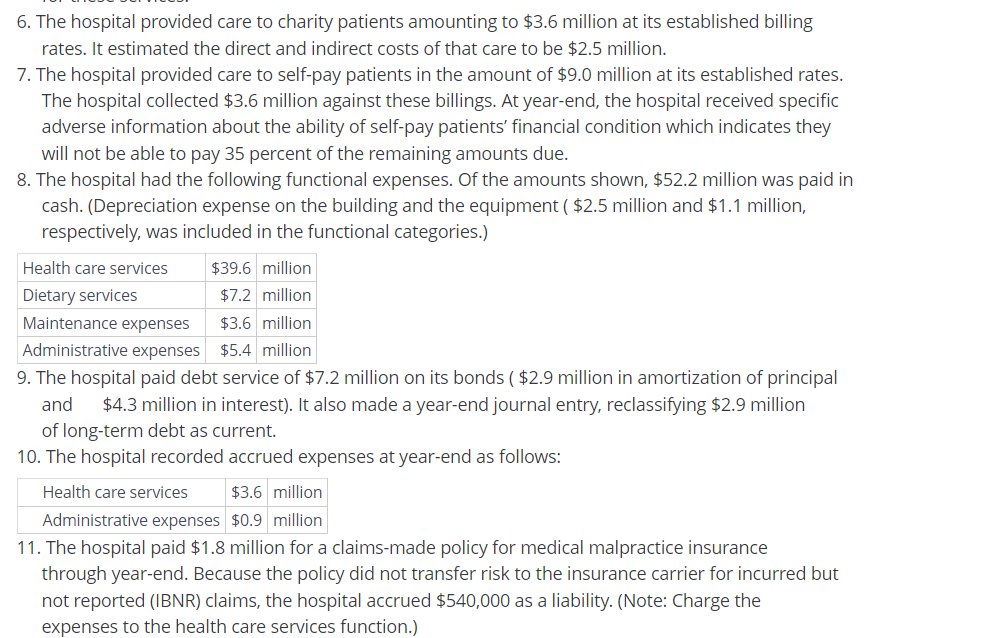
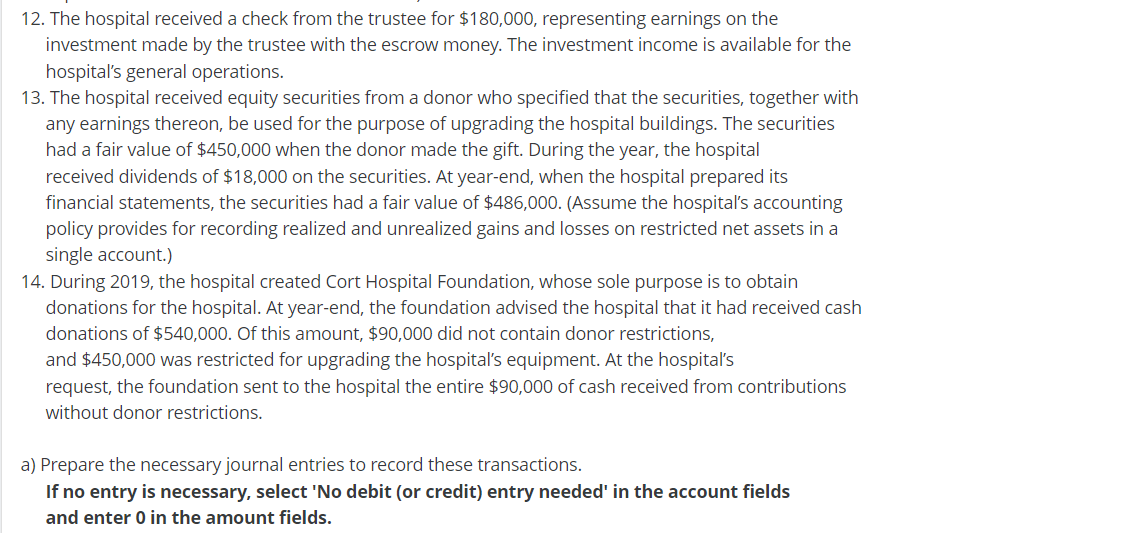
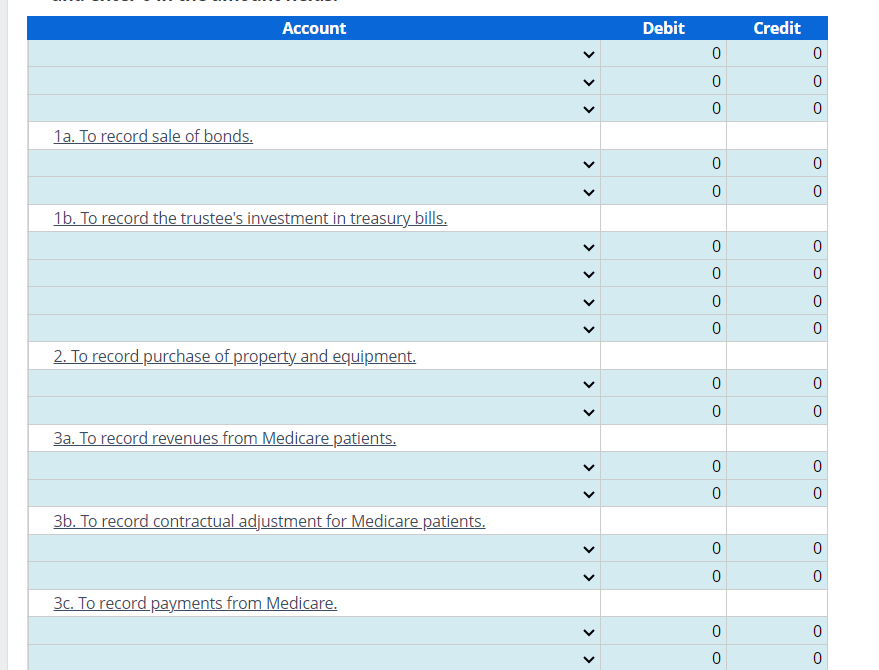
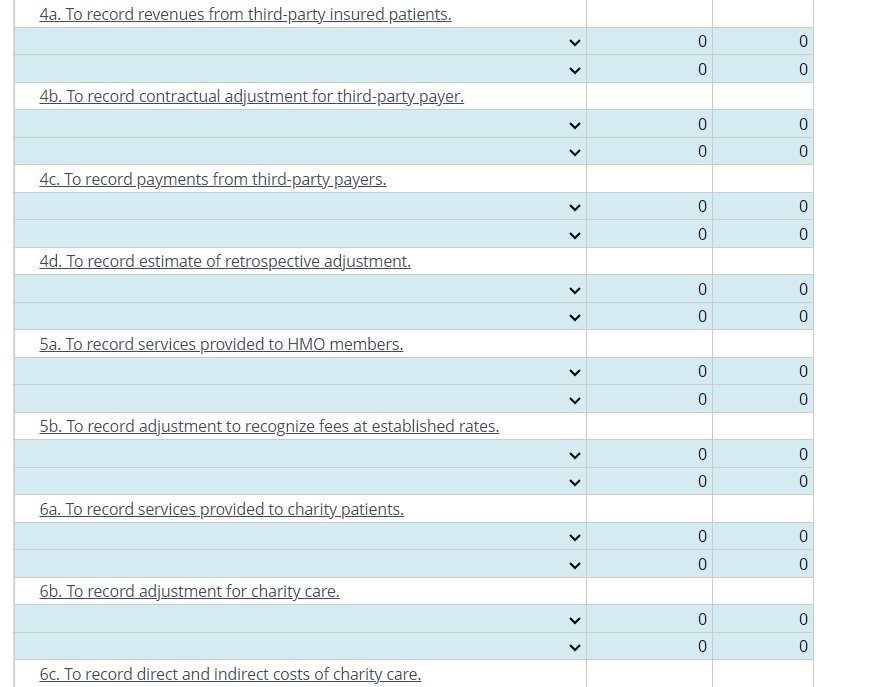
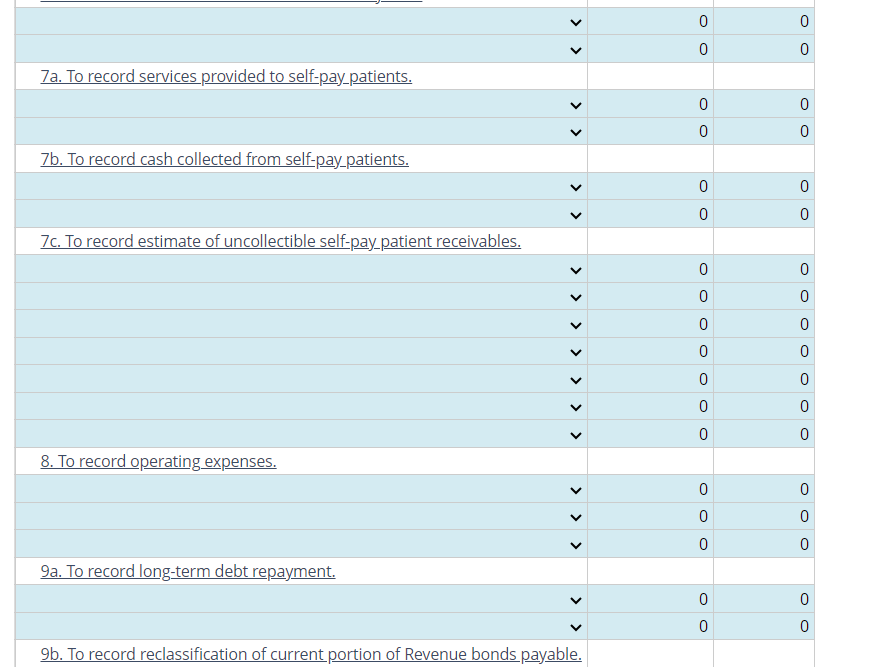
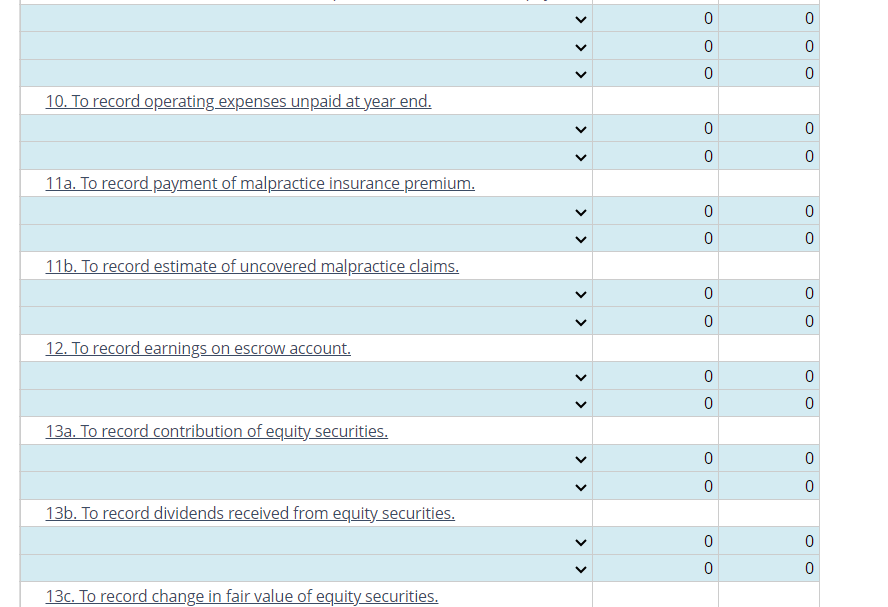
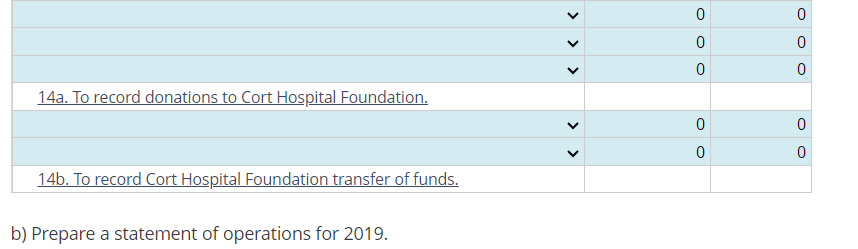
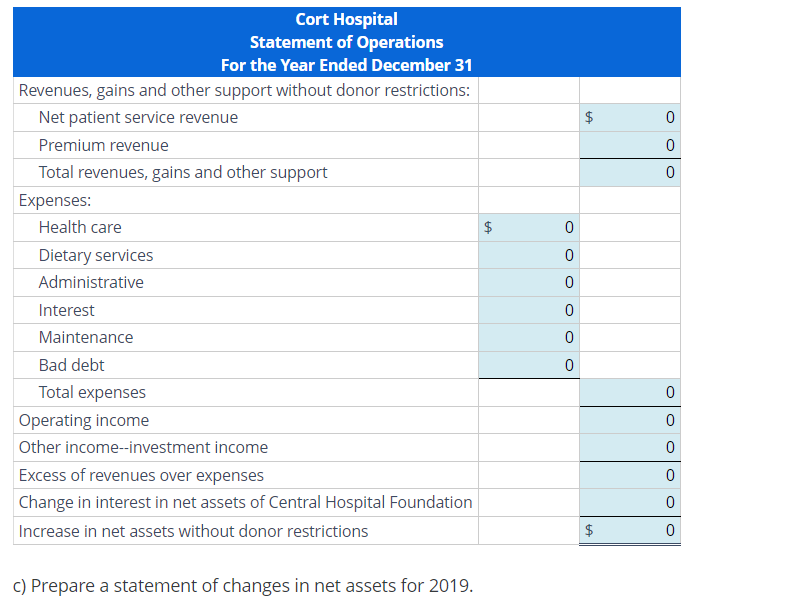
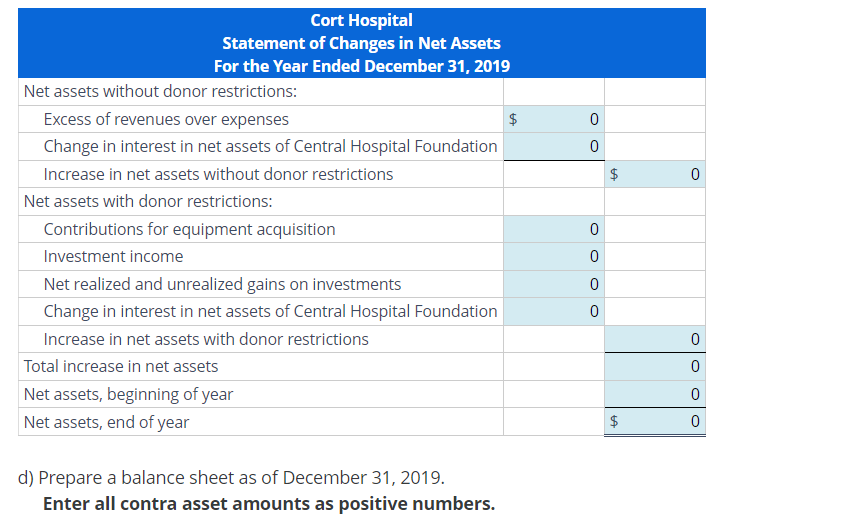
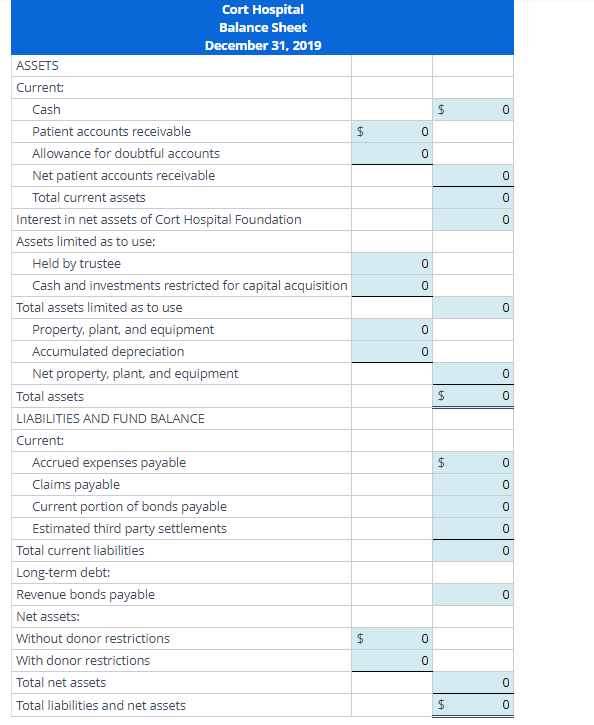
b) Prepare a statement ot operations tor 2019 . c) Prepare a statement of changes in net assets for 2019. d) Prepare a balance sheet as of December 31, 2019. Enter all contra asset amounts as positive numbers. Comprehensive set of journal entries and financial statements Cort Hospital was established as a nonprofit organization on January 1 to take over the assets of an existing hospital. It had the following transactions during its calendar fiscal year. 1. The hospital sold revenue bonds in the amount of $72.0 million. The hospital received $68.4 million in cash from sale of the bonds. To provide security for payment of the debt service, the other $3.6 million was deposited in an escrow account with a trustee. The trustee immediately invested the cash in U.S. Treasury bills. 2. The physical assets of the existing hospital were purchased for $63.0 million in cash. The appraised values of the assets were as follows: land $5.4 million; buildings $50.4 million; and equipment $7.2 million. 3. The hospital provided services of $36.0 million at its established rates to Medicare patients. Its agreement with Medicare provided for contractual adjustments of 25 percent against the established rates. By year-end, the hospital had collected $22.5 million against the billings. 4. The hospital provided services of $18.0 million at its established rates to patients insured by a third party payer. Its agreement with the third party provided for contractual adjustments of 15 percent from the established rates. It also provided for a retrospective adjustment, based on a cost submission by the hospital 30 days after the end of the year. By year-end, the hospital had collected the entire amount that it was owed by the third-party payer. When it prepared its financial statements, the hospital estimated that it owed the third party $144,000, but the final settlement had not yet been negotiated. 5. The hospital provided services to members of an HMO at rates per member, per month, receiving cash premiums totaling $27.0 million for the year. The hospital's internal records showed that, if billings had been made at its established rates, it would have charged the HMO \$32.4 million for these services. 12. The hospital received a check from the trustee for $180,000, representing earnings on the investment made by the trustee with the escrow money. The investment income is available for the hospital's general operations. 13. The hospital received equity securities from a donor who specified that the securities, together with any earnings thereon, be used for the purpose of upgrading the hospital buildings. The securities had a fair value of $450,000 when the donor made the gift. During the year, the hospital received dividends of $18,000 on the securities. At year-end, when the hospital prepared its financial statements, the securities had a fair value of $486,000. (Assume the hospital's accounting policy provides for recording realized and unrealized gains and losses on restricted net assets in a single account.) 14. During 2019, the hospital created Cort Hospital Foundation, whose sole purpose is to obtain donations for the hospital. At year-end, the foundation advised the hospital that it had received cash donations of $540,000. Of this amount, $90,000 did not contain donor restrictions, and $450,000 was restricted for upgrading the hospital's equipment. At the hospital's request, the foundation sent to the hospital the entire $90,000 of cash received from contributions without donor restrictions. a) Prepare the necessary journal entries to record these transactions. If no entry is necessary, select 'No debit (or credit) entry needed' in the account fields and enter 0 in the amount fields. 6. The hospital provided care to charity patients amounting to $3.6 million at its established billing rates. It estimated the direct and indirect costs of that care to be $2.5 million. 7. The hospital provided care to self-pay patients in the amount of $9.0 million at its established rates. The hospital collected $3.6 million against these billings. At year-end, the hospital received specific adverse information about the ability of self-pay patients' financial condition which indicates they will not be able to pay 35 percent of the remaining amounts due. 8. The hospital had the following functional expenses. Of the amounts shown, $52.2 million was paid in cash. (Depreciation expense on the building and the equipment ( $2.5 million and $1.1 million, respectively, was included in the functional categories.) 9. The hospital paid debt service of $7.2 million on its bonds ( $2.9 million in amortization of principal and $4.3 million in interest). It also made a year-end journal entry, reclassifying $2.9 million of long-term debt as current. 10. The hospital recorded accrued expenses at year-end as follows: 11. The hospital paid $1.8 million for a claims-made policy for medical malpractice insurance through year-end. Because the policy did not transfer risk to the insurance carrier for incurred but not reported (IBNR) claims, the hospital accrued $540,000 as a liability. (Note: Charge the expenses to the health care services function.) 4a. To record revenues from third-party insured patients. 4b. To record contractual adjustment for third-party_payer. 4c. To record payments from third-party_payers. 4 d. To record estimate of retrospective adjustment. 5a. To record services provided to HMO members. 5b. To record adjustment to recognize fees at established rates. 6a. To record services provided to charity_patients. 6b. To record adjustment for charity care. 6c. To record direct and indirect costs of charity care. Cort Hospital Balance Sheet December 31, 2019
Step by Step Solution
There are 3 Steps involved in it

Get step-by-step solutions from verified subject matter experts
 Study Help