







Question: B. Python application 1. Obtain from http://finance.yahoo.com/ the historical daily values of the NYSE Composite index (ticker: NYA) and NASDAQ Composite Index (ticker: IXIC) from
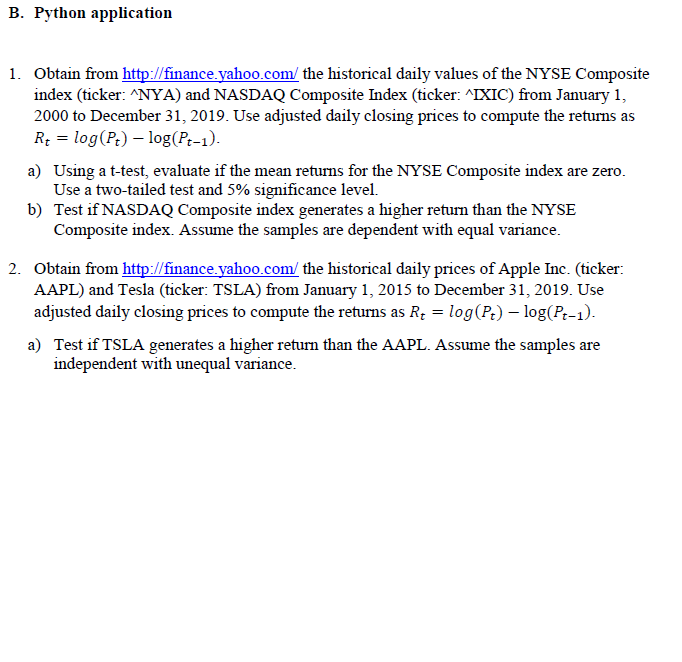
B. Python application 1. Obtain from http://finance.yahoo.com/ the historical daily values of the NYSE Composite index (ticker: NYA) and NASDAQ Composite Index (ticker: IXIC) from January 1, 2000 to December 31, 2019. Use adjusted daily closing prices to compute the returns as Rt = log(Pt) - log(Pt-1). a) Using a t-test, evaluate if the mean returns for the NYSE Composite index are zero. Use a two-tailed test and 5% significance level. b) Test if NASDAQ Composite index generates a higher return than the NYSE Composite index. Assume the samples are dependent with equal variance. 2. Obtain from http://finance.yahoo.com/ the historical daily prices of Apple Inc. (ticker: AAPL) and Tesla (ticker: TSLA) from January 1, 2015 to December 31, 2019. Use adjusted daily closing prices to compute the returns as R = log(Pt) log(Pt-1). a) Test if TSLA generates a higher return than the AAPL. Assume the samples are independent with unequal variance. B. Python application 1. Obtain from http://finance.yahoo.com/ the historical daily values of the NYSE Composite index (ticker: NYA) and NASDAQ Composite Index (ticker: IXIC) from January 1, 2000 to December 31, 2019. Use adjusted daily closing prices to compute the returns as Rt = log(Pt) - log(Pt-1). a) Using a t-test, evaluate if the mean returns for the NYSE Composite index are zero. Use a two-tailed test and 5% significance level. b) Test if NASDAQ Composite index generates a higher return than the NYSE Composite index. Assume the samples are dependent with equal variance. 2. Obtain from http://finance.yahoo.com/ the historical daily prices of Apple Inc. (ticker: AAPL) and Tesla (ticker: TSLA) from January 1, 2015 to December 31, 2019. Use adjusted daily closing prices to compute the returns as R = log(Pt) log(Pt-1). a) Test if TSLA generates a higher return than the AAPL. Assume the samples are independent with unequal variance
Step by Step Solution
There are 3 Steps involved in it

Get step-by-step solutions from verified subject matter experts
 Study Help