







Question: (b) State (do NOT derive / prove) the posterior standard deviation of 0. (c) Assume for this part that, for the sample data at the
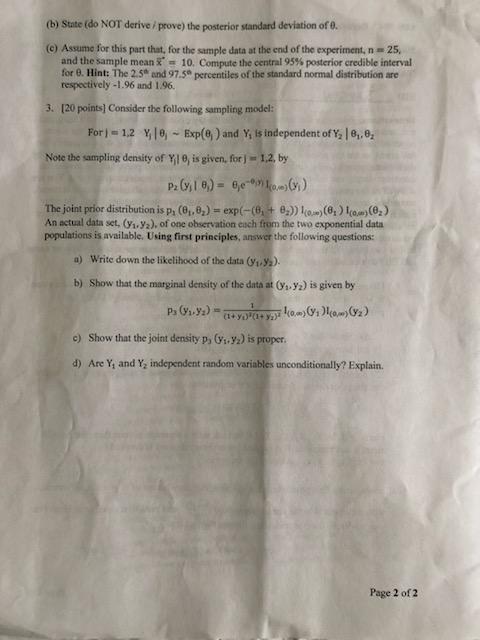
(b) State (do NOT derive / prove) the posterior standard deviation of 0. (c) Assume for this part that, for the sample data at the end of the experiment, n . 25, and the sample mean ?" = 10. Compute the central 95% posterior credible interval for 0. Hint: The 2:5" and 97.5" percentiles of the standard normal distribution are respectively -1.96 and 1.96. 3. [20 points] Consider the following sampling model: For) = 1.2 Y|0, - Exp(6, ) and Y, Is independent of Y, | 6,, 0, Note the sampling density of Y | 0, is given, for ] = 1,2, by The joint prior distribution is p. (0,, 0,) = exp(-(8, + 8.)) law)(0, ) 1com)(02) An actual data set, (y1. ya), of one observation each from the two exponential data populations is available. Using first principles, answer the following questions: a) Write down the likelihood of the data (1. ya). b) Show that the marginal density of the data at (y. y, ) is given by omlom,(y) c) Show that the joint density p, (ya. yz) is proper. d) Are Y, and Y, independent random variables unconditionally ? Explain. Page 2 of 2
Step by Step Solution
There are 3 Steps involved in it

Get step-by-step solutions from verified subject matter experts
 Study Help