



Question: b . The helium line at 5 8 7 . 6 n m is present in the absorption spectrum of a star. The observed wavelength
b The helium line at is present in the absorption spectrum of a star. The observed wavelength of the line varies between and with a period of several days.
i Explain, without calculation, what the variation in wavelength suggests about the nature of the star.
marks
ii Calculate, relative to the Earth, the maximum velocity of the star along the line of sight. marks
c The spectrum of the star has a maximum intensity at a wavelength of
i Calculate the surface temperature of the star. Assume that the star radiates as a black body.
mark
The parallax angle of the star is arcsecond.
ii Calculate, in light years ly the distance to the star.
marks
The apparent brightness of the star is also measured.
iii. State what is meant by apparent brightness.
mark
iv Explain, without calculation, how the radius of the star can be determined from these data.
marks
d Kepler deduced his laws of orbital motion by analysing observations of the planets in the Solar System.
i Discuss why these same laws can be applied to orbital motion of objects outside the Solar System.
marks
Astronomers have discovered many planets orbiting stars other than the Sun. The orbital periods have been directly measured for some of these planets.
ii Outline how Kepler's laws can be used to determine the orbital radii of these planets.
marks
Question
a State what is meant by an elastic collision. mark
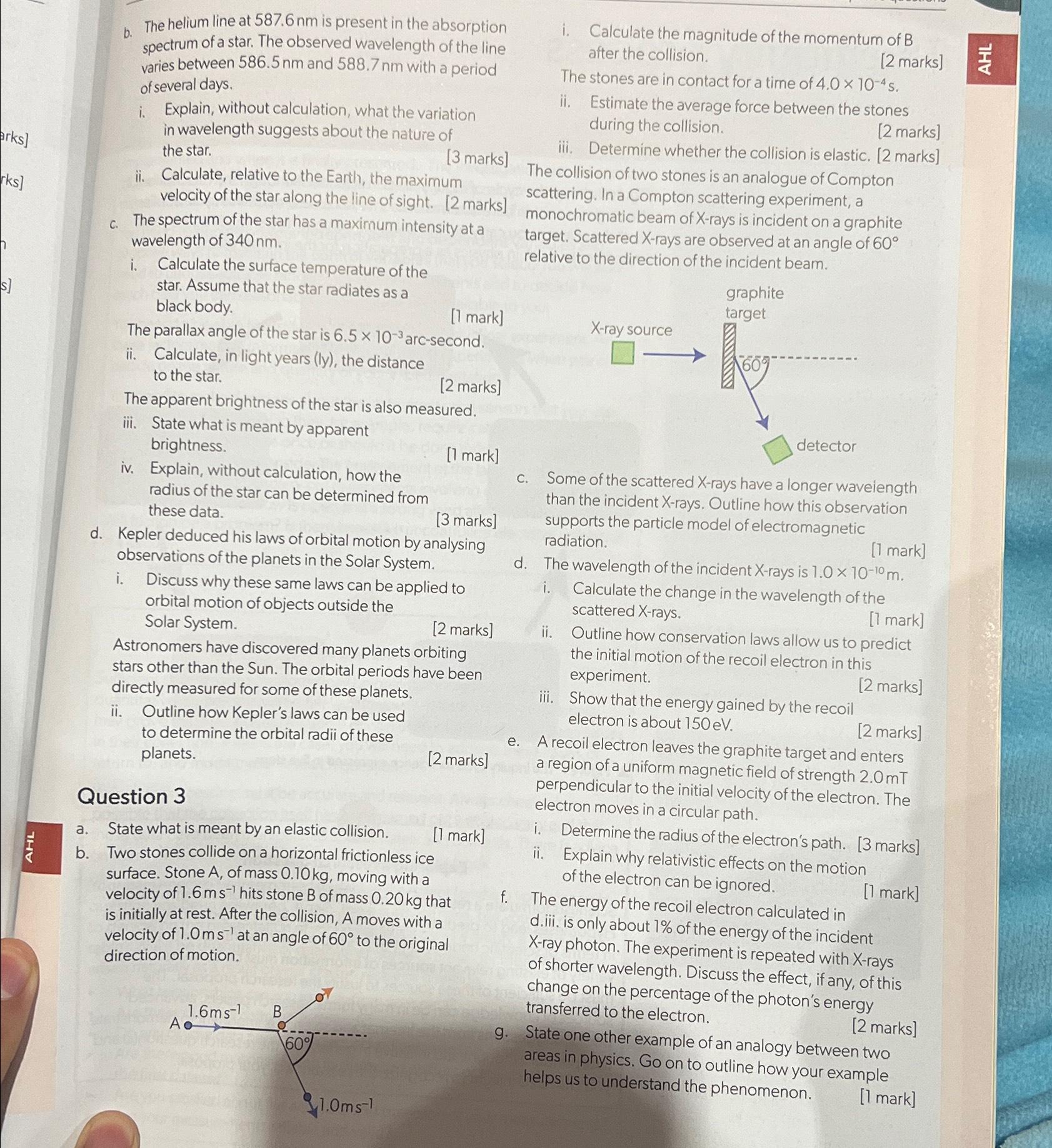
b Two stones collide on a horizontal frictionless ice surface. Stone of mass moving with a velocity of hits stone of mass that is initially at rest. After the collision, A moves with a velocity of at an angle of to the original direction of motion.
i Calculate the magnitude of the momentum of after the collision.
marks
The stones are in contact for a time of
ii Estimate the average force between the stones during the collision.
marks
iii. Determine whether the collision is elastic. marks The collision of two stones is an analogue of Compton scattering. In a Compton scattering experiment, a monochromatic beam of rays is incident on a graphite target. Scattered Xrays are observed at an angle of relative to the direction of the incident beam.
Step by Step Solution
There are 3 Steps involved in it
1 Expert Approved Answer
Step: 1 Unlock

Question Has Been Solved by an Expert!
Get step-by-step solutions from verified subject matter experts
Step: 2 Unlock
Step: 3 Unlock