







Question: The table gives the population of the world P(t), in millions, where t is measured in years and t = 0 corresponds to the
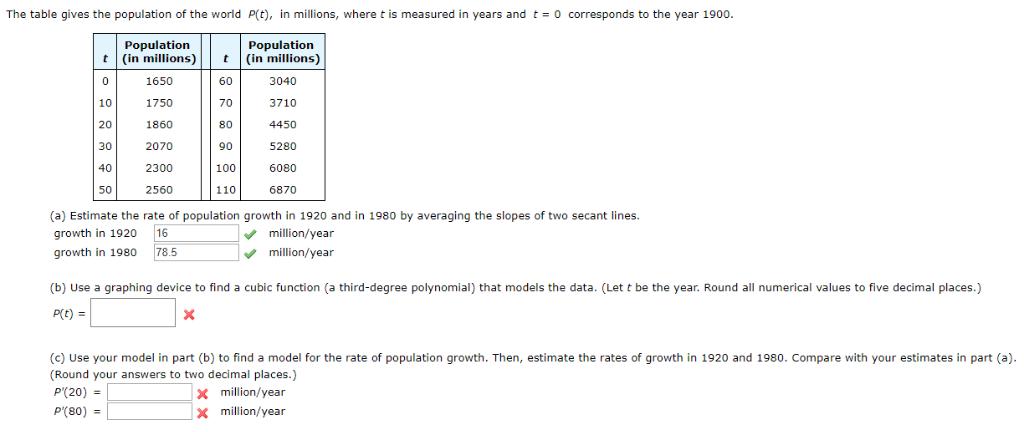

The table gives the population of the world P(t), in millions, where t is measured in years and t = 0 corresponds to the year 1900. Population t (in millions) Population (in millions) 1650 60 3040 10 1750 70 3710 20 1860 80 4450 30 2070 90 5280 40 2300 100 6080 50 2560 110 6870 (a) Estimate the rate of population growth in 1920 and in 1980 by averaging the slopes of two secant lines. growth in 1920 16 growth in 1980 78.5 v million/year v million/year (b) Use a graphing device to find a cubic function (a third-degree polynomial) that models the data. (Let t be the year. Round all numerical values to five decimal places.) P(t) = (c) Use your model in part (b) to find a model for the rate of population growth. Then, estimate the rates of growth in 1920 and 1980. Compare with your estimates in part (a). (Round your answers to two decimal places.) x million/year x million/year P'(20) = P'(80) = %3D (c) Use your model in part (b) to find a model for the rate of population growth. Then, estimate the rates of growth in 1920 and 1980. Compare with your estimates in part (a). (Round your answers to two decimal places.) x million/year X million/year P'(20) = P'(80) = (d) P(t) can be modeled with with the exponential function f(t) = (1.43653 x 10) (1.01395)*. Use this model to find a model for the rate of population growth. Then, use the model to estimate the rate of growth in 1920 and 1980. Compare with your estimates in parts (a) and (c). (Round your answers to two decimal places.) x million/year x million/year f'(20) = f'(80) = (e) Estimate the rate of growth in 1983. (Round your answer to two decimal places.) x million/year
Step by Step Solution
3.47 Rating (154 Votes )
There are 3 Steps involved in it

Get step-by-step solutions from verified subject matter experts
 Study Help