







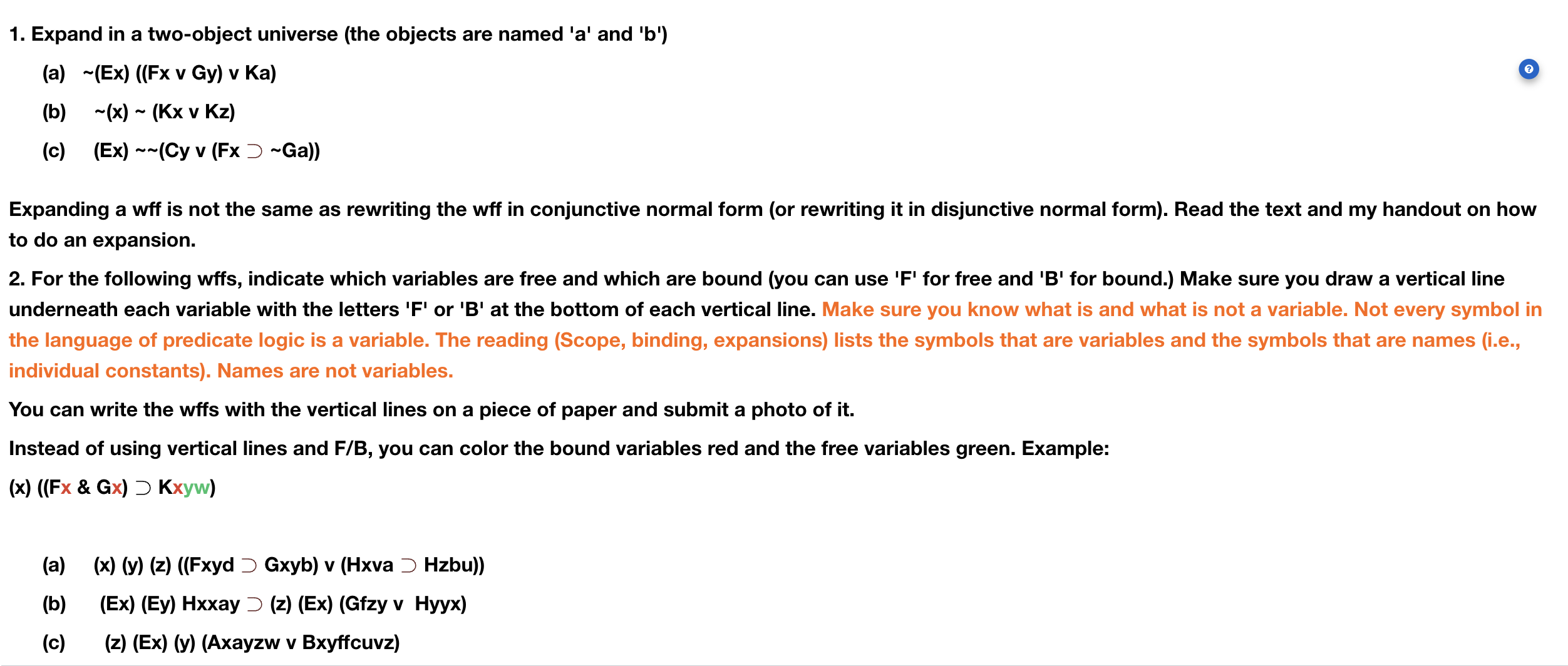
Question: ( b ) v Kz ) ( c ) , ( Ex ) ( C y v ( F x G a ) ) Expanding
b v Kz
cEx
Expanding a wff is not the same as rewriting the wff in conjunctive normal form or rewriting it in disjunctive normal form Read the text and my handout on how
to do an expansion.
For the following wffs indicate which variables are free and which are bound you can use for free and for bound. Make sure you draw a vertical line
underneath each variable with the letters or B at the bottom of each vertical line. Make sure you know what is and what is not a variable. Not every symbol in
the language of predicate logic is a variable. The reading Scope binding, expansions lists the symbols that are variables and the symbols that are names ie
individual constants Names are not variables.
You can write the wffs with the vertical lines on a piece of paper and submit a photo of it
Instead of using vertical lines and FB you can color the bound variables red and the free variables green. Example:
xFx & Gx sup Kxyw
axyzFxyd sup Gxyb
bExEy Hxxay sup zExGfzy v Hyyx
czExyAxayzw v Bxyffcuvz
Step by Step Solution
There are 3 Steps involved in it
1 Expert Approved Answer
Step: 1 Unlock

Question Has Been Solved by an Expert!
Get step-by-step solutions from verified subject matter experts
Step: 2 Unlock
Step: 3 Unlock
 Study Help