







Question: B2: In class, we wrote down a way to track the motion of a simple harmonic oscillator using sine and cosine waves. For the
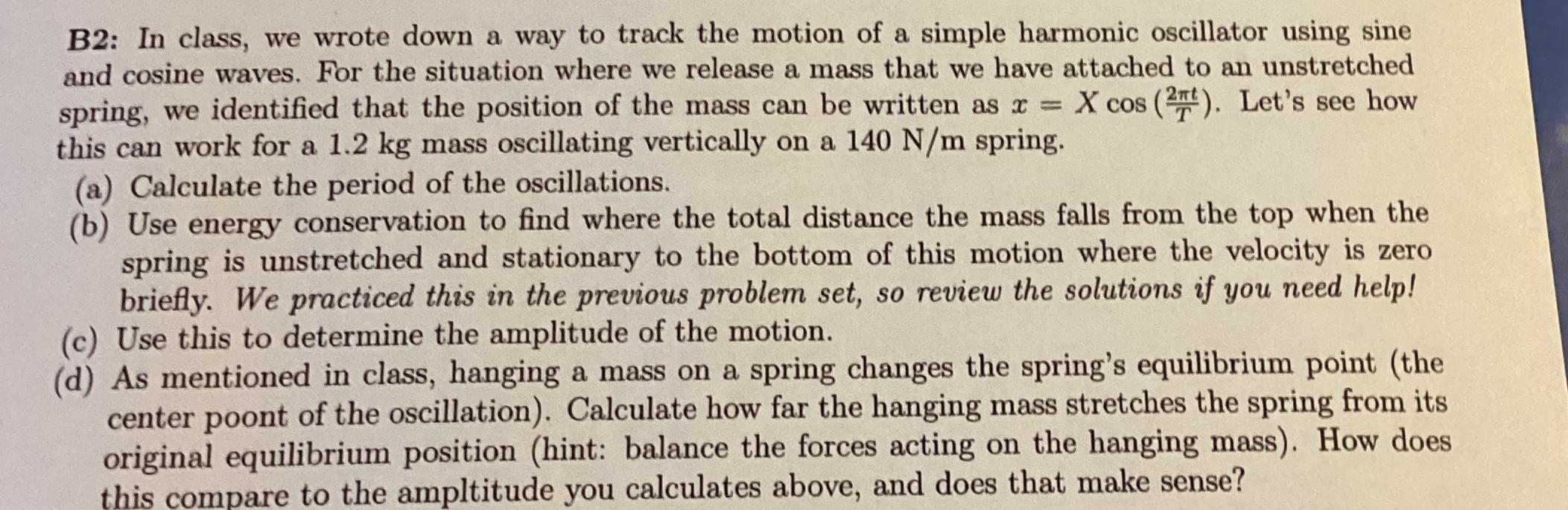
B2: In class, we wrote down a way to track the motion of a simple harmonic oscillator using sine and cosine waves. For the situation where we release a mass that we have attached to an unstretched spring, we identified that the position of the mass can be written as x = X cos (2). Let's see how this can work for a 1.2 kg mass oscillating vertically on a 140 N/m spring. (a) Calculate the period of the oscillations. (b) Use energy conservation to find where the total distance the mass falls from the top when the spring is unstretched and stationary to the bottom of this motion where the velocity is zero briefly. We practiced this in the previous problem set, so review the solutions if you need help! (c) Use this to determine the amplitude of the motion. (d) As mentioned in class, hanging a mass on a spring changes the spring's equilibrium point (the center poont of the oscillation). Calculate how far the hanging mass stretches the spring from its original equilibrium position (hint: balance the forces acting on the hanging mass). How does this compare to the ampltitude you calculates above, and does that make sense?
Step by Step Solution
There are 3 Steps involved in it

Get step-by-step solutions from verified subject matter experts
 Study Help