







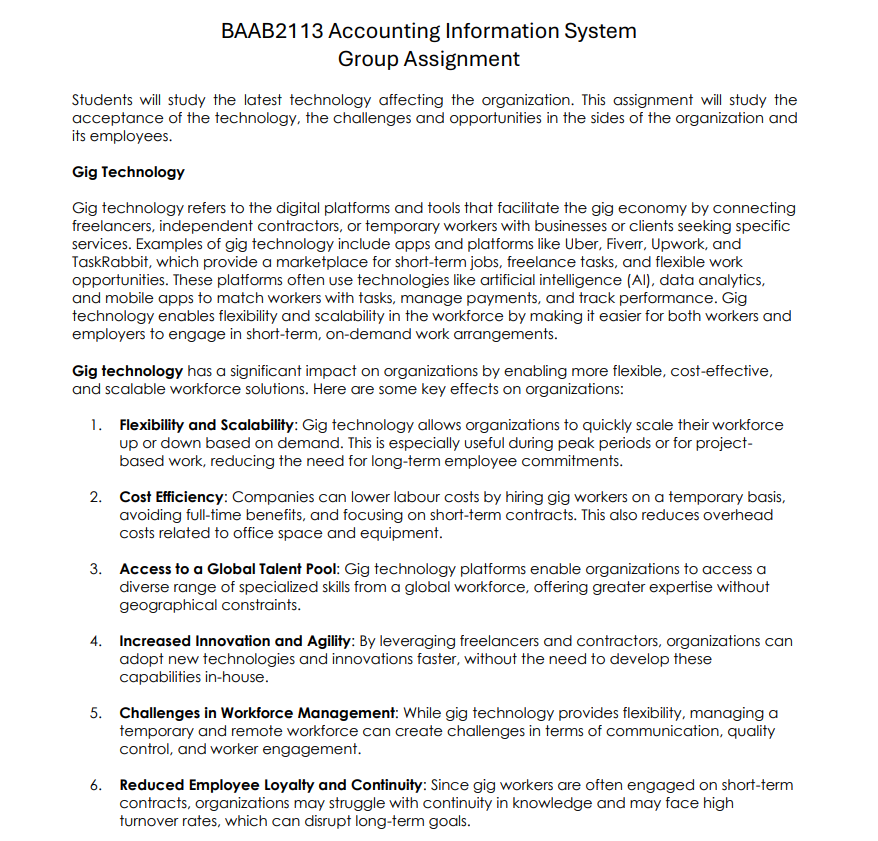
Question: BAAB 2 1 1 3 Accounting Information System Group Assignment Students will study the latest technology affecting the organization. This assignment will study the acceptance
BAAB Accounting Information System
Group Assignment
Students will study the latest technology affecting the organization. This assignment will study the
acceptance of the technology, the challenges and opportunities in the sides of the organization and
its employees.
Gig Technology
Gig technology refers to the digital platforms and tools that facilitate the gig economy by connecting
freelancers, independent contractors, or temporary workers with businesses or clients seeking specific
services. Examples of gig technology include apps and platforms like Uber, Fiverr, Upwork, and
TaskRabbit, which provide a marketplace for shortterm jobs, freelance tasks, and flexible work
opportunities. These platforms often use technologies like artificial intelligence AI data analytics,
and mobile apps to match workers with tasks, manage payments, and track performance. Gig
technology enables flexibility and scalability in the workforce by making it easier for both workers and
employers to engage in shortterm, ondemand work arrangements.
Gig technology has a significant impact on organizations by enabling more flexible, costeffective,
and scalable workforce solutions. Here are some key effects on organizations:
Flexibility and Scalability: Gig technology allows organizations to quickly scale their workforce
up or down based on demand. This is especially useful during peak periods or for project
based work, reducing the need for longterm employee commitments.
Cost Efficiency: Companies can lower labour costs by hiring gig workers on a temporary basis,
avoiding fulltime benefits, and focusing on shortterm contracts. This also reduces overhead
costs related to office space and equipment.
Access to a Global Talent Pool: Gig technology platforms enable organizations to access a
diverse range of specialized skills from a global workforce, offering greater expertise without
geographical constraints.
Increased Innovation and Agility: By leveraging freelancers and contractors, organizations can
adopt new technologies and innovations faster, without the need to develop these
capabilities inhouse.
Challenges in Workforce Management: While gig technology provides flexibility, managing a
temporary and remote workforce can create challenges in terms of communication, quality
control, and worker engagement.
Reduced Employee Loyalty and Continuity: Since gig workers are often engaged on shortterm
contracts, organizations may struggle with continuity in knowledge and may face high
turnover rates, which can disrupt longterm goals.
The gig economy in the education industry
Step by Step Solution
There are 3 Steps involved in it
1 Expert Approved Answer
Step: 1 Unlock

Question Has Been Solved by an Expert!
Get step-by-step solutions from verified subject matter experts
Step: 2 Unlock
Step: 3 Unlock
 Study Help