



Question: Background Information: There are two players: Player A and Player B. Strategy for Player A: H or L Strategy for Player B: H, M, L
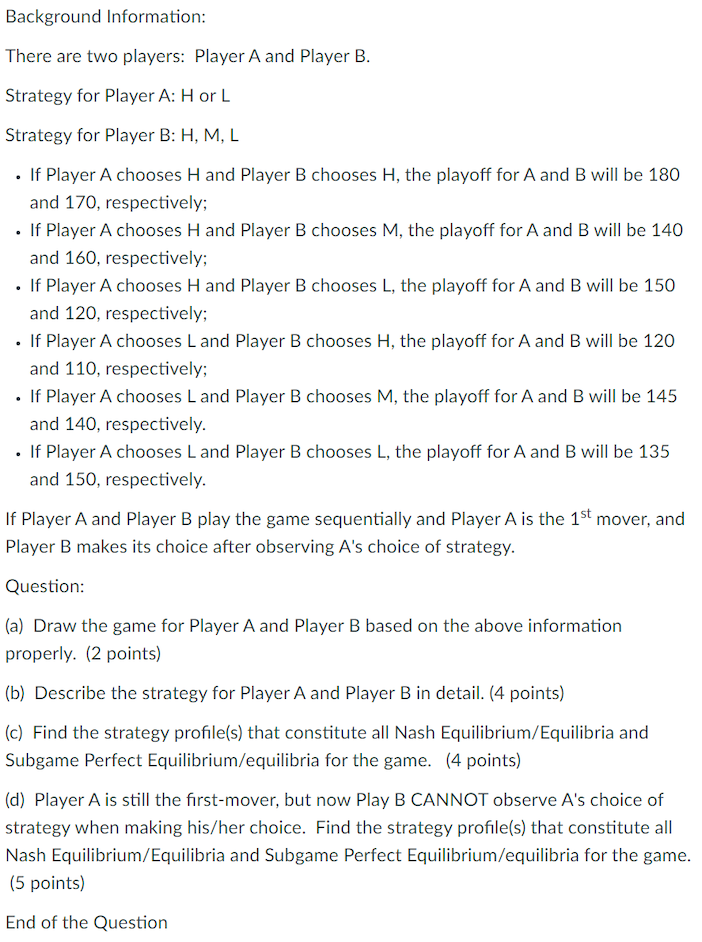
Background Information: There are two players: Player A and Player B. Strategy for Player A: H or L Strategy for Player B: H, M, L . If Player A chooses H and Player B chooses H, the playoff for A and B will be 180 and 170, respectively; . If Player A chooses H and Player B chooses M, the playoff for A and B will be 140 and 160, respectively; . If Player A chooses H and Player B chooses L, the playoff for A and B will be 150 and 120, respectively; . If Player A chooses L and Player B chooses H, the playoff for A and B will be 120 and 110, respectively; . If Player A chooses L and Player B chooses M, the playoff for A and B will be 145 and 140, respectively. . If Player A chooses L and Player B chooses L, the playoff for A and B will be 135 and 150, respectively. If Player A and Player B play the game sequentially and Player A is the 1st mover, and Player B makes its choice after observing A's choice of strategy. Question: (a) Draw the game for Player A and Player B based on the above information properly. (2 points) (b) Describe the strategy for Player A and Player B in detail. (4 points) (c) Find the strategy profile(s) that constitute all Nash Equilibrium/Equilibria and Subgame Perfect Equilibrium/equilibria for the game. (4 points) (d) Player A is still the first-mover, but now Play B CANNOT observe A's choice of strategy when making his/her choice. Find the strategy profile(s) that constitute all Nash Equilibrium/Equilibria and Subgame Perfect Equilibrium/equilibria for the game. (5 points) End of the
Step by Step Solution
There are 3 Steps involved in it

Get step-by-step solutions from verified subject matter experts