



Question: Consider a game of simultaneous moves between two players, Player A and Player B. Depending on their choices the payoffs are (r, y), denoting r
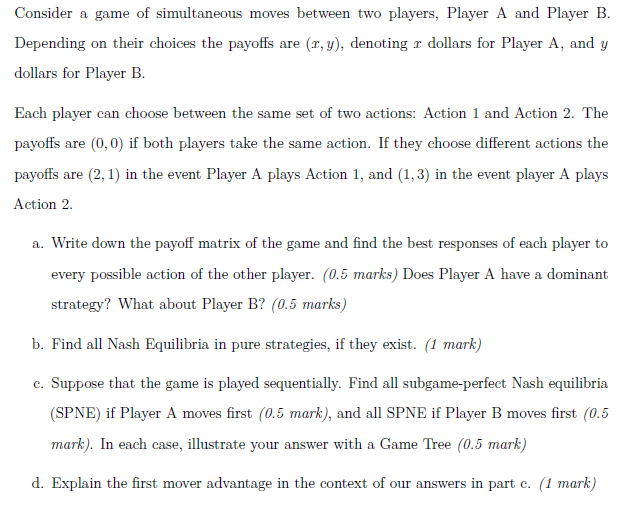
Consider a game of simultaneous moves between two players, Player A and Player B. Depending on their choices the payoffs are (r, y), denoting r dollars for Player A, and y dollars for Player B. Each player can choose between the same set of two actions: Action 1 and Action 2. The payoffs are (0,0) if both players take the same action. If they choose different actions the payoffs are (2, 1) in the event Player A plays Action 1, and (1, 3) in the event player A plays Action 2. a. Write down the payoff matrix of the game and find the best responses of each player to every possible action of the other player. (0.5 marks) Does Player A have a dominant strategy? What about Player B? (0.5 marks) b. Find all Nash Equilibria in pure strategies, if they exist. (1 mark) c. Suppose that the game is played sequentially. Find all subgame-perfect Nash equilibria (SPNE) if Player A moves first (0.5 mark), and all SPNE if Player B moves first (0.5 mark). In each case, illustrate your answer with a Game Tree (0.5 mark) d. Explain the first mover advantage in the context of our answers in part c. (1 mark)
Step by Step Solution
There are 3 Steps involved in it

Get step-by-step solutions from verified subject matter experts