







Question: Background: Morris Saldov conducted a study in Eastern and Central Newfoundland in 1988 to examine public attitudes towards social spending. In particular, the study tried
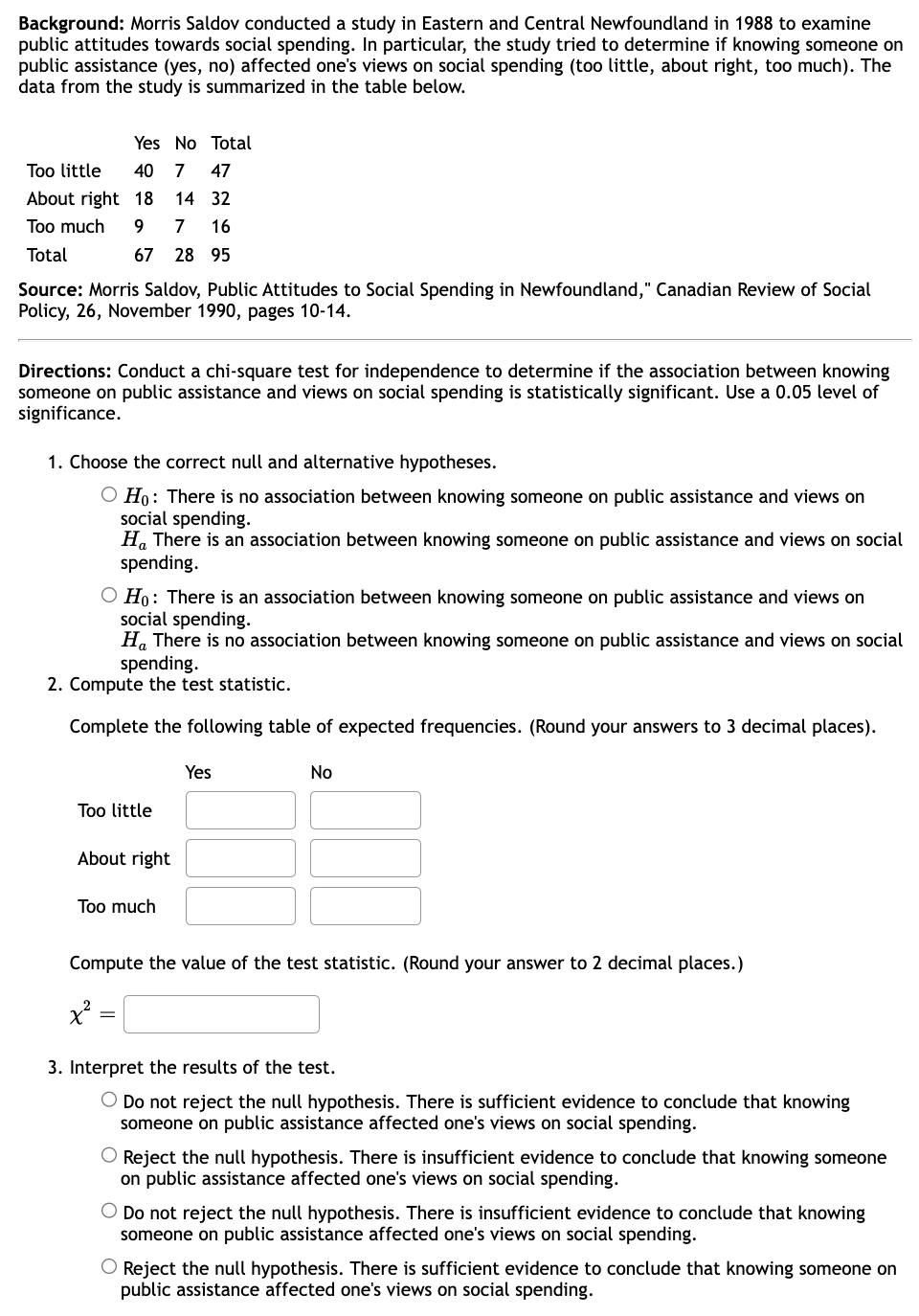
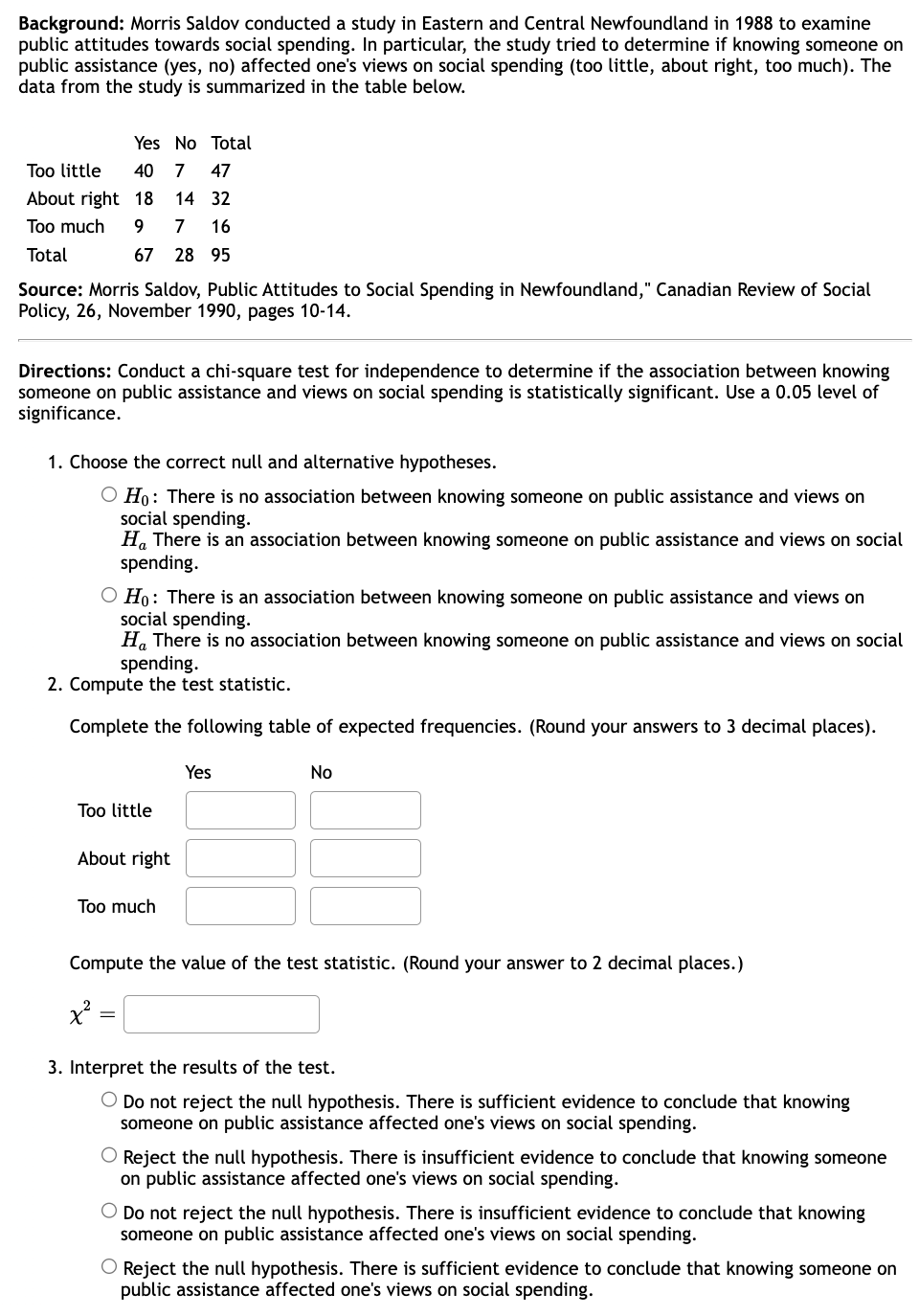
Background: Morris Saldov conducted a study in Eastern and Central Newfoundland in 1988 to examine public attitudes towards social spending. In particular, the study tried to determine if knowing someone on public assistance (yes, no) affected one's views on social spending (too little, about right, too much). The data from the study is summarized in the table below. Yes No Total Too little 4O 7 47 About right 18 14 32 Too much 9 7 16 Total 67 28 95 Source: Morris Saldov, Public Attitudes to Social Spending in Newfoundland," Canadian Review of Social Policy, 26, November 1990, pages 10-14. Directions: Conduct a chi-square test for independence to determine if the association between knowing someone on public assistance and views on social spending is statistically significant. Use a 0.05 level of significance. 1. Choose the correct null and alternative hypotheses. O Ho: There is no association between knowing someone on public assistance and views on social spending. Ha There is an association between knowing someone on public assistance and views on social spending. 0 Ho: There is an association between knowing someone on public assistance and views on social spending. Ha There is no association between knowing someone on public assistance and views on social spending. 2. Compute the test statistic. Complete the following table of expected frequencies. (Round your answers to 3 decimal places). Yes No Too little About right Too much Compute the value of the test statistic. (Round your answer to 2 decimal places.) x2= 3. Interpret the results of the test. '3' Do not reject the null hypothesis. There is sufficient evidence to conclude that knowing someone on public assistance affected one's views on social spending. '3' Reject the null hypothesis. There is insufficient evidence to conclude that knowing someone on public assistance affected one's views on social spending. '3' Do not reject the null hypothesis. There is insufficient evidence to conclude that knowing someone on public assistance affected one's views on social spending. '1-) Reject the null hypothesis. There is sufficient evidence to conclude that knowing someone on public assistance affected one's views on social spending
Step by Step Solution
There are 3 Steps involved in it

Get step-by-step solutions from verified subject matter experts
 Study Help