



Question: Background: ORGANIZING & ORGANIZATION STRUCTURE Q: What are the major steps involved in creating an organizational structure? Once the mission of the organization has been
Background:
ORGANIZING & ORGANIZATION STRUCTURE Q: What are the major steps involved in creating an organizational structure?
Once the mission of the organization has been determined and the objectives and strategies (that need to be accomplished in order to support the mission) have been set:
- Determine the tasks that will have to be performed (in order to accomplish the organization's objectives and strategies).
- Group the tasks in a reasonable manner into jobs. (A "job" is a rational collection of tasks -- or, at least, that's what it's supposed to be!)
- Group the jobs in a reasonable manner into departments (i.e., departmentalize).
ORGANIZATIONS CAN BE DEPARTMENTALIZED IN A NUMBER OF DIFFERENT WAYS, BUT THERE IS BOTH A "CORRECT" WAY TO DEPARTMENTALIZE AND AN "INCORRECT WAY. WHAT SHOULD HAPPEN IS THAT THE ORGANIZATION DEPARTMENTALIZES IN A MANNER THAT IS CONSISTENT WITH THE TYPE OF PRODUCTS AND/OR SERVICES IT IS OFFERING AND THE TYPE OF CUSTOMERS IT IS ATTEMPTING TO REACH (I.E., WHAT IS THE BEST WAY TO MARKET THESE PRODUCTS AND/OR SERVICES?) Product departmentalization is most appropriate when an organization offers a number of products that are similar to each other in some way but dissimilar enough such that different marketing strategies should be used for each product.
Departmentalization by SBU is most appropriate when an organization operates several very different kinds of businessesunder the umbrella of the organization. An example would be an organization that operates, at the same time, a paper products manufacturing business, a pet grooming business, and a management consulting business.
Departmentalization by customer is most appropriate when an organization offers the same product todifferent kinds of customers, such that different marketing strategies should be used for each customer.
Geographical departmentalization is most appropriate when the product being offered by theorganization should be marketed by different strategies in different geographical areas.
Departmentalization by function is most appropropriate for organizations offering a single product in the same fashion to a mass market (e.g., its product is chewing gum). It should be considered a "default" form of departmentalization, to be used only if conditions do not call for the use of product, SBU, customer, geographical, or (please see below) matrix departmentalization.
he matrix structure is most appropriate for organizations that have several "projects" taking place simultaneously and need the flexibility, if the occasion arises, to move its employees from one project to another at a moment's notice. One such candidate for the use of this type of organization structure would be a construction company. Another would be a management consulting firm. The matrix structure is set up much like a grid or a matrix. (The example above represents a 4x4 matrix structure.) In a traditional organization structure, individualsreport to just one boss. In a matrix organization, employees report to both a functional manager and aproject manager.
The video that follows explains how a matrix organization functions and describes its major advantages and disadvantages. Please watch the first seven minutes of the video for this information. THE MATRIX STRUCTURE
Q: What are some of the most important decisions to make in creating a firm's organizational structure?
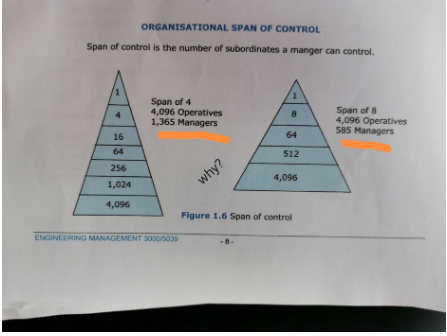
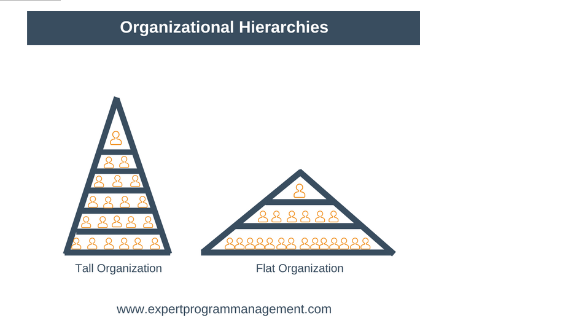
Span of control Span of control refers to the number of direct subordinates a manager has. Typically, a manager should have a narrow span of control (a small number of subordinates) if the job responsibilities they perform are fairly complex and subject to change. By the same token, a manager whose subordinates'job responsibilities are fairly repetitive and non-complex may be able to effectively supervise larger numbers of employees (i.e., may be able to have a wide span of control). An organization characterized primarily by narrow spans of control will result in a structure called a "tall" organization.An organization characterized primarily by wide spans of control will result in a structure called a "flat" organization. Degree of centralization A"centralized organization" is characterized by most of the decision making in the organizationperformed by managers, withvery little autonomy given to their subordinates. A "decentralized organization"is characterized by much of the decision making delegatedby managersto their subordinates. Generally speaking, managers should delegate ("push") decision making to lower levels only when: (1) the subordinates are "up to it," (i.e., possess the knowledge, skills, and abilities needed to make these decisions), and (2) are willing to accept these responsibilities.
What are some of the more important principles of organizing to keep in mind?
- The "unity of direction" principle -- all decisions made and actions taken within the organization must be consistent with the organization's mission
- The "unity of command" principle -- an employee should have but one direct supervisor at the same time (the one major exception being the matrix organization
- The "parity" principle -- managers must make sure, in delegating ("pushing") responsibilities downward to their subordinates, that they give these subordinates sufficient authority to carry out these responsibilities
And finally, keeping in mind that a firm's "organizational chart" is a visual representation of its structure -- Why is it that all organizations should develop and maintain an organizational chart?
Please Answer the questions below :
Question 13A: Please respond to each of the following questions.
- What type of departmentalization is shown in the image below?
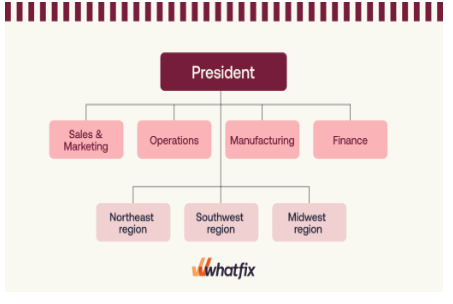
President Sales & Operations Manufacturing Finance Marketing Northeast Southwest Midwest region region region WhatfixORGANISATIONAL SPAN OF CONTROL Span of control is the number of subordinates a manger can control. Span of 4 4,096 Operatives Span of 8 1,365 Managers 4,096 Operatives 64 585 Managers 16 64 512 256 why? 4,096 1, 024 1,096 Figure 1.6 Span of control ENGINEERING MANAGEMENT 30506039\f
Step by Step Solution
There are 3 Steps involved in it

Get step-by-step solutions from verified subject matter experts