







Question: Backwards #3 Given a discrete time system, time normally moves forwards in the sense that the system may start at a time k =
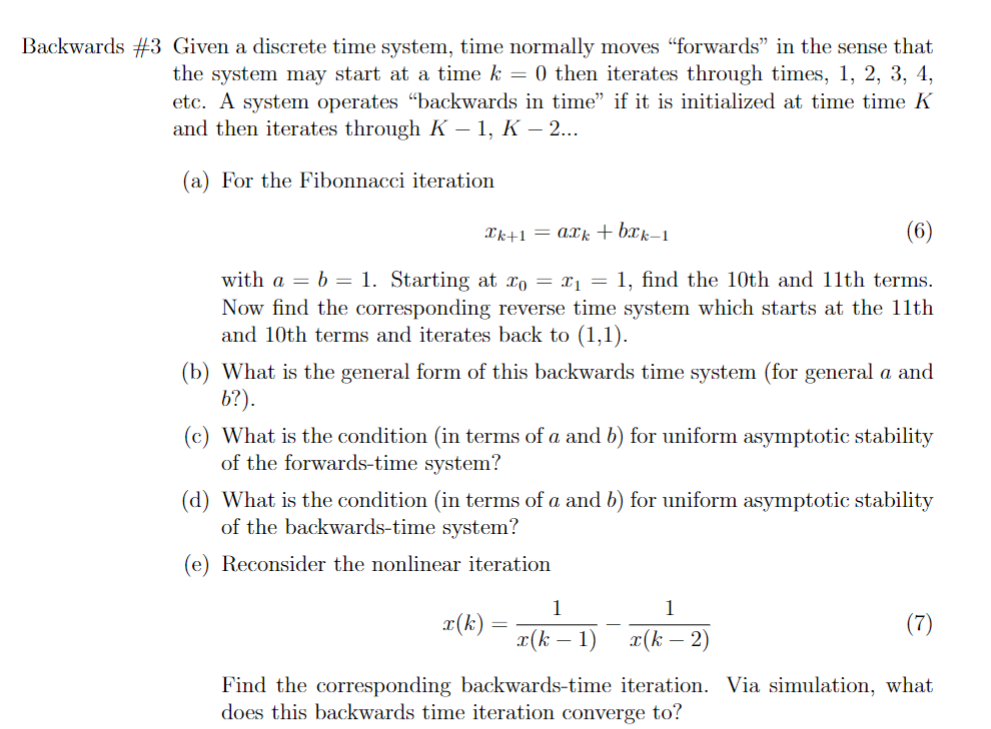
Backwards #3 Given a discrete time system, time normally moves "forwards" in the sense that the system may start at a time k = 0 then iterates through times, 1, 2, 3, 4, etc. A system operates "backwards in time" if it is initialized at time time K and then iterates through K - 1, K 2... (a) For the Fibonacci iteration xk+1 = axk+bk1 (6) with a = b = 1. Starting at x0 = x = 1, find the 10th and 11th terms. Now find the corresponding reverse time system which starts at the 11th and 10th terms and iterates back to (1,1). (b) What is the general form of this backwards time system (for general a and b?). (c) What is the condition (in terms of a and b) for uniform asymptotic stability of the forwards-time system? (d) What is the condition (in terms of a and b) for uniform asymptotic stability of the backwards-time system? (e) Reconsider the nonlinear iteration x(k) = 1 1 x(k 1) x(k-2) Find the corresponding backwards-time iteration. Via simulation, what does this backwards time iteration converge to?
Step by Step Solution
There are 3 Steps involved in it

Get step-by-step solutions from verified subject matter experts
 Study Help