







Question: based of this article : 3 point based paragraphs as the points support to the main idea of The Transition from beauty to ugliness Rose's
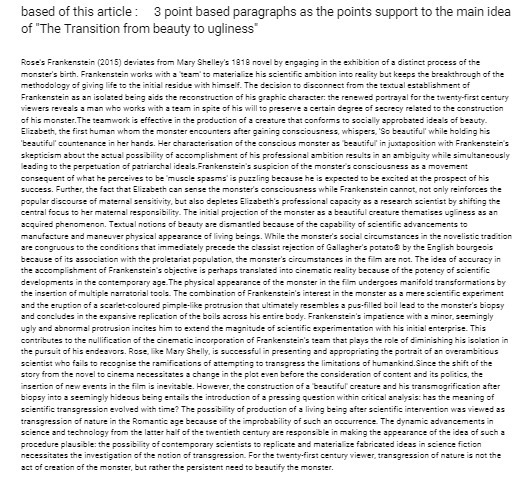
based of this article : 3 point based paragraphs as the points support to the main idea of "The Transition from beauty to ugliness Rose's Frankenstein (2015) deviates from Mary Shelley's 1818 novel by engaging in the exhibition of a distinct process of the monster's birth. Frankenstein works with a team' to materialize his scientific ambition into reality but keeps the breakthrough of the methodology of giving life to the initial residue with himself. The decision to disconnect from the textual establishment of Frankenstein as an isolated being aids the reconstruction of his graphic character: the renewed portrayal for the twenty-first century newers reveals a man who works with a team in spite of his will to preserve a certain degree of secrecy related to the construction of his monster. The teamwork is effective in the production of a creature that conforms to socially approbated idea's of beauty. Elizabeth, the first human whom the monster encounters after gaining consciousness, whispers, 'So beautiful' while holding his beautiful' countenance in her hands. Her characterisation of the conscious monster as 'beautiful in juxtaposition with Frankenstein's skepticism about the actual possibility of accomplishment of his professional ambition results in an ambiguity while simultaneously leading to the perpetuation of patriarchal ideals. Frankenstein's suspicion of the monster's consciousness as a movement consequent of what he perceives to be "muscle spasms' is puzzling because he is expected to be excited at the prospect of his success. Further, the fact that Elizabeth can sense the monster's consciousness while Frankenstein cannot, not only reinforces the popular discourse of matera sensitivity, but also depletes Elizabeth's professional capacity as a research scientist by shifting the central focus to her maternal responsibility. The initial projection of the monster as a beautiful creature thematises ugliness as an acquired phenomenon. Textual notions of beauty are dismantled because of the capability of scientific advancements to manufacture and maneuver physical appearance of living beings. While the monster's social circumstances in the novelistic tradition are congruous to the conditions that immediately precede the classist rejection of Gallagher's potato@ by the English bourgeois because of its association with the proletariat population, the monster's circumstances in the film are not. The idea of accuracy in the accomplishment of Frankenstein's objective is perhaps translated into cinematic reality because of the potency of scientific developments in the contemporary age. The physical appearance of the monster in the film undergoes manifold transformations by the insertion of multiple narratorial tools. The combination of Frankenstein's interest in the monster as a mere scientific experiment and the eruption of a scarlet-coloured pimple-like protrusion that ultimately resembles a pus-filled boil lead to the monster's biopsy and concludes in the expansive replication of the boils across his entire body. Frankenstein's impatience with a minor, seemingly ugly and abnormal protrusion incites him to extend the magnitude of scientific experimentation with his initial enterprise. This contributes to the nullification of the cinematic incorporation of Frankenstein's team that plays the role of diminishing his isolation in the pursuit of his endeavors. Rose, like Mary Shelly, is successful in presenting and appropriating the portrait of an overambitious scientist who fails to recognise the ramifications of attempting to transgress the limitations of humankind. Since the shift of the story from the novel to cinema necessitates a change in the plot even before the consideration of content and its politics, the insertion of new events in the film is inevitable. However, the construction of a beautiful creature and his transmogrification after biopsy into a seemingly hideous being entails the introduction of a pressing question within critical analysis: has the meaning of scientific transgression evolved with time? The possibity of production of a living being after scientific intervention was viewed as transgression of nature in the Romantic age because of the improbability of such an occurrence. The dynamic advancements in science and technology from the latter half of the twentieth century are responsible in making the appearance of the idea of such a procedure plausible: the possibility of contemporary scientists to replicate and materialize fabricated ideas in science fiction necessitates the investigation of the notion of transgression. For the twenty-first century viewer, transgression of nature is not the act of creation of the monster, but rather the persistent need to beautify the monster
Step by Step Solution
There are 3 Steps involved in it

Get step-by-step solutions from verified subject matter experts
 Study Help