- Based on information available, assess the general strategic planning approach/process used by each of the healthcare organizations:
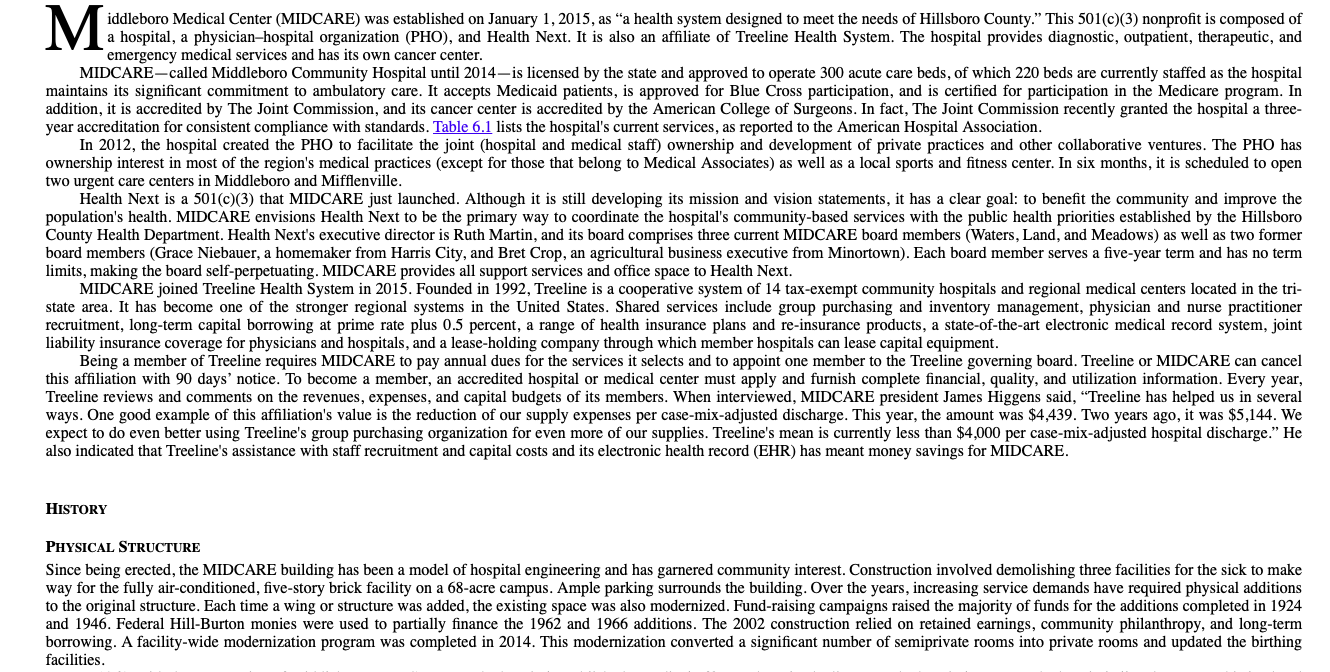
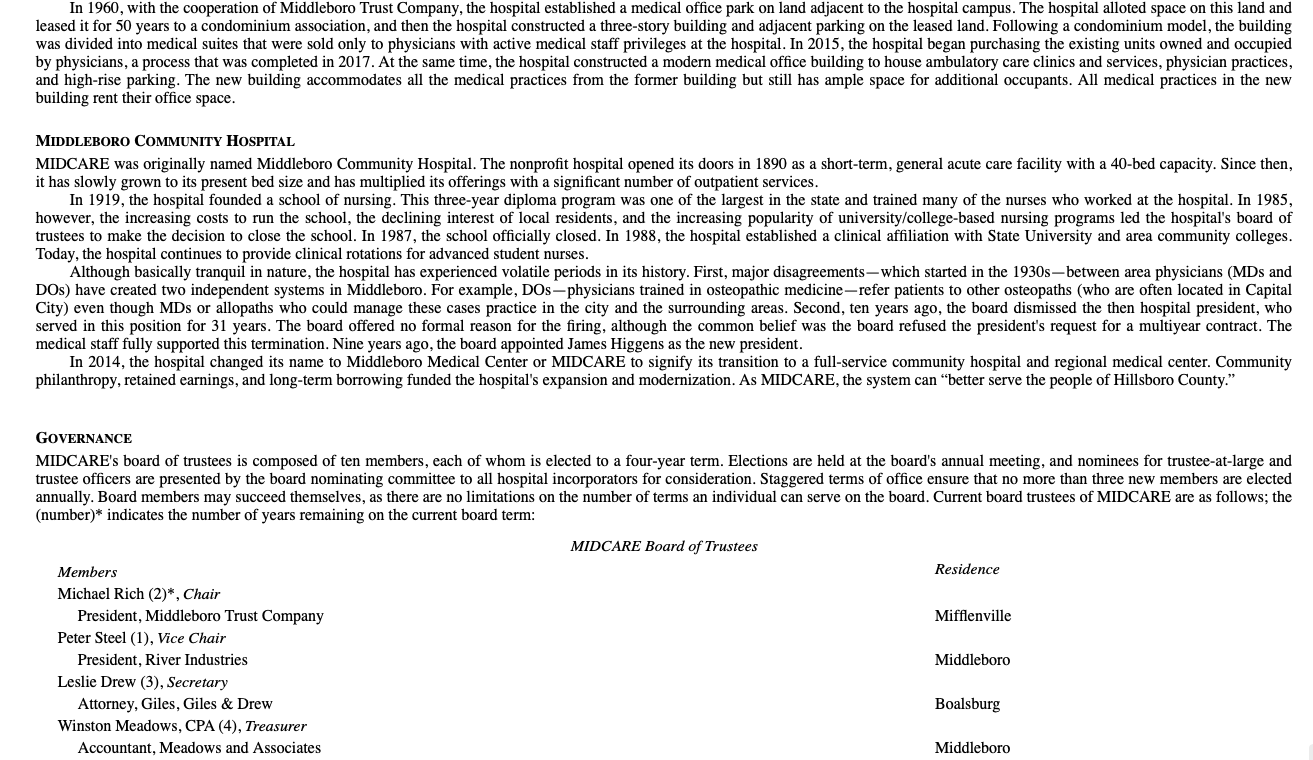
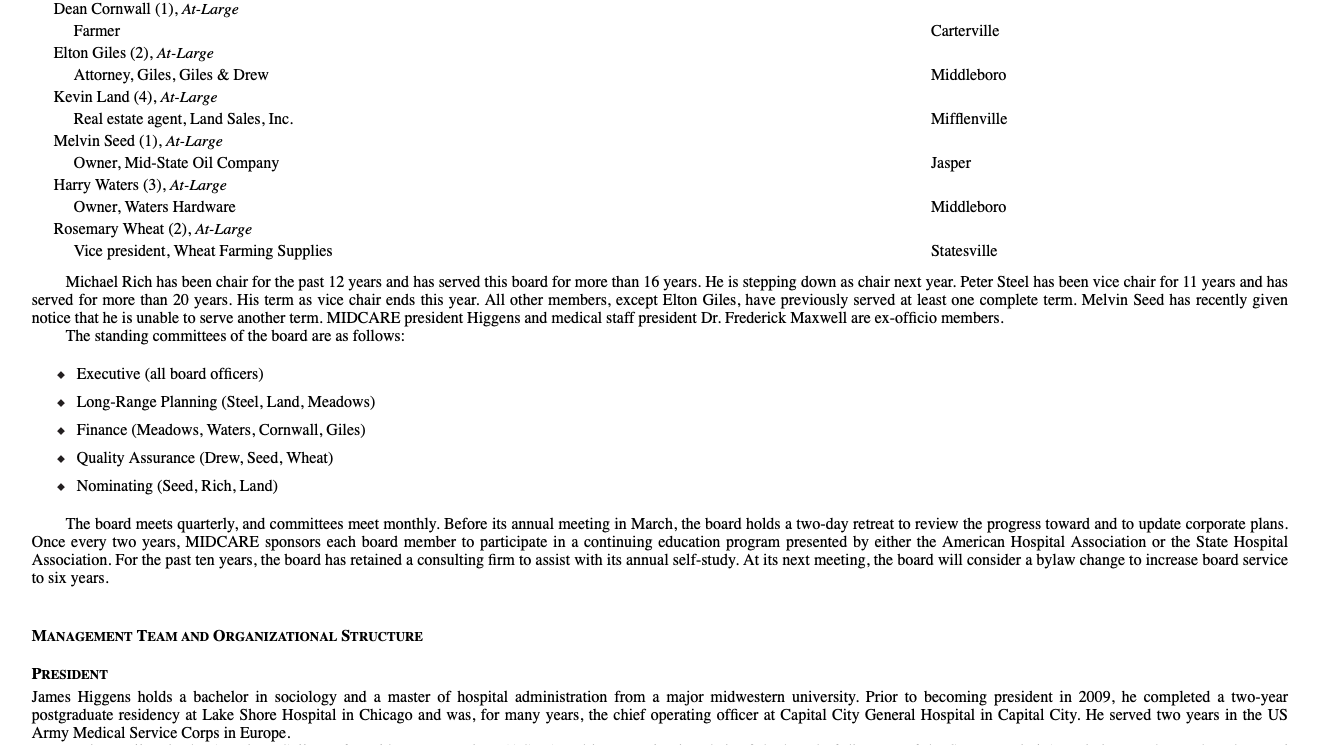
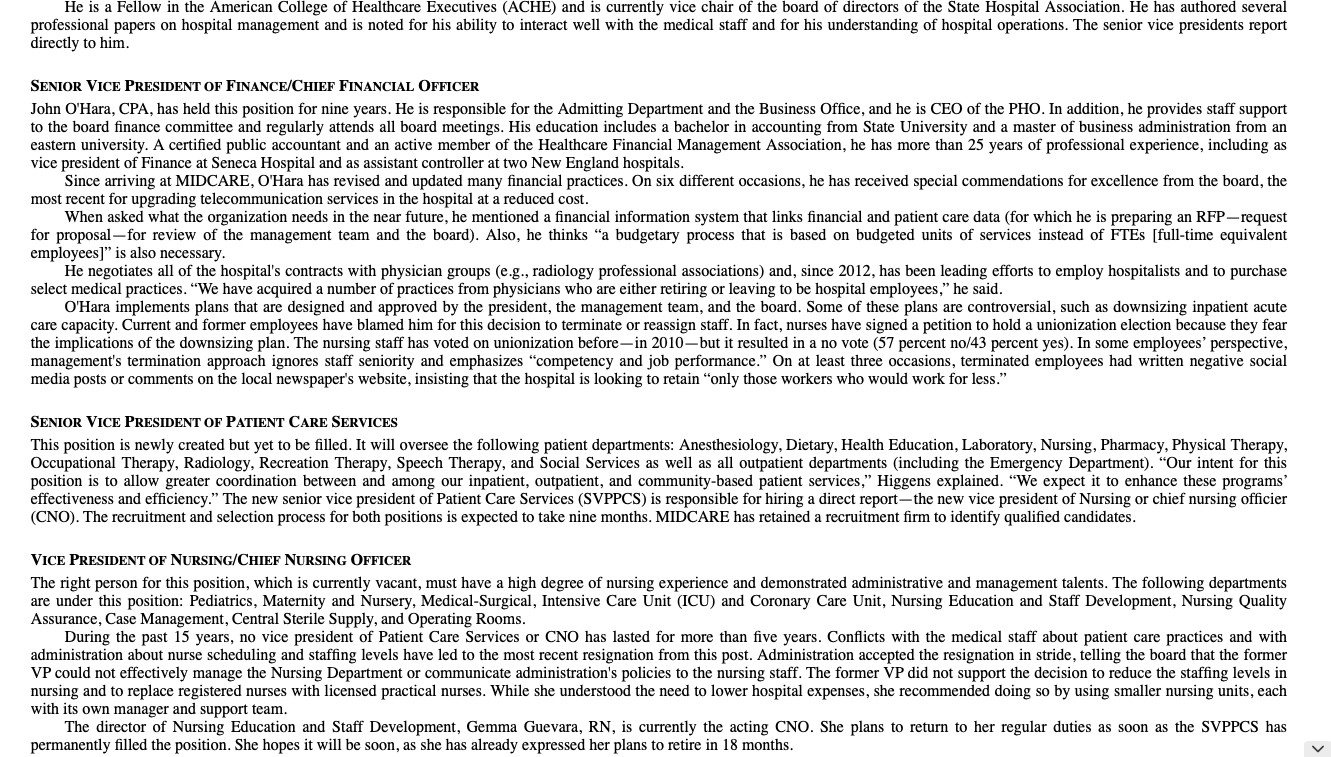
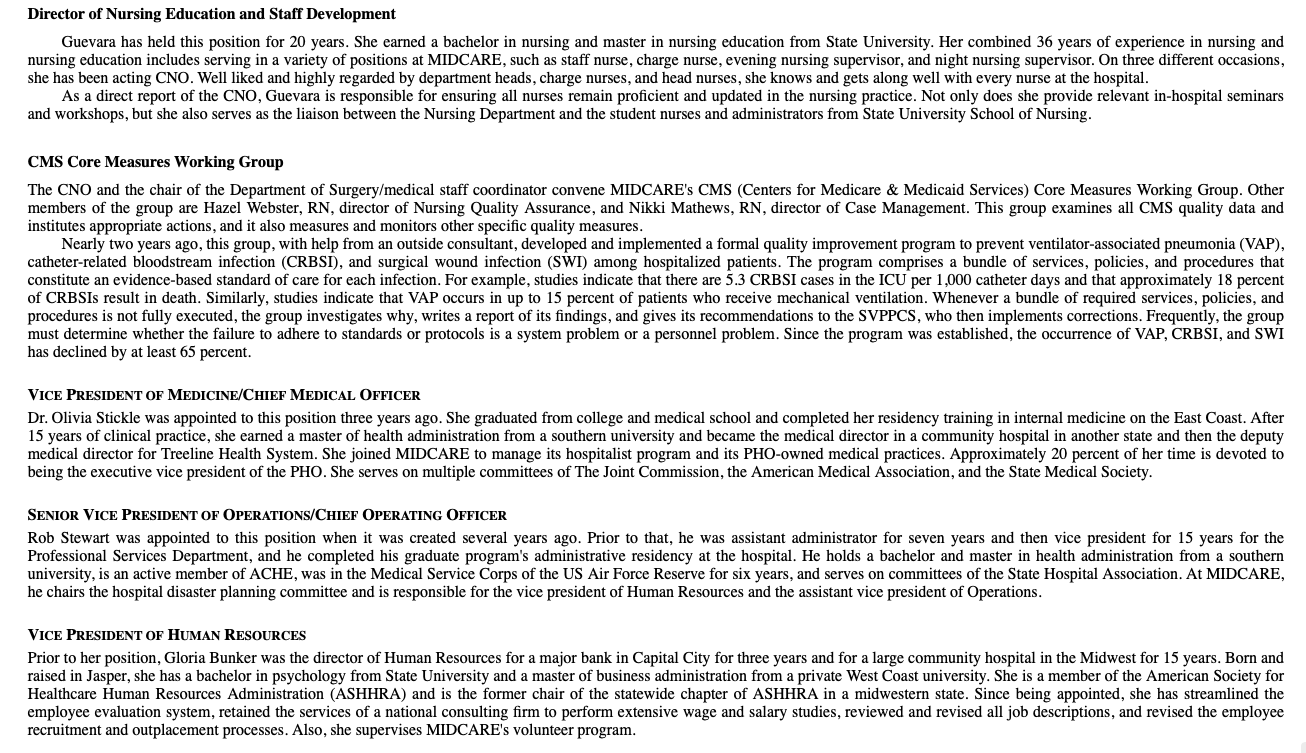
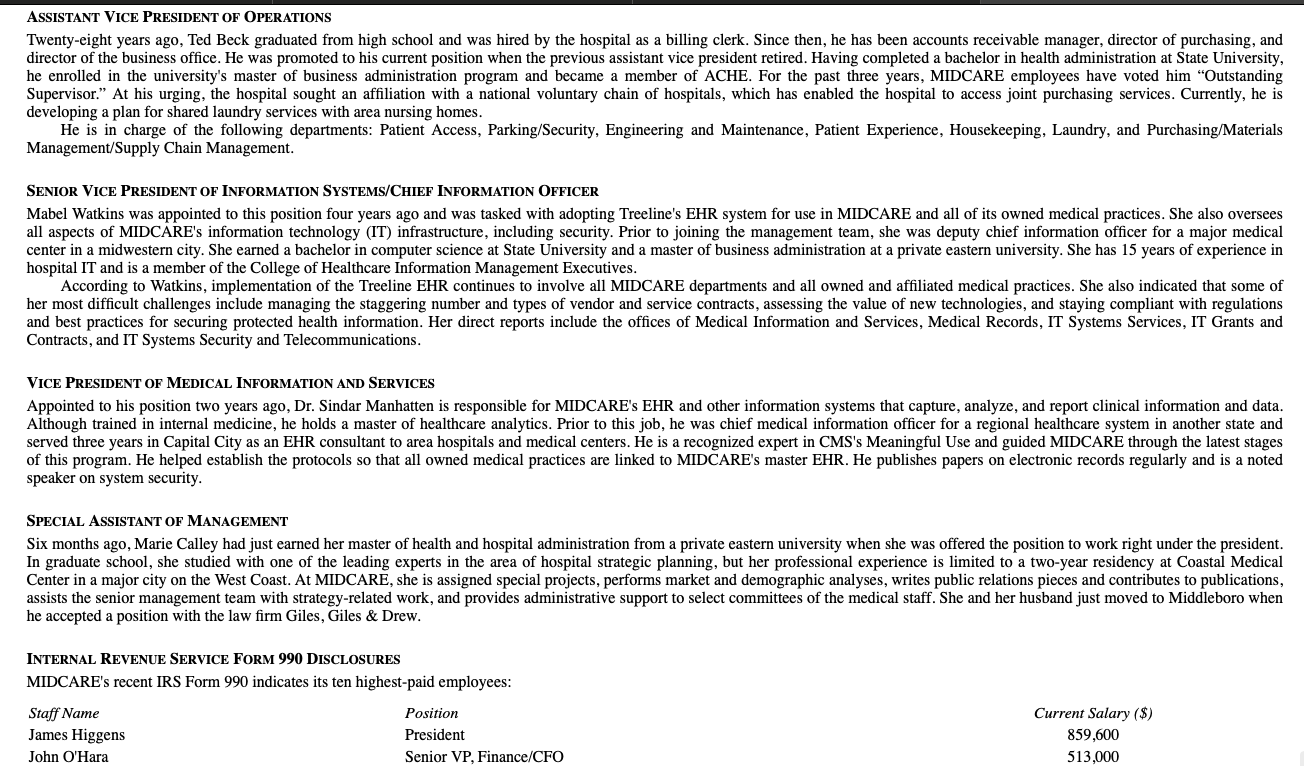
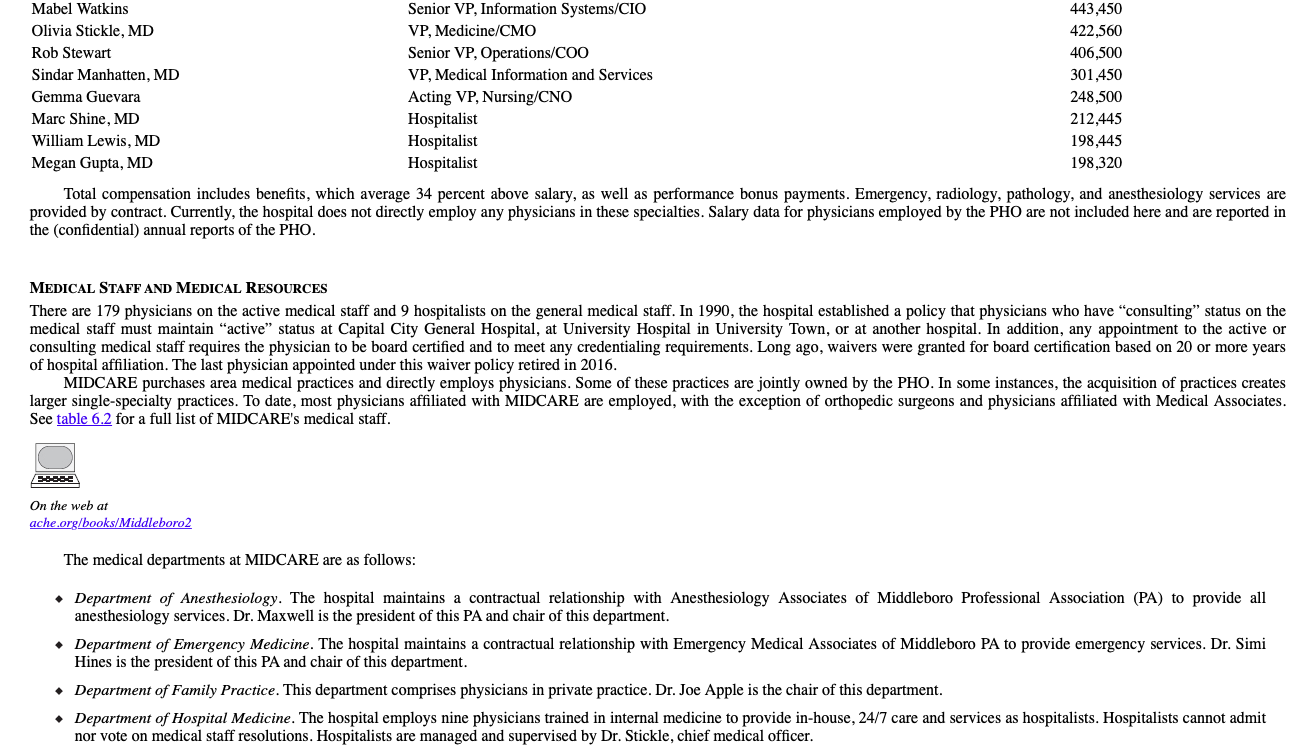
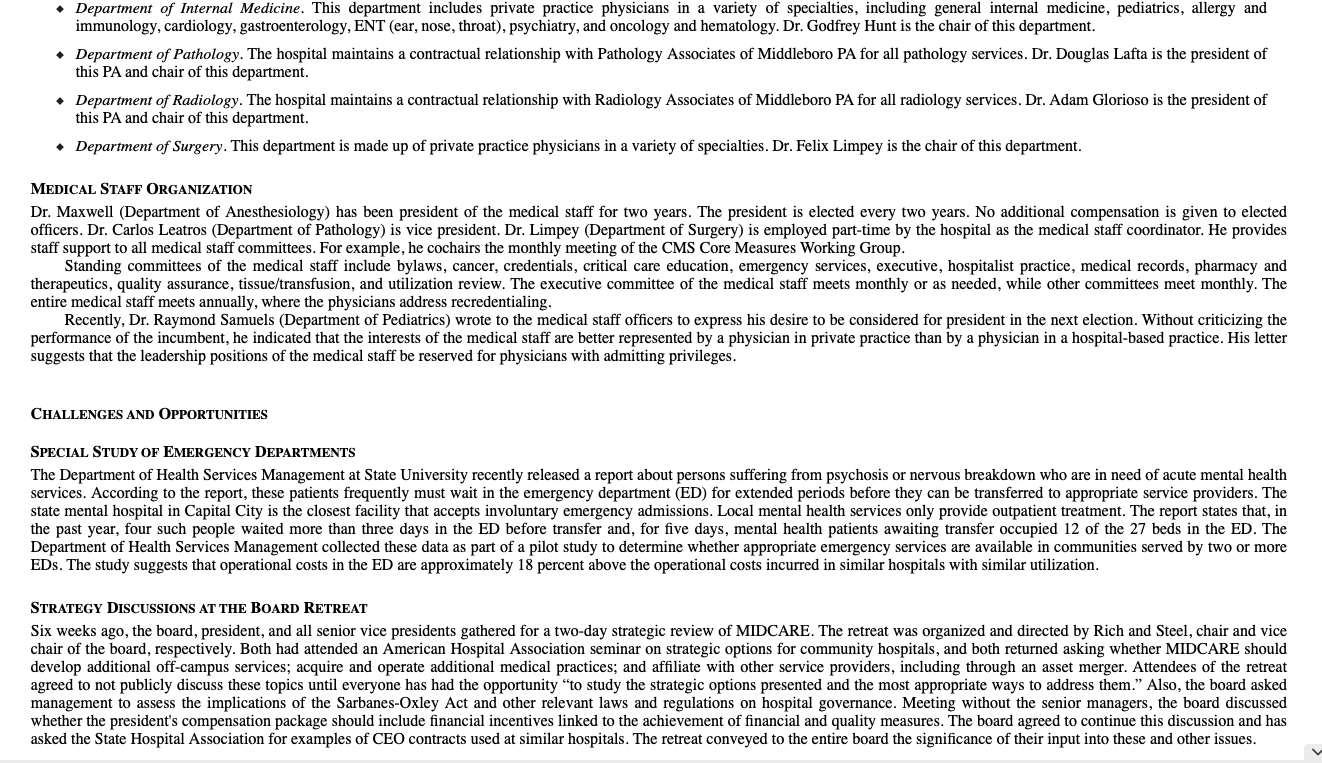
M iddleboro Medical Center (MIDCARE) was established on January 1, 2015, as "a health system designed to meet the needs of Hillsboro County." This 501(c)(3) nonprofit is composed of a hospital, a physician-hospital organization (PHO), and Health Next. It is also an affiliate of Treeline Health System. The hospital provides diagnostic, outpatient, therapeutic, and emergency medical services and has its own cancer center. MIDCARE-called Middleboro Community Hospital until 2014 is licensed by the state and approved to operate 300 acute care beds, of which 220 beds are currently staffed as the hospital maintains its significant commitment to ambulatory care. It accepts Medicaid patients, is approved for Blue Cross participation, and is certified for participation in the Medicare program. In addition, it is accredited by The Joint Commission, and its cancer center is accredited by the American College of Surgeons. In fact, The Joint Commission recently granted the hospital a three- year accreditation for consistent compliance with standards. Table 6.1 lists the hospital's current services, as reported to the American Hospital Association. In 2012, the hospital created the PHO to facilitate the joint (hospital and medical staff) ownership and development of private practices and other collaborative ventures. The PHO has ownership interest in most of the region's medical practices (except for those that belong to Medical Associates) as well as a local sports and fitness center. In six months, it is scheduled to open two urgent care centers in Middleboro and Mifflenville. Health Next is a 501(c)(3) that MIDCARE just launched. Although it is still developing its mission and vision statements, it has a clear goal: to benefit the community and improve the population's health. MIDCARE envisions Health Next to be the primary way to coordinate the hospital's community-based services with the public health priorities established by the Hillsboro County Health Department. Health Next's executive director is Ruth Martin, and its board comprises three current MIDCARE board members (Waters, Land, and Meadows) as well as two former board members (Grace Niebauer, a homemaker from Harris City, and Bret Crop, an agricultural business executive from Minortown). Each board member serves a five-year term and has no term limits, making the board self-perpetuating. MIDCARE provides all support services and office space to Health Next. MIDCARE joined Treeline Health System in 2015. Founded in 1992, Treeline is a cooperative system of 14 tax-exempt community hospitals and regional medical centers located in the tri- state area. It has become one of the stronger regional systems in the United States. Shared services include group purchasing and inventory management, physician and nurse practitioner recruitment, long-term capital borrowing at prime rate plus 0.5 percent, a range of health insurance plans and re-insurance products, a state-of-the-art electronic medical record system, joint liability insurance coverage for physicians and hospitals, and a lease-holding company through which member hospitals can lease capital equipment. Being a member of Treeline requires MIDCARE to pay annual dues for the services it selects and to appoint one member to the Treeline governing board. Treeline or MIDCARE can cancel this affiliation with 90 days' notice. To become a member, an accredited hospital or medical center must apply and furnish complete financial, quality, and utilization information. Every year, Treeline reviews and comments on the revenues, expenses, and capital budgets of its members. When interviewed, MIDCARE president James Higgens said, Treeline has helped us in several ways. One good example of this affiliation's value is the reduction of our supply expenses per case-mix-adjusted discharge. This year, the amount was $4,439. Two years ago, it was $5,144. We expect to do even better using Treeline's group purchasing organization for even more of our supplies. Treeline's mean is currently less than $4,000 per case-mix-adjusted hospital discharge." He also indicated that Treeline's assistance with staff recruitment and capital costs and its electronic health record (EHR) has meant money savings for MIDCARE. HISTORY PHYSICAL STRUCTURE Since being erected, the MIDCARE building has been a model of hospital engineering and has garnered community interest. Construction involved demolishing three facilities for the sick to make way for the fully air-conditioned, five-story brick facility on a 68-acre campus. Ample parking surrounds the building. Over the years, increasing service demands have required physical additions to the original structure. Each time a wing or structure was added, the existing space was also modernized. Fund-raising campaigns raised the majority of funds for the additions completed in 1924 and 1946. Federal Hill-Burton monies were used to partially finance the 1962 and 1966 additions. The 2002 construction relied on retained earnings, community philanthropy, and long-term borrowing. A facility-wide modernization program was completed in 2014. This modernization converted a significant number of semiprivate rooms into private rooms and updated the birthing facilities. In 1960, with the cooperation of Middleboro Trust Company, the hospital established a medical office park on land adjacent to the hospital campus. The hospital alloted space on this land and leased it for 50 years to a condominium association, and then the hospital constructed a three-story building and adjacent parking on the leased land. Following a condominium model, the building was divided into medical suites that were sold only to physicians with active medical staff privileges at the hospital. In 2015, the hospital began purchasing the existing units owned and occupied by physicians, a process that was completed in 2017. At the same time, the hospital constructed a modern medical office building to house ambulatory care clinics and services, physician practices, and high-rise parking. The new building accommodates all the medical practices from the former building but still has ample space for additional occupants. All medical practices in the new building rent their office space. MIDDLEBORO COMMUNITY HOSPITAL MIDCARE was originally named Middleboro Community Hospital. The nonprofit hospital opened its doors in 1890 as a short-term, general acute care facility with a 40-bed capacity. Since then, it has slowly grown to its present bed size and has multiplied its offerings with a significant number of outpatient services. In 1919, the hospital founded a school of nursing. This three-year diploma program was one of the largest in the state and trained many of the nurses who worked at the hospital. In 1985, however, the increasing costs to run the school, the declining interest of local residents, and the increasing popularity of university/college-based nursing programs led the hospital's board of trustees to make the decision to close the school. In 1987, the school officially closed. In 1988, the hospital established a clinical affiliation with State University and area community colleges. Today, the hospital continues to provide clinical rotations for advanced student nurses. Although basically tranquil in nature, the hospital has experienced volatile periods in its history. First, major disagreements, which started in the 1930s-between area physicians (MDs and DOs) have created two independent systems in Middleboro. For example, Dos-physicians trained in osteopathic medicine-refer patients to other osteopaths (who are often located in Capital City) even though MDs or allopaths who could manage these cases practice in the city and the surrounding areas. Second, ten years ago, the board dismissed the then hospital president, who served in this position for 31 years. The board offered no formal reason for the firing, although the common belief was the board refused the president's request for a multiyear contract. The medical staff fully supported this termination. Nine years ago, the board appointed James Higgens as the new president. In 2014, the hospital changed its name to Middleboro Medical Center or MIDCARE to signify its transition to a full-service community hospital and regional medical center. Community philanthropy, retained earnings, and long-term borrowing funded the hospital's expansion and modernization. As MIDCARE, the system can "better serve the people of Hillsboro County." GOVERNANCE MIDCARE's board of trustees is composed of ten members, each of whom is elected to a four-year term. Elections are held at the board's annual meeting, and nominees for trustee-at-large and trustee officers are presented by the board nominating committee to all hospital incorporators for consideration. Staggered terms of office ensure that no more than three new members are elected annually. Board members may succeed themselves, as there are no limitations on the number of terms an individual can serve on the board. Current board trustees of MIDCARE are as follows; the (number)* indicates the number of years remaining on the current board term: MIDCARE Board of Trustees Members Residence Michael Rich (2)*, Chair President, Middleboro Trust Company Mifflenville Peter Steel (1), Vice Chair President, River Industries Middleboro Leslie Drew (3), Secretary Attorney, Giles, Giles & Drew Boalsburg Winston Meadows, CPA (4), Treasurer Accountant, Meadows and Associates Middleboro Dean Cornwall (1), At-Large Farmer Carterville Elton Giles (2), At-Large Attorney, Giles, Giles & Drew Middleboro Kevin Land (4), At-Large Real estate agent, Land Sales, Inc. Mifflenville Melvin Seed (1), At-Large Owner, Mid-State Oil Company Jasper Harry Waters (3), At-Large Owner, Waters Hardware Middleboro Rosemary Wheat (2), At-Large Vice president, Wheat Farming Supplies Statesville Michael Rich has been chair for the past 12 years and has served this board for more than 16 years. He is stepping down as chair next year. Peter Steel has been vice chair for 11 years and has served for more than 20 years. His term as vice chair ends this year. All other members, except Elton Giles, have previously served at least one complete term. Melvin Seed has recently given notice that he is unable to serve another term. MIDCARE president Higgens and medical staff president Dr. Frederick Maxwell are ex-officio members. The standing committees of the board are as follows: Executive (all board officers) Long-Range Planning (Steel, Land, Meadows) Finance (Meadows, Waters, Cornwall, Giles) Quality Assurance (Drew, Seed, Wheat) Nominating (Seed, Rich, Land) The board meets quarterly, and committees meet monthly. Before its annual meeting in March, the board holds a two-day retreat to review the progress toward and to update corporate plans. Once every two years, MIDCARE sponsors each board member to participate in a continuing education program presented by either the American Hospital Association or the State Hospital Association. For the past ten years, the board has retained a consulting firm to assist with its annual self-study. At its next meeting, the board will consider a bylaw change to increase board service to six years. MANAGEMENT TEAM AND ORGANIZATIONAL STRUCTURE PRESIDENT James Higgens holds a bachelor in sociology and a master of hospital administration from a major midwestern university. Prior to becoming president in 2009, he completed a two-year postgraduate residency at Lake Shore Hospital in Chicago and was, for many years, the chief operating officer at Capital City General Hospital in Capital City. He served two years in the US Army Medical Service Corps in Europe. He is a Fellow in the American College of Healthcare Executives (ACHE) and is currently vice chair of the board of directors of the State Hospital Association. He has authored several professional papers on hospital management and is noted for his ability to interact well with the medical staff and for his understanding of hospital operations. The senior vice presidents report directly to him. SENIOR VICE PRESIDENT OF FINANCE/CHIEF FINANCIAL OFFICER John O'Hara, CPA, has held this position for nine years. He is responsible for the Admitting Department and the Business Office, and he is CEO of the PHO. In addition, he provides staff support to the board finance committee and regularly attends all board meetings. His education includes a bachelor in accounting from State University and a master of business administration from an eastern university. A certified public accountant and an active member of the Healthcare Financial Management Association, he has more than 25 years of professional experience, including as vice president of Finance at Seneca Hospital and as assistant controller at two New England hospitals. Since arriving at MIDCARE, O'Hara has revised and updated many financial practices. On six different occasions, he has received special commendations for excellence from the board, the most recent for upgrading telecommunication services in the hospital at a reduced cost. When asked what the organization needs in the near future, he mentioned a financial information system that links financial and patient care data (for which he is preparing an RFP-request for proposal - for review of the management team and the board). Also, he thinks "a budgetary process that is based on budgeted units of services instead of FTES [full-time equivalent employees)" is also necessary. He negotiates all of the hospital's contracts with physician groups (e.g., radiology professional associations) and, since 2012, has been leading efforts to employ hospitalists and to purchase select medical practices. We have acquired a number of practices from physicians who are either retiring or leaving to be hospital employees," he said. O'Hara implements plans that are designed and approved by the president, the management team, and the board. Some of these plans are controversial, such as downsizing inpatient acute care capacity. Current and former employees have blamed him for this decision to terminate or reassign staff. In fact, nurses have signed a petition to hold a unionization election because they fear the implications of the downsizing plan. The nursing staff has voted on unionization before-in 2010but it resulted in a no vote (57 percent no/43 percent yes). In some employees' perspective, management's termination approach ignores staff seniority and emphasizes "competency and job performance. On at least three occasions, terminated employees had written negative social media posts or comments on the local newspaper's website, insisting that the hospital is looking to retain "only those workers who would work for less." SENIOR VICE PRESIDENT OF PATIENT CARE SERVICES This position is newly created but yet to be filled. It will oversee the following patient departments: Anesthesiology, Dietary, Health Education, Laboratory, Nursing, Pharmacy, Physical Therapy, Occupational Therapy, Radiology, Recreation Therapy, Speech Therapy, and as well as all outpatient departments (including the Emergency Department). "Our intent for this position is to allow greater coordination between and among our inpatient, outpatient, and community-based patient services," Higgens explained. "We expect it to enhance these programs effectiveness and efficiency." The new senior vice president of Patient Care Services (SVPPCS) is responsible for hiring a direct reportthe new vice president of Nursing or chief nursing officier (CNO). The recruitment and selection process for both positions is expected to take nine months. MIDCARE has retained a recruitment firm to identify qualified candidates. VICE PRESIDENT OF NURSING/CHIEF NURSING OFFICER The right person for this position, which is currently vacant, must have a high degree of nursing experience and demonstrated administrative and management talents. The following departments are under this position: Pediatrics, Maternity and Nursery, Medical-Surgical, Intensive Care Unit (ICU) and Coronary Care Unit, Nursing Education and Staff Development, Nursing Quality Assurance, Case Management, Central Sterile Supply, and Operating Rooms. During the past 15 years, no vice president of Patient Care Services or CNO has lasted for more than five years. Conflicts with the medical staff about patient care practices and with administration about nurse scheduling and staffing levels have led to the most recent resignation from this post. Administration accepted the resignation in stride, telling the board that the former VP could not effectively manage the Nursing Department or communicate administration's policies to the nursing staff. The former VP did not support the decision to reduce the staffing levels in nursing and to replace registered nurses with licensed practical nurses. While she understood the need to lower hospital expenses, she recommended doing so by using smaller nursing units, each with its own manager and support team. The director of Nursing Education and Staff Development, Gemma Guevara, RN, is currently the acting CNO. She plans to return to her regular duties as soon as the SVPPCS has permanently filled the position. She hopes it will be soon, as she has already expressed her plans to retire in 18 months. Director of Nursing Education and Staff Development Guevara has held this position for 20 years. She earned a bachelor in nursing and master in nursing education from State University. Her combined 36 years of experience in nursing and nursing education includes serving in a variety of positions at MIDCARE, such as staff nurse, charge nurse, evening nursing supervisor, and night nursing supervisor. On three different occasions, she has been acting CNO. Well liked and highly regarded by department heads, charge nurses, and head nurses, she knows and gets along well with every nurse at the hospital. As a direct report of the CNO, Guevara is responsible for ensuring all nurses remain proficient and updated in the nursing practice. Not only does she provide relevant in-hospital seminars and workshops, but she also serves as the liaison between the Nursing Department and the student nurses and administrators from State University School of Nursing. CMS Core Measures Working Group The CNO and the chair of the Department of Surgery/medical staff coordinator convene MIDCARE's CMS (Centers for Medicare & Medicaid Services) Core Measures Working Group. Other members of the group are Hazel Webster, RN, director of Nursing Quality Assurance, and Nikki Mathews, RN, director of Case Management. This group examines all CMS quality data and institutes appropriate actions, and it also measures and monitors other specific quality measures. Nearly two years ago, this group, with help from an outside consultant, developed and implemented a formal quality improvement program to prevent ventilator-associated pneumonia (VAP), catheter-related bloodstream infection (CRBSI), and surgical wound infection (SWI) among hospitalized patients. The program comprises a bundle of services, policies, and procedures that constitute an evidence-based standard of care for each infection. For example, studies indicate that there are 5.3 CRBSI cases in the ICU per 1,000 catheter days and that approximately 18 percent of CRBSIs result in death. Similarly, studies indicate that VAP occurs in up to 15 percent of patients who receive mechanical ventilation. Whenever a bundle of required services, policies, and procedures is not fully executed, the group investigates why, writes a report of its findings, and gives its recommendations to the SVPPCS, who then implements corrections. Frequently, the group must determine whether the failure to adhere to standards or protocols is a system problem or a personnel problem. Since the program was established, the occurrence of VAP, CRBSI, and SWI has declined by at least 65 percent. VICE PRESIDENT OF MEDICINE/CHIEF MEDICAL OFFICER Dr. Olivia Stickle was appointed to this position three years ago. She graduated from college and medical school and completed her residency training in internal medicine on the East Coast. After 15 years of clinical practice, she earned a master of health administration from a southern university and became the medical director in a community hospital in another state and then the deputy medical director for Treeline Health System. She joined MIDCARE to manage its hospitalist program and its PHO-owned medical practices. Approximately 20 percent of her time is devoted to being the executive vice president of the PHO. She serves on multiple committees of The Joint Commission, the American Medical Association, and the State Medical Society. SENIOR VICE PRESIDENT OF OPERATIONS/CHIEF OPERATING OFFICER Rob Stewart was appointed to this position when it was created several years ago. Prior to that, he was assistant administrator for seven years and then vice president for 15 years for the Professional Services Department, and he completed his graduate program's administrative residency at the hospital. He holds a bachelor and master in health administration from a southern university, is an active member of ACHE, was in the Medical Service Corps of the US Air Force Reserve for six years, and serves on committees of the State Hospital Association. At MIDCARE, he chairs the hospital disaster planning committee and is responsible for the vice president of Human Resources and the assistant vice president of Operations. VICE PRESIDENT OF HUMAN RESOURCES Prior to her position, Gloria Bunker was the director of Human Resources for a major bank in Capital City for three years and for a large community hospital in the Midwest for 15 years. Born and raised in Jasper, she has a bachelor in psychology from State University and a master of business administration from a private West Coast university. She is a member of the American Society for Healthcare Human Resources Administration (ASHHRA) and is the former chair of the statewide chapter of ASHHRA in a midwestern state. Since being appointed, she has streamlined the employee evaluation system, retained the services of a national consulting firm to perform extensive wage and salary studies, reviewed and revised all job descriptions, and revised the employee recruitment and outplacement processes. Also, she supervises MIDCARE's volunteer program. ASSISTANT VICE PRESIDENT OF OPERATIONS Twenty-eight years ago, Ted Beck graduated from high school and was hired by the hospital as a billing clerk. Since then, he has been accounts receivable manager, director of purchasing, and director of the business office. He was promoted to his current position when the previous assistant vice president retired. Having completed a bachelor in health administration at State University, he enrolled in the university's master of business administration program and became a member of ACHE. For the past three years, MIDCARE employees have voted him "Outstanding Supervisor. At his urging, the hospital sought an affiliation with a national voluntary chain of hospitals, which has enabled the hospital to access joint purchasing services. Currently, he is developing a plan for shared laundry services with area nursing homes. He is in charge of the following departments: Patient Access, Parking/Security, Engineering and Maintenance, Patient Experience, Housekeeping, Laundry, and Purchasing/Materials Management/Supply Chain Management. SENIOR VICE PRESIDENT OF INFORMATION SYSTEMS/CHIEF INFORMATION OFFICER Mabel Watkins was appointed to this position four years ago and was tasked with adopting Treeline's EHR system for use in MIDCARE and all of its owned medical practices. She also oversees all aspects of MIDCARE's information technology (IT) infrastructure, including security. Prior to joining the management team, she was deputy chief information officer for a major medical center in a midwestern city. She earned a bachelor in computer science at State University and a master of business administration at a private eastern university. She has 15 years of experience in hospital IT and is a member of the College of Healthcare Information Management Executives. According to Watkins, implementation of the Treeline EHR continues to involve all MIDCARE departments and all owned and affiliated medical practices. She also indicated that some of her most difficult challenges include managing the staggering number and types of vendor and service contracts, assessing the value of new technologies, and staying compliant with regulations and best practices for securing protected health information. Her direct reports include the offices of Medical Information and Services, Medical Records, IT Systems Services, IT Grants and Contracts, and IT Systems Security and Telecommunications. VICE PRESIDENT OF MEDICAL INFORMATION AND SERVICES Appointed to his position two years ago, Dr. Sindar Manhatten is responsible for MIDCARE's EHR and other information systems that capture, analyze, and report clinical information and data. Although trained in internal medicine, he holds a master of healthcare analytics. Prior to this job, he was chief medical information officer for a regional healthcare system in another state and served three years in Capital City as an EHR consultant to area hospitals and medical centers. He is a recognized expert in CMS's Meaningful Use and guided MIDCARE through the latest stages of this program. He helped establish the protocols so that all owned medical practices are linked to MIDCARE's master EHR. He publishes papers on electronic records regularly and is a noted speaker on system security. SPECIAL ASSISTANT OF MANAGEMENT Six months ago, Marie Calley had just earned her master of health and hospital administration from a private eastern university when she was offered the position to work right under the president. In graduate school, she studied with one of the leading experts in the area of hospital strategic planning, but her professional experience is limited to a two-year residency at Coastal Medical Center in a major city on the West Coast. At MIDCARE, she is assigned special projects, performs market and demographic analyses, writes public relations pieces and contributes to publications, assists the senior management team with strategy-related work, and provides administrative support to select committees of the medical staff. She and her husband just moved to Middleboro when he accepted a position with the law firm Giles, Giles & Drew. INTERNAL REVENUE SERVICE FORM 990 DISCLOSURES MIDCARE's recent IRS Form 990 indicates its ten highest-paid employees: Staff Name Position James Higgens President John O'Hara Senior VP, Finance/CFO Current Salary ($) 859,600 513,000 Mabel Watkins Senior VP, Information Systems/CIO 443,450 Olivia Stickle, MD VP, Medicine/CMO 422,560 Rob Stewart Senior VP, Operations/COO 406,500 Sindar Manhatten, MD VP, Medical Information and Services 301,450 Gemma Guevara Acting VP, Nursing/CNO 248,500 Marc Shine, MD Hospitalist 212,445 William Lewis, MD Hospitalist 198,445 Megan Gupta, MD Hospitalist 198,320 Total compensation includes benefits, which average 34 percent above salary, as well as performance bonus payments. Emergency, radiology, pathology, and anesthesiology services are provided by contract. Currently, the hospital does not directly employ any physicians in these specialties. Salary data for physicians employed by the PHO are not included here and are reported in the confidential) annual reports of the PHO. MEDICAL STAFF AND MEDICAL RESOURCES There are 179 physicians on the active medical staff and 9 hospitalists on the general medical staff. In 1990, the hospital established a policy that physicians who have "consulting" status on the medical staff must maintain "active" status at Capital City General Hospital, at University Hospital in University Town, or at another hospital. In addition, any appointment to the active or consulting medical staff requires the physician to be board certified and to meet any credentialing requirements. Long ago, waivers were granted for board certification based on 20 or more years of hospital affiliation. The last physician appointed under this waiver policy retired in 2016. MIDCARE purchases area medical practices and directly employs physicians. Some of these practices are jointly owned by the PHO. In some instances, the acquisition of practices creates larger single-specialty practices. To date, most physicians affiliated with MIDCARE are employed, with the exception of orthopedic surgeons and physicians affiliated with Medical Associates. See table 6.2 for a full list of MIDCARE's medical staff. On the web at ache.org/books/Middleboro2 The medical departments at MIDCARE are as follows: Department of Anesthesiology. The hospital maintains a contractual relationship with Anesthesiology Associates of Middleboro Professional Association (PA) to provide all anesthesiology services. Dr. Maxwell is the president of this PA and chair of this department. Department of Emergency Medicine. The hospital maintains a contractual relationship with Emergency Medical Associates of Middleboro PA to provide emergency services. Dr. Simi Hines is the president of this PA and chair of this department. Department of Family Practice. This department comprises physicians in private practice. Dr. Joe Apple is the chair of this department. Department of Hospital Medicine. The hospital employs nine physicians trained in internal medicine to provide in-house, 24/7 care and services as hospitalists. Hospitalists cannot admit nor vote on medical staff resolutions. Hospitalists are managed and supervised by Dr. Stickle, chief medical officer. Department of Internal Medicine. This department includes private practice physicians in a variety of specialties, including general internal medicine, pediatrics, allergy and immunology, cardiology, gastroenterology, ENT (ear, nose, throat), psychiatry, and oncology and hematology. Dr. Godfrey Hunt is the chair of this department. Department of Pathology. The hospital maintains a contractual relationship with Pathology Associates of Middleboro PA for all pathology services. Dr. Douglas Lafta is the president of this PA and chair of this department. Department of Radiology. The hospital maintains a contractual relationship with Radiology Associates of Middleboro PA for all radiology services. Dr. Adam Glorioso is the president of this PA and chair of this department. Department of Surgery. This department is made up of private practice physicians in a variety of specialties. Dr. Felix Limpey is the chair of this department. MEDICAL STAFF ORGANIZATION Dr. Maxwell (Department of Anesthesiology) has been president of the medical staff for two years. The president is elected every two years. No additional compensation is given to elected officers. Dr. Carlos Leatros (Department of Pathology) is vice president. Dr. Limpey (Department of Surgery) is employed part-time by the hospital as the medical staff coordinator. He provides staff support to all medical staff committees. For example, he cochairs the monthly meeting of the CMS Core Measures Working Group. Standing committees of the medical staff include bylaws, cancer, credentials, critical care education, emergency services, executive, hospitalist practice, medical records, pharmacy and therapeutics, quality assurance, tissue/transfusion, and utilization review. The executive committee of the medical staff meets monthly or as needed, while other committees meet monthly. The entire medical staff meets annually, where the physicians address recredentialing. Recently, Dr. Raymond Samuels (Department of Pediatrics) wrote to the medical staff officers to express his desire to be considered for president in the next election. Without criticizing the performance of the incumbent, he indicated that the interests of the medical staff are better represented by a physician in private practice than by a physician in a hospital-based practice. His letter suggests that the leadership positions of the medical staff be reserved for physicians with admitting privileges. CHALLENGES AND OPPORTUNITIES SPECIAL STUDY OF EMERGENCY DEPARTMENTS The Department of Health Services Management at State University recently released a report about persons suffering from psychosis or nervous breakdown who are in need of acute mental health services. According to the report, these patients frequently must wait in the emergency department (ED) for extended periods before they can be transferred to appropriate service providers. The state mental hospital in Capital City is the closest facility that accepts involuntary emergency admissions. Local mental health services only provide outpatient treatment. The report states that, in the past year, four such people waited more than three days in the ED before transfer and, for five days, mental health patients awaiting transfer occupied 12 of the 27 beds in the ED. The Department of Health Services Management collected these data as part of a pilot study to determine whether appropriate emergency services are available in communities served by two or more EDs. The study suggests that operational costs in the ED are approximately 18 percent above the operational costs incurred in similar hospitals with similar utilization. STRATEGY DISCUSSIONS AT THE BOARD RETREAT Six weeks ago, the board, president, and all senior vice presidents gathered for a two-day strategic review of MIDCARE. The retreat was organized and directed by Rich and Steel, chair and vice chair of the board, respectively. Both had attended an American Hospital Association seminar on strategic options for community hospitals, and both returned asking whether MIDCARE should develop additional off-campus services; acquire and operate additional medical practices; and affiliate with other service providers, including through an asset merger. Attendees of the retreat agreed to not publicly discuss these topics until everyone has had the opportunity to study the strategic options presented and the most appropriate ways to address them. Also, the board asked management to assess the implications of the Sarbanes-Oxley Act and other relevant laws and regulations on hospital governance. Meeting without the senior managers, the board discussed whether the president's compensation package should include financial incentives linked to the achievement of financial and quality measures. The board agreed to continue this discussion and has asked the State Hospital Association for examples of CEO contracts used at similar hospitals. The retreat conveyed to the entire board the significance of their input into these and other issues. ELIMINATION OF CERTIFICATE-OF-NEED LAW Harry Waters, an at-large board trustee and an elected member of the state legislature, has been asked by the governor to introduce legislation that will deregulate the healthcare system and allow the current certificate-of-need (CON) law to lapse at the end of 2022. Waters thinks that, with the governor's endorsement, the bill will pass. He is concerned, however, that deregulation will allow hospitals and other healthcare providers to move into new markets, such as Jasper. He thinks the governor could be convinced to delay abolishing the CON law if he were given compelling reasons. In general, hospital leaders in cities across the state, especially Capital City, strongly support the demise of CON, while leaders of community hospitals in suburban and rural areas want the law retained. Waters asked board members for their views on this issue and requested Higgens to provide the board with a legal opinion on whether federal antitrust laws and regulations would constrain other hospitals from serving Jasper and other communities traditionally served by MIDCARE. Higgens turned to the hospital counsel - Giles, Giles & Drew-to furnish this opinion within 60 days. The State Hospital Association has reserved any judgment about the CON law until "after the specific legislation has been introduced." Higgens does not think the association will be able to present a unified position given that its constituents have diverging sentiments on this statute. In a future without CON, antitrust considerations will drive market competition," he said. EXPANDED MATERNITY SERVICES In 2014, MIDCARE's maternity ward was renovated and its services were upgraded. Today, the hospital offers three types of maternity rooms that exactly meet our needs and are one of the reasons we are increasing our services to the community," explained Higgens: 1. Labor-delivery-recovery-postpartum (LDRP) room. An LDRP room is equipped to accommodate the mother and baby throughout the birthing process and the days afterward, assuming a patient transfer to another unit is not necessary. A designated nurse cares for both mother and baby. The planned length of stay in an LDRP room is 24 to 48 hours after delivery. 2. Labor-delivery-recovery (LDR) room. An LDR room is equipped to be used throughout the birthing process and the period of recovery after childbirth. Then, the new mother and baby are transferred to a room and the nursery, respectively. An LDR room may be used by a mother who does not desire LDRP or whose baby needs care in the newborn nursery. 3. Labor room. A labor room is equipped to handle an expectant mother in labor, before she is transferred to a delivery room or an operating room for a cesarean section. In addition, the PHO has brought to the system new physicians and specialties. This addition has expanded expectant or new mothers' choice of obstetricians, gynecologists, pediatricians, and other related providers. INTERVIEW WITH THE PRESIDENT When asked to assess the current state of MIDCARE, Higgens said, The past five years have been filled with a great deal of positive change. We continue to accomplish our objectives. We have remodeled our physical facilities and expanded and deepened our reach into our primary markets. Plus, because of our PHO, we have a much tighter and larger network of affiliated physicians who are ready to collaborate with the hospital." According to Higgens, MIDCARE faces the following challenges in the future: continuing to strengthen finances, long-range planning, creating cooperative ventures with the medical staff, increasing worker productivity, and using the affiliation with Treeline to achieve maximum advantage. He also indicated that Hillsboro County, given its demographic changes and Jasper's proximity to Capital City, might benefit from just one hospital, instead of two. When asked about long-standing issues in nursing, he stated, We have reorganized the department and are using a national search firm to find a well-qualified senior vice president for patient care services. Our plan is for this senior vice present to, ultimately, be in charge of all aspects of patient care services in MIDCARE. This should prevent many of the issues we had in the past." MIDCARE retains Market Solutions, Inc. to perform market analyses and quarterly audits of all guest relations programs and advertising. The contract with Market Solutions is coordinated by Stewart, and Market Solutions staff reports to a committee composed of all the MIDCARE senior vice presidents. We are very pleased with them," Higgens affirmed. They provide us insights and resources we previously had no access to nor could develop. This model is leading edge, and other hospitals are considering replicating it." Higgens named the medical staff and the board as MIDCARE's primary strength. In contrast, he cited the inadequate health insurance coverage of county residents and the low reimbursement rates from state Medicaid and federal Medicare as MIDCARE's primary threats. To cope with these rates, he said, We have to continue to strive for respectable inpatient occupancy and lower our operational costs throughout the hospital. Although he is aware that a national for-profit firm has recently purchased a hospital just east of Capital City, he sees no consequences for the local market. M iddleboro Medical Center (MIDCARE) was established on January 1, 2015, as "a health system designed to meet the needs of Hillsboro County." This 501(c)(3) nonprofit is composed of a hospital, a physician-hospital organization (PHO), and Health Next. It is also an affiliate of Treeline Health System. The hospital provides diagnostic, outpatient, therapeutic, and emergency medical services and has its own cancer center. MIDCARE-called Middleboro Community Hospital until 2014 is licensed by the state and approved to operate 300 acute care beds, of which 220 beds are currently staffed as the hospital maintains its significant commitment to ambulatory care. It accepts Medicaid patients, is approved for Blue Cross participation, and is certified for participation in the Medicare program. In addition, it is accredited by The Joint Commission, and its cancer center is accredited by the American College of Surgeons. In fact, The Joint Commission recently granted the hospital a three- year accreditation for consistent compliance with standards. Table 6.1 lists the hospital's current services, as reported to the American Hospital Association. In 2012, the hospital created the PHO to facilitate the joint (hospital and medical staff) ownership and development of private practices and other collaborative ventures. The PHO has ownership interest in most of the region's medical practices (except for those that belong to Medical Associates) as well as a local sports and fitness center. In six months, it is scheduled to open two urgent care centers in Middleboro and Mifflenville. Health Next is a 501(c)(3) that MIDCARE just launched. Although it is still developing its mission and vision statements, it has a clear goal: to benefit the community and improve the population's health. MIDCARE envisions Health Next to be the primary way to coordinate the hospital's community-based services with the public health priorities established by the Hillsboro County Health Department. Health Next's executive director is Ruth Martin, and its board comprises three current MIDCARE board members (Waters, Land, and Meadows) as well as two former board members (Grace Niebauer, a homemaker from Harris City, and Bret Crop, an agricultural business executive from Minortown). Each board member serves a five-year term and has no term limits, making the board self-perpetuating. MIDCARE provides all support services and office space to Health Next. MIDCARE joined Treeline Health System in 2015. Founded in 1992, Treeline is a cooperative system of 14 tax-exempt community hospitals and regional medical centers located in the tri- state area. It has become one of the stronger regional systems in the United States. Shared services include group purchasing and inventory management, physician and nurse practitioner recruitment, long-term capital borrowing at prime rate plus 0.5 percent, a range of health insurance plans and re-insurance products, a state-of-the-art electronic medical record system, joint liability insurance coverage for physicians and hospitals, and a lease-holding company through which member hospitals can lease capital equipment. Being a member of Treeline requires MIDCARE to pay annual dues for the services it selects and to appoint one member to the Treeline governing board. Treeline or MIDCARE can cancel this affiliation with 90 days' notice. To become a member, an accredited hospital or medical center must apply and furnish complete financial, quality, and utilization information. Every year, Treeline reviews and comments on the revenues, expenses, and capital budgets of its members. When interviewed, MIDCARE president James Higgens said, Treeline has helped us in several ways. One good example of this affiliation's value is the reduction of our supply expenses per case-mix-adjusted discharge. This year, the amount was $4,439. Two years ago, it was $5,144. We expect to do even better using Treeline's group purchasing organization for even more of our supplies. Treeline's mean is currently less than $4,000 per case-mix-adjusted hospital discharge." He also indicated that Treeline's assistance with staff recruitment and capital costs and its electronic health record (EHR) has meant money savings for MIDCARE. HISTORY PHYSICAL STRUCTURE Since being erected, the MIDCARE building has been a model of hospital engineering and has garnered community interest. Construction involved demolishing three facilities for the sick to make way for the fully air-conditioned, five-story brick facility on a 68-acre campus. Ample parking surrounds the building. Over the years, increasing service demands have required physical additions to the original structure. Each time a wing or structure was added, the existing space was also modernized. Fund-raising campaigns raised the majority of funds for the additions completed in 1924 and 1946. Federal Hill-Burton monies were used to partially finance the 1962 and 1966 additions. The 2002 construction relied on retained earnings, community philanthropy, and long-term borrowing. A facility-wide modernization program was completed in 2014. This modernization converted a significant number of semiprivate rooms into private rooms and updated the birthing facilities. In 1960, with the cooperation of Middleboro Trust Company, the hospital established a medical office park on land adjacent to the hospital campus. The hospital alloted space on this land and leased it for 50 years to a condominium association, and then the hospital constructed a three-story building and adjacent parking on the leased land. Following a condominium model, the building was divided into medical suites that were sold only to physicians with active medical staff privileges at the hospital. In 2015, the hospital began purchasing the existing units owned and occupied by physicians, a process that was completed in 2017. At the same time, the hospital constructed a modern medical office building to house ambulatory care clinics and services, physician practices, and high-rise parking. The new building accommodates all the medical practices from the former building but still has ample space for additional occupants. All medical practices in the new building rent their office space. MIDDLEBORO COMMUNITY HOSPITAL MIDCARE was originally named Middleboro Community Hospital. The nonprofit hospital opened its doors in 1890 as a short-term, general acute care facility with a 40-bed capacity. Since then, it has slowly grown to its present bed size and has multiplied its offerings with a significant number of outpatient services. In 1919, the hospital founded a school of nursing. This three-year diploma program was one of the largest in the state and trained many of the nurses who worked at the hospital. In 1985, however, the increasing costs to run the school, the declining interest of local residents, and the increasing popularity of university/college-based nursing programs led the hospital's board of trustees to make the decision to close the school. In 1987, the school officially closed. In 1988, the hospital established a clinical affiliation with State University and area community colleges. Today, the hospital continues to provide clinical rotations for advanced student nurses. Although basically tranquil in nature, the hospital has experienced volatile periods in its history. First, major disagreements, which started in the 1930s-between area physicians (MDs and DOs) have created two independent systems in Middleboro. For example, Dos-physicians trained in osteopathic medicine-refer patients to other osteopaths (who are often located in Capital City) even though MDs or allopaths who could manage these cases practice in the city and the surrounding areas. Second, ten years ago, the board dismissed the then hospital president, who served in this position for 31 years. The board offered no formal reason for the firing, although the common belief was the board refused the president's request for a multiyear contract. The medical staff fully supported this termination. Nine years ago, the board appointed James Higgens as the new president. In 2014, the hospital changed its name to Middleboro Medical Center or MIDCARE to signify its transition to a full-service community hospital and regional medical center. Community philanthropy, retained earnings, and long-term borrowing funded the hospital's expansion and modernization. As MIDCARE, the system can "better serve the people of Hillsboro County." GOVERNANCE MIDCARE's board of trustees is composed of ten members, each of whom is elected to a four-year term. Elections are held at the board's annual meeting, and nominees for trustee-at-large and trustee officers are presented by the board nominating committee to all hospital incorporators for consideration. Staggered terms of office ensure that no more than three new members are elected annually. Board members may succeed themselves, as there are no limitations on the number of terms an individual can serve on the board. Current board trustees of MIDCARE are as follows; the (number)* indicates the number of years remaining on the current board term: MIDCARE Board of Trustees Members Residence Michael Rich (2)*, Chair President, Middleboro Trust Company Mifflenville Peter Steel (1), Vice Chair President, River Industries Middleboro Leslie Drew (3), Secretary Attorney, Giles, Giles & Drew Boalsburg Winston Meadows, CPA (4), Treasurer Accountant, Meadows and Associates Middleboro Dean Cornwall (1), At-Large Farmer Carterville Elton Giles (2), At-Large Attorney, Giles, Giles & Drew Middleboro Kevin Land (4), At-Large Real estate agent, Land Sales, Inc. Mifflenville Melvin Seed (1), At-Large Owner, Mid-State Oil Company Jasper Harry Waters (3), At-Large Owner, Waters Hardware Middleboro Rosemary Wheat (2), At-Large Vice president, Wheat Farming Supplies Statesville Michael Rich has been chair for the past 12 years and has served this board for more than 16 years. He is stepping down as chair next year. Peter Steel has been vice chair for 11 years and has served for more than 20 years. His term as vice chair ends this year. All other members, except Elton Giles, have previously served at least one complete term. Melvin Seed has recently given notice that he is unable to serve another term. MIDCARE president Higgens and medical staff president Dr. Frederick Maxwell are ex-officio members. The standing committees of the board are as follows: Executive (all board officers) Long-Range Planning (Steel, Land, Meadows) Finance (Meadows, Waters, Cornwall, Giles) Quality Assurance (Drew, Seed, Wheat) Nominating (Seed, Rich, Land) The board meets quarterly, and committees meet monthly. Before its annual meeting in March, the board holds a two-day retreat to review the progress toward and to update corporate plans. Once every two years, MIDCARE sponsors each board member to participate in a continuing education program presented by either the American Hospital Association or the State Hospital Association. For the past ten years, the board has retained a consulting firm to assist with its annual self-study. At its next meeting, the board will consider a bylaw change to increase board service to six years. MANAGEMENT TEAM AND ORGANIZATIONAL STRUCTURE PRESIDENT James Higgens holds a bachelor in sociology and a master of hospital administration from a major midwestern university. Prior to becoming president in 2009, he completed a two-year postgraduate residency at Lake Shore Hospital in Chicago and was, for many years, the chief operating officer at Capital City General Hospital in Capital City. He served two years in the US Army Medical Service Corps in Europe. He is a Fellow in the American College of Healthcare Executives (ACHE) and is currently vice chair of the board of directors of the State Hospital Association. He has authored several professional papers on hospital management and is noted for his ability to interact well with the medical staff and for his understanding of hospital operations. The senior vice presidents report directly to him. SENIOR VICE PRESIDENT OF FINANCE/CHIEF FINANCIAL OFFICER John O'Hara, CPA, has held this position for nine years. He is responsible for the Admitting Department and the Business Office, and he is CEO of the PHO. In addition, he provides staff support to the board finance committee and regularly attends all board meetings. His education includes a bachelor in accounting from State University and a master of business administration from an eastern university. A certified public accountant and an active member of the Healthcare Financial Management Association, he has more than 25 years of professional experience, including as vice president of Finance at Seneca Hospital and as assistant controller at two New England hospitals. Since arriving at MIDCARE, O'Hara has revised and updated many financial practices. On six different occasions, he has received special commendations for excellence from the board, the most recent for upgrading telecommunication services in the hospital at a reduced cost. When asked what the organization needs in the near future, he mentioned a financial information system that links financial and patient care data (for which he is preparing an RFP-request for proposal - for review of the management team and the board). Also, he thinks "a budgetary process that is based on budgeted units of services instead of FTES [full-time equivalent employees)" is also necessary. He negotiates all of the hospital's contracts with physician groups (e.g., radiology professional associations) and, since 2012, has been leading efforts to employ hospitalists and to purchase select medical practices. We have acquired a number of practices from physicians who are either retiring or leaving to be hospital employees," he said. O'Hara implements plans that are designed and approved by the president, the management team, and the board. Some of these plans are controversial, such as downsizing inpatient acute care capacity. Current and former employees have blamed him for this decision to terminate or reassign staff. In fact, nurses have signed a petition to hold a unionization election because they fear the implications of the downsizing plan. The nursing staff has voted on unionization before-in 2010but it resulted in a no vote (57 percent no/43 percent yes). In some employees' perspective, management's termination approach ignores staff seniority and emphasizes "competency and job performance. On at least three occasions, terminated employees had written negative social media posts or comments on the local newspaper's website, insisting that the hospital is looking to retain "only those workers who would work for less." SENIOR VICE PRESIDENT OF PATIENT CARE SERVICES This position is newly created but yet to be filled. It will oversee the following patient departments: Anesthesiology, Dietary, Health Education, Laboratory, Nursing, Pharmacy, Physical Therapy, Occupational Therapy, Radiology, Recreation Therapy, Speech Therapy, and as well as all outpatient departments (including the Emergency Department). "Our intent for this position is to allow greater coordination between and among our inpatient, outpatient, and community-based patient services," Higgens explained. "We expect it to enhance these programs effectiveness and efficiency." The new senior vice president of Patient Care Services (SVPPCS) is responsible for hiring a direct reportthe new vice president of Nursing or chief nursing officier (CNO). The recruitment and selection process for both positions is expected to take nine months. MIDCARE has retained a recruitment firm to identify qualified candidates. VICE PRESIDENT OF NURSING/CHIEF NURSING OFFICER The right person for this position, which is currently vacant, must have a high degree of nursing experience and demonstrated administrative and management talents. The following departments are under this position: Pediatrics, Maternity and Nursery, Medical-Surgical, Intensive Care Unit (ICU) and Coronary Care Unit, Nursing Education and Staff Development, Nursing Quality Assurance, Case Management, Central Sterile Supply, and Operating Rooms. During the past 15 years, no vice president of Patient Care Services or CNO has lasted for more than five years. Conflicts with the medical staff about patient care practices and with administration about nurse scheduling and staffing levels have led to the most recent resignation from this post. Administration accepted the resignation in stride, telling the board that the former VP could not effectively manage the Nursing Department or communicate administration's policies to the nursing staff. The former VP did not support the decision to reduce the staffing levels in nursing and to replace registered nurses with licensed practical nurses. While she understood the need to lower hospital expenses, she recommended doing so by using smaller nursing units, each with its own manager and support team. The director of Nursing Education and Staff Development, Gemma Guevara, RN, is currently the acting CNO. She plans to return to her regular duties as soon as the SVPPCS has permanently filled the position. She hopes it will be soon, as she has already expressed her plans to retire in 18 months. Director of Nursing Education and Staff Development Guevara has held this position for 20 years. She earned a bachelor in nursing and master in nursing education from State University. Her combined 36 years of experience in nursing and nursing education includes serving in a variety of positions at MIDCARE, such as staff nurse, charge nurse, evening nursing supervisor, and night nursing supervisor. On three different occasions, she has been acting CNO. Well liked and highly regarded by department heads, charge nurses, and head nurses, she knows and gets along well with every nurse at the hospital. As a direct report of the CNO, Guevara is responsible for ensuring all nurses remain proficient and updated in the nursing practice. Not only does she provide relevant in-hospital seminars and workshops, but she also serves as the liaison between the Nursing Department and the student nurses and administrators from State University School of Nursing. CMS Core Measures Working Group The CNO and the chair of the Department of Surgery/medical staff coordinator convene MIDCARE's CMS (Centers for Medicare & Medicaid Services) Core Measures Working Group. Other members of the group are Hazel Webster, RN, director of Nursing Quality Assurance, and Nikki Mathews, RN, director of Case Management. This group examines all CMS quality data and institutes appropriate actions, and it also measures and monitors other specific quality measures. Nearly two years ago, this group, with help from an outside consultant, developed and implemented a formal quality improvement program to prevent ventilator-associated pneumonia (VAP), catheter-related bloodstream infection (CRBSI), and surgical wound infection (SWI) among hospitalized patients. The program comprises a bundle of services, policies, and procedures that constitute an evidence-based standard of care for each infection. For example, studies indicate that there are 5.3 CRBSI cases in the ICU per 1,000 catheter days and that approximately 18 percent of CRBSIs result in death. Similarly, studies indicate that VAP occurs in up to 15 percent of patients who receive mechanical ventilation. Whenever a bundle of required services, policies, and procedures is not fully executed, the group investigates why, writes a report of its findings, and gives its recommendations to the SVPPCS, who then implements corrections. Frequently, the group must determine whether the failure to adhere to standards or protocols is a system problem or a personnel problem. Since the program was established, the occurrence of VAP, CRBSI, and SWI has declined by at least 65 percent. VICE PRESIDENT OF MEDICINE/CHIEF MEDICAL OFFICER Dr. Olivia Stickle was appointed to this position three years ago. She graduated from college and medical school and completed her residency training in internal medicine on the East Coast. After 15 years of clinical practice, she earned a master of health administration from a southern university and became the medical director in a community hospital in another state and then the deputy medical director for Treeline Health System. She joined MIDCARE to manage its hospitalist program and its PHO-owned medical practices. Approximately 20 percent of her time is devoted to being the executive vice president of the PHO. She serves on multiple committees of The Joint Commission, the American Medical Association, and the State Medical Society. SENIOR VICE PRESIDENT OF OPERATIONS/CHIEF OPERATING OFFICER Rob Stewart was appointed to this position when it was created several years ago. Prior to that, he was assistant administrator for seven years and then vice president for 15 years for the Professional Services Department, and he completed his graduate program's administrative residency at the hospital. He holds a bachelor and master in health administration from a southern university, is an active member of ACHE, was in the Medical Service Corps of the US Air Force Reserve for six years, and serves on committees of the State Hospital Association. At MIDCARE, he chairs the hospital disaster planning committee and is responsible for the vice president of Human Resources and the assistant vice president of Operations. VICE PRESIDENT OF HUMAN RESOURCES Prior to her position, Gloria Bunker was the director of Human Resources for a major bank in Capital City for three years and for a large community hospital in the Midwest for 15 years. Born and raised in Jasper, she has a bachelor in psychology from State University and a master of business administration from a private West Coast university. She is a member of the American Society for Healthcare Human Resources Administration (ASHHRA) and is the former chair of the statewide chapter of ASHHRA in a midwestern state. Since being appointed, she has streamlined the employee evaluation system, retained the services of a national consulting firm to perform extensive wage and salary studies, reviewed and revised all job descriptions, and revised the employee recruitment and outplacement processes. Also, she supervises MIDCARE's volunteer program. ASSISTANT VICE PRESIDENT OF OPERATIONS Twenty-eight years ago, Ted Beck graduated from high school and was hired by the hospital as a billing clerk. Since then, he has been accounts receivable manager, director of purchasing, and director of the business office. He was promoted to his current position when the previous assistant vice president retired. Having completed a bachelor in health administration at State University, he enrolled in the university's master of business administration program and became a member of ACHE. For the past three years, MIDCARE employees have voted him "Outstanding Supervisor. At his urging, the hospital sought an affiliation with a national voluntary chain of hospitals, which has enabled the hospital to access joint purchasing services. Currently, he is developing a plan for shared laundry services with area nursing homes. He is in charge of the following departments: Patient Access, Parking/Security, Engineering and Maint




