







Question: Based on the above case, answer the following questions: QUESTION 1 Discuss any FOUR (4) steps MAS can do if they want to prevent their
Based on the above case, answer the following questions:
QUESTION 1
Discuss any FOUR (4) steps MAS can do if they want to prevent their employees from joining a union. (10 marks)
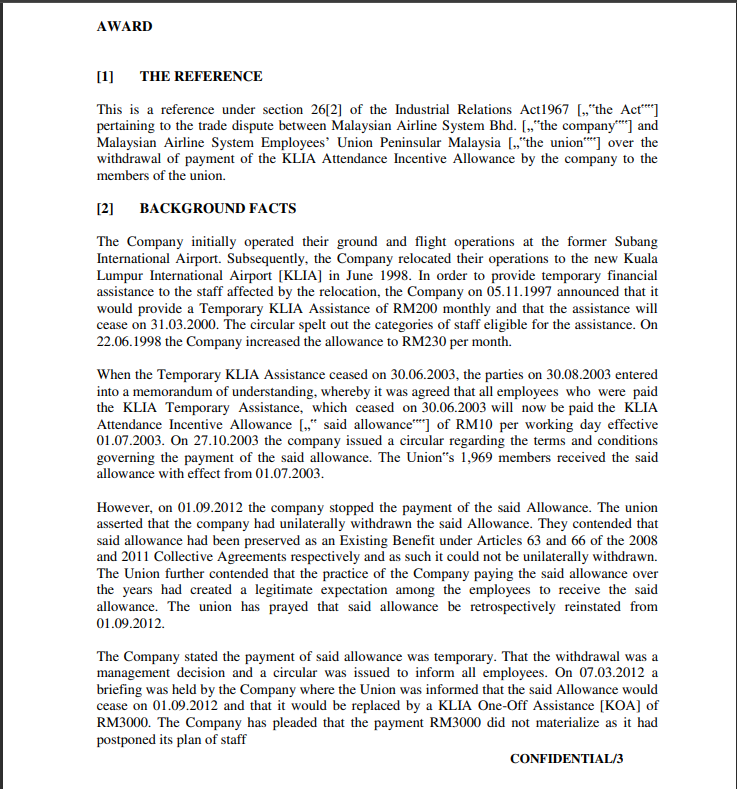
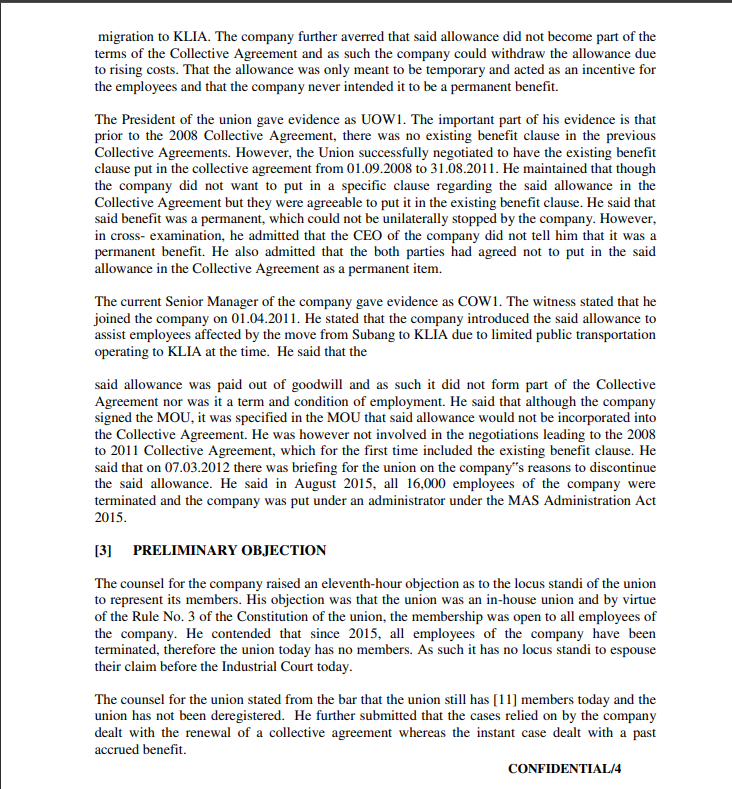
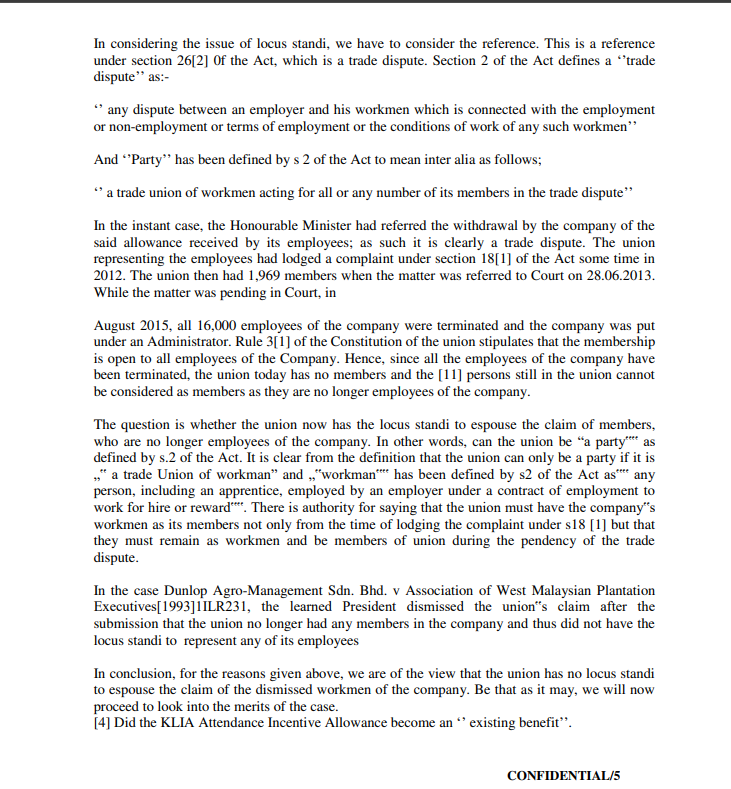
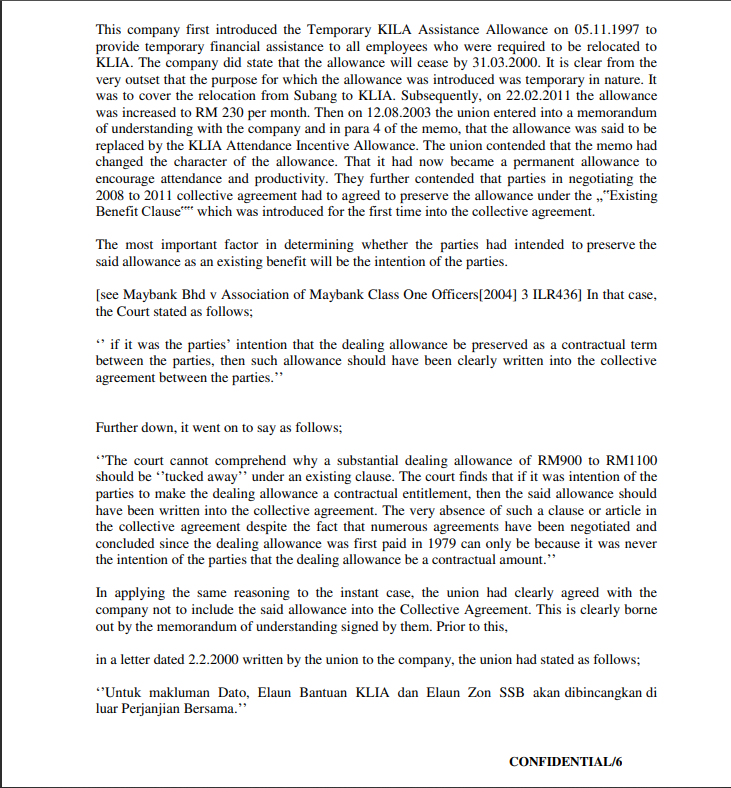
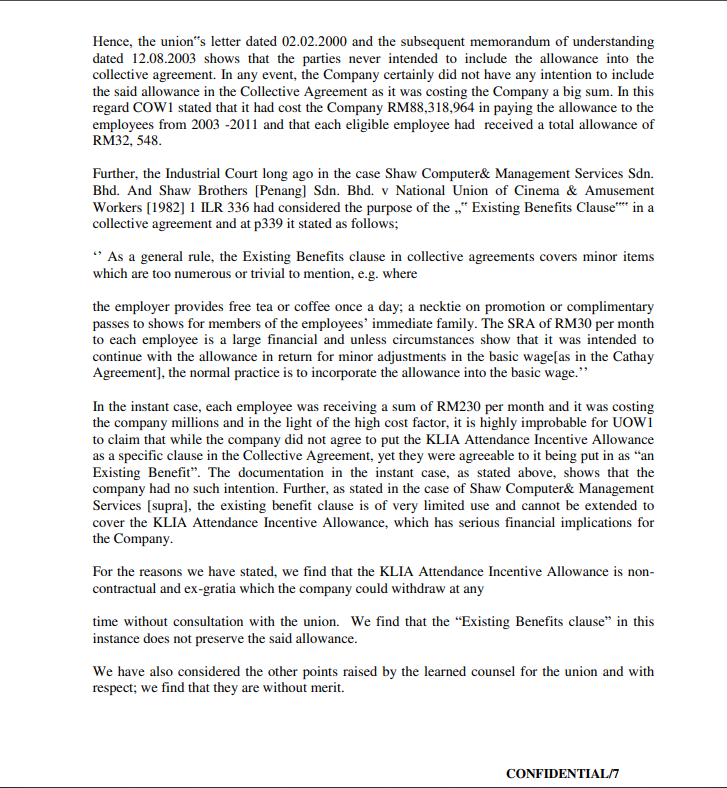
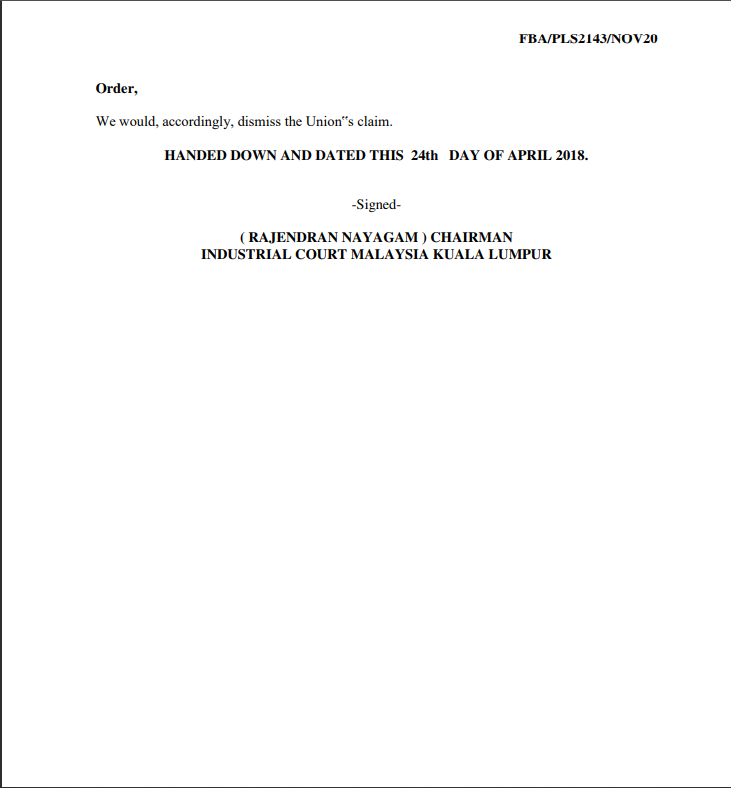
AWARD [1] THE REFERENCE This is a reference under section 26[2] of the Industrial Relations Act1967 (the Act***] pertaining to the trade dispute between Malaysian Airline System Bhd. (the company***] and Malaysian Airline System Employees' Union Peninsular Malaysia (,"the union***] over the withdrawal of payment of the KLIA Attendance Incentive Allowance by the company to the members of the union. BACKGROUND FACTS [2] The Company initially operated their ground and flight operations at the former Subang International Airport. Subsequently, the Company relocated their operations to the new Kuala Lumpur International Airport (KLIA) in June 1998. In order to provide temporary financial assistance to the staff affected by the relocation, the Company on 05.11.1997 announced that it would provide a Temporary KLIA Assistance of RM200 monthly and that the assistance will cease on 31.03.2000. The circular spelt out the categories of staff eligible for the assistance. On 22.06.1998 the Company increased the allowance to RM230 per month. When the Temporary KLIA Assistance ceased on 30.06.2003, the parties on 30.08.2003 entered into a memorandum of understanding, whereby it was agreed that all employees who were paid the KLIA Temporary Assistance, which ceased on 30.06.2003 will now be paid the KLIA Attendance Incentive Allowance (," said allowance***] of RM10 per working day effective 01.07.2003. On 27.10.2003 the company issued a circular regarding the terms and conditions governing the payment of the said allowance. The Union's 1,969 members received the said allowance with effect from 01.07.2003. However, on 01.09.2012 the company stopped the payment of the said Allowance. The union asserted that the company had unilaterally withdrawn the said Allowance. They contended that said allowance had been preserved as an Existing Benefit under Articles 63 and 66 of the 2008 and 2011 Collective Agreements respectively and as such it could not be unilaterally withdrawn. The Union further contended that the practice of the Company paying the said allowance over the years had created a legitimate expectation among the employees to receive the said allowance. The union has prayed that said allowance be retrospectively reinstated from 01.09.2012. The Company stated the payment of said allowance was temporary. That the withdrawal was a management decision and a circular was issued to inform all employees. On 07.03.2012 a briefing was held by the Company where the Union was informed that the said Allowance would cease on 01.09.2012 and that it would be replaced by a KLIA One-Off Assistance [KOA) of RM3000. The Company has pleaded that the payment RM3000 did not materialize as it had postponed its plan of staff CONFIDENTIAL/3 migration to KLIA. The company further averred that said allowance did not become part of the terms of the Collective Agreement and as such the company could withdraw the allowance due to rising costs. That the allowance was only meant to be temporary and acted as an incentive for the employees and that the company never intended it to be a permanent benefit. The President of the union gave evidence as UOW1. The important part of his evidence is that prior to the 2008 Collective Agreement, there was no existing benefit clause in the previous Collective Agreements. However, the Union successfully negotiated to have the existing benefit clause put in the collective agreement from 01.09.2008 to 31.08.2011. He maintained that though the company did not want to put in a specific clause regarding the said allowance in the Collective Agreement but they were agreeable to put it in the existing benefit clause. He said that said benefit was a permanent, which could not be unilaterally stopped by the company. However, in cross-examination, he admitted that the CEO of the company did not tell him that it was a permanent benefit. He also admitted that the both parties had agreed not to put in the said allowance in the Collective Agreement as a permanent item. The current Senior Manager of the company gave evidence as COW1. The witness stated that he joined the company on 01.04.2011. He stated that the company introduced the said allowance to assist employees affected by the move from Subang to KLIA due to limited public transportation operating to KLIA at the time. He said that the said allowance was paid out of goodwill and as such it did not form part of the Collective Agreement nor was it a term and condition of employment. He said that although the company signed the MOU, it was specified in the MOU that said allowance would not be incorporated into the Collective Agreement. He was however not involved in the negotiations leading to the 2008 to 2011 Collective Agreement, which for the first time included the existing benefit clause. He said that on 07.03.2012 there was briefing for the union on the company's reasons to discontinue the said allowance. He said in August 2015, all 16,000 employees of the company were terminated and the company was put under an administrator under the MAS Administration Act 2015. [3] PRELIMINARY OBJECTION The counsel for the company raised an eleventh-hour objection as to the locus standi of the union to represent its members. His objection was that the union was an in-house union and by virtue of the Rule No. 3 of the Constitution of the union, the membership was open to all employees of the company. He contended that since 2015, all employees of the company have been terminated, therefore the union today has no members. As such it has no locus standi to espouse their claim before the Industrial Court today. The counsel for the union stated from the bar that the union still has [11] members today and the union has not been deregistered. He further submitted that the cases relied on by the company dealt with the renewal of a collective agreement whereas the instant case dealt with a past accrued benefit. CONFIDENTIAL/4 In considering the issue of locus standi, we have to consider the reference. This is a reference under section 26[2] of the Act, which is a trade dispute. Section 2 of the Act defines a trade dispute" as:- any dispute between an employer and his workmen which is connected with the employment or non-employment or terms of employment or the conditions of work of any such workmen And "Party" has been defined by s 2 of the Act to mean inter alia as follows; a trade union of workmen acting for all or any number of its members in the trade dispute" In the instant case, the Honourable Minister had referred the withdrawal by the company of the said allowance received by its employees; as such it is clearly a trade dispute. The union representing the employees had lodged a complaint under section 18[1] of the Act some time in 2012. The union then had 1,969 members when the matter was referred to Court on 28.06.2013. While the matter was pending in Court, in August 2015, all 16,000 employees of the company were terminated and the company was put under an Administrator. Rule 3[1] of the Constitution of the union stipulates that the membership is open to all employees of the Company. Hence, since all the employees of the company have been terminated, the union today has no members and the [11] persons still in the union cannot be considered as members as they are no longer employees of the company. The question is whether the union now has the locus standi to espouse the claim of members, who are no longer employees of the company. In other words, can the union be "a party**** as defined by s.2 of the Act. It is clear from the definition that the union can only be a party if it is * a trade Union of workman" and "workman**** has been defined by s2 of the Act as*** any person, including an apprentice, employed by an employer under a contract of employment to work for hire or reward***. There is authority for saying that the union must have the company's workmen as its members not only from the time of lodging the complaint under s18 [1] but that they must remain as workmen and be members of union during the pendency of the trade dispute. In the case Dunlop Agro-Management Sdn. Bhd. v Association of West Malaysian Plantation Executives[1993]1ILR231, the learned President dismissed the union's claim after the submission that the union no longer had any members in the company and thus did not have the locus standi to represent any of its employees In conclusion, for the reasons given above, we are of the view that the union has no locus standi to espouse the claim of the dismissed workmen of the company. Be that as it may, we will now proceed to look into the merits of the case. (4] Did the KLIA Attendance Incentive Allowance become an existing benefit". CONFIDENTIAL/5 This company first introduced the Temporary KILA Assistance Allowance on 05.11.1997 to provide temporary financial assistance to all employees who were required to be relocated to KLIA. The company did state that the allowance will cease by 31.03.2000. It is clear from the very outset that the purpose for which the allowance was introduced was temporary in nature. It was to cover the relocation from Subang to KLIA. Subsequently, on 22.02.2011 the allowance was increased to RM 230 per month. Then on 12.08.2003 the union entered into a memorandum of understanding with the company and in para 4 of the memo, that the allowance was said to be replaced by the KLIA Attendance Incentive Allowance. The union contended that the memo had changed the character of the allowance. That it had now became a permanent allowance to encourage attendance and productivity. They further contended that parties in negotiating the 2008 to 2011 collective agreement had to agreed to preserve the allowance under the ,, "Existing Benefit Clause**** which was introduced for the first time into the collective agreement. The most important factor in determining whether the parties had intended to preserve the said allowance as an existing benefit will be the intention of the parties. (see Maybank Bhd v Association of Maybank Class One Officers[2004] 3 ILR436] In that case, the Court stated as follows; if it was the parties intention that the dealing allowance be preserved as a contractual term between the parties, then such allowance should have been clearly written into the collective agreement between the parties." Further down, it went on to say as follows: 'The court cannot comprehend why a substantial dealing allowance of RM900 to RM1100 should be ''tucked away" under an existing clause. The court finds that if it was intention of the parties to make the dealing allowance a contractual entitlement, then the said allowance should have been written into the collective agreement. The very absence of such a clause or article in the collective agreement despite the fact that numerous agreements have been negotiated and concluded since the dealing allowance was first paid in 1979 can only be because it was never the intention of the parties that the dealing allowance be a contractual amount." In applying the same reasoning to the instant case, the union had clearly agreed with the company not to include the said allowance into the Collective Agreement. This is clearly borne out by the memorandum of understanding signed by them. Prior to this, in a letter dated 2.2.2000 written by the union to the company, the union had stated as follows; Untuk makluman Dato, Elaun Bantuan KLIA dan Elaun Zon SSB akan dibincangkan di luar Perjanjian Bersama." CONFIDENTIAL/6 Hence, the union's letter dated 02.02.2000 and the subsequent memorandum of understanding dated 12.08.2003 shows that the parties never intended to include the allowance into the collective agreement. In any event, the Company certainly did not have any intention to include the said allowance in the Collective Agreement as it was costing the Company a big sum. In this regard COW1 stated that it had cost the Company RM88,318,964 in paying the allowance to the employees from 2003-2011 and that each eligible employee had received a total allowance of RM32, 548. Further, the Industrial Court long ago in the case Shaw Computer& Management Services Sdn. Bhd. And Shaw Brothers (Penang) Sdn. Bhd. v National Union of Cinema & Amusement Workers [1982] 1 ILR 336 had considered the purpose of the " Existing Benefits Clause *** in a collective agreement and at p339 it stated as follows; As a general rule, the Existing Benefits clause in collective agreements covers minor items which are too numerous or trivial to mention, e.g. where the employer provides free tea or coffee once a day; a necktie on promotion or complimentary passes to shows for members of the employees' immediate family. The SRA of RM30 per month to each employee is a large financial and unless circumstances show that it was intended to continue with the allowance in return for minor adjustments in the basic wage[as in the Cathay Agreement), the normal practice is to incorporate the allowance into the basic wage. In the instant case, each employee was receiving a sum of RM230 per month and it was costing the company millions and in the light of the high cost factor, it is highly improbable for Uowi to claim that while the company did not agree to put the KLIA Attendance Incentive Allowance as a specific clause in the Collective Agreement, yet they were agreeable to it being put in as an Existing Benefit". The documentation in the instant case, as stated above, shows that the company had no such intention. Further, as stated in the case of Shaw Computer& Management Services (supra), the existing benefit clause is of very limited use and cannot be extended to cover the KLIA Attendance Incentive Allowance, which has serious financial implications for the Company. For the reasons we have stated, we find that the KLIA Attendance Incentive Allowance is non- contractual and ex-gratia which the company could withdraw at any time without consultation with the union. We find that the "Existing Benefits clause in this instance does not preserve the said allowance. We have also considered the other points raised by the learned counsel for the union and with respect; we find that they are without merit. CONFIDENTIAL/7 FBA/PLS2143/NOV 20 Order, We would, accordingly, dismiss the Union's claim. HANDED DOWN AND DATED THIS 24th DAY OF APRIL 2018. Signed (RAJENDRAN NAYAGAM ) CHAIRMAN INDUSTRIAL COURT MALAYSIA KUALA LUMPURStep by Step Solution
There are 3 Steps involved in it
1 Expert Approved Answer
Step: 1 Unlock

Question Has Been Solved by an Expert!
Get step-by-step solutions from verified subject matter experts
Step: 2 Unlock
Step: 3 Unlock
 Study Help