Question: Based on the article below answer the questions below in detail. 1. What are the advantages and disadvantages of keeping too little or too much
Based on the article below answer the questions below in detail.
1. What are the advantages and disadvantages of keeping too little or too much inventory?
2. Why do some companies still opt for "just-in-time Inventory" strategy despite its disadvantages?
Article screen shot:
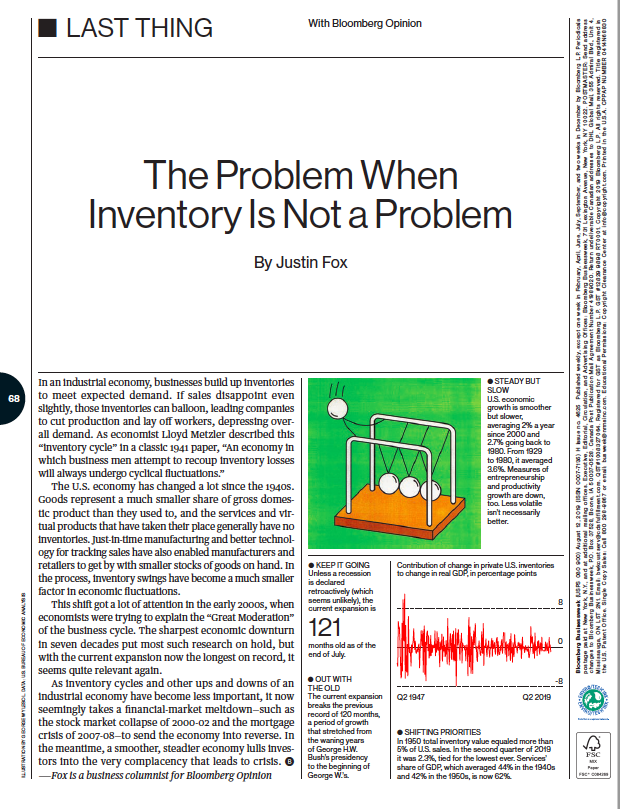
LAST THING With Bloomberg Opinion The Problem When Inventory Is Not a Problem By Justin Fox Bloomberg Busrosak S.PS 000 9001 Aug 12.2010 ISN 0007-7136) Mbwene Published dynawskin brusyfail, nay. Seebad on Decembe by Bloomberg Le Periodicals postage and at New York NY and additional wing offices, Execut, dari Gotion, and Advertising Office Bamberk 701 Lington Avenue, New York, NY 10022. POST MASTER Sand changes to Bloombero Bu hesive PO, Box 372. BooneIA 5003T-0520 Canada Pont Publication Mal Agreement Number 06020. Return undeliverable Cmadan address to DHL Global Mail Adrial Blvd. Unt the US Patent Single Copy Hole Cal 100 196.6667 or endi bu inson di Permat on copyright Clarice Center wie e te richt.com Printed in the USA PPAP NUMBER DAN NOT 68 .STEADY BUT SLOW US. economic growth is smoother but slower, averaging 2% a year since 2000 and 2.7% going back to 1980. From 1929 to 1990, it averaged 3.6% Measures of entrepreneurship and productivity growth are down toa Less volatile isn't necessarily better In an industrial economy, businesses build up inventories to meet expected demand. If sales disappoint even slightly, those inventories can balloon, leading companies to cut production and lay off workers, depressing over- all demand. As economist Lloyd Metzler described this Inventory cycle in a classic 1941 paper, "An economy in which business men attempt to recoup Inventory losses will always undergo cyclical fluctuations." The U.S. economy has changed a lot since the 1940s. Goods represent a much smaller share of gross domes- tic product than they used to, and the services and vtr- tual products that have taken ther place generally have no Inventortes. Just-in-time manufacturing and better technol- ogy for tracking sales have also enabled manufacturers and retailers to get by with smaller stocks of goods on hand. In KEEP IT GOING Unless a recession the process, inventory swings have become a much smaller is declared factor in economic fluctuations. retroactively (which This shift got a lot of attention tn the early 2000s, when acero unlikelyd, the current economists were trying to explain the "Great Moderation" of the business cycle. The sharpest economic downturn 121 in seven decades put most such research on hold, but months old as of the with the current expansion now the longest on record, it end of July seems quite relevant again. As inventory cycles and other ups and downs of an OUT WITH Industrial economy have become less important, it now The current expansion seemingly takes a financial-market meltdown-such as breaks the previous record of 120 months, the stock market collapse of 2000-02 and the mortgage a period of growth crists of 2007-08-to send the economy into reverse. In the waring years the meantime, a smoother, steadter economy lulls inves- of George HW. tors into the very complacency that leads to crists. Bush's presidency to the beginning of - Fox is a business columnist for Bloomberg Opinion George W. Contribution of change in private US inventories to change in real GDP in percentage points TONEGORO WYROL WRITOFONOWE AW. THE OLD Q2 1947 Q2 2019 that stretched from .SHIFTING PRIORITIES In 1950 total inventory value equaled more than 5% of US sales. In the second quarter of 2019 it was 2.3%, tied for the lowest ever. Services share of GDP, which averaged 44% in the 1940s and 42% in the 1960s, is now 62% PSC









 Study Help