







Question: Based on the article, Please help me below questions 1. An investor who buys stock in a company is also known as A. A dividend
Based on the article, Please help me below questions
1. An investor who buys stock in a company is also known as
A. A dividend holder
B. A manager
C. None of the answer are correct
D. A lender
E. An owner
2. A bondholder of an unsecured bond is entitled to ________ if the organization is unable to pay its debt.
A. Ownership
B. Collateral
C. Dividends
D. Nothing
E. Stock
3. If a company's stock is trading at $27 per share, and the book value of the stock is $32 per share, then the typical investor might
A. Not buy the stock
B. Demand a dividend of $5 per share
C. Buy the bonds of the company
D. Buy the stock
E. None of the answers are correct
4. When a corporation releases profits to its owners, this is known as
A. Yield
B. Profit sharing
C. Interest
D. None of the answer are correct
E. Dividends
5. Which of the following represents a stock split?
A. 100 shares becomes 10 shares
B. None of the answers are correct
C. 10 shares are converted into 1 bond
D. 10 shares becomes 100 shares
E. 100 shares are converted into 1 bond
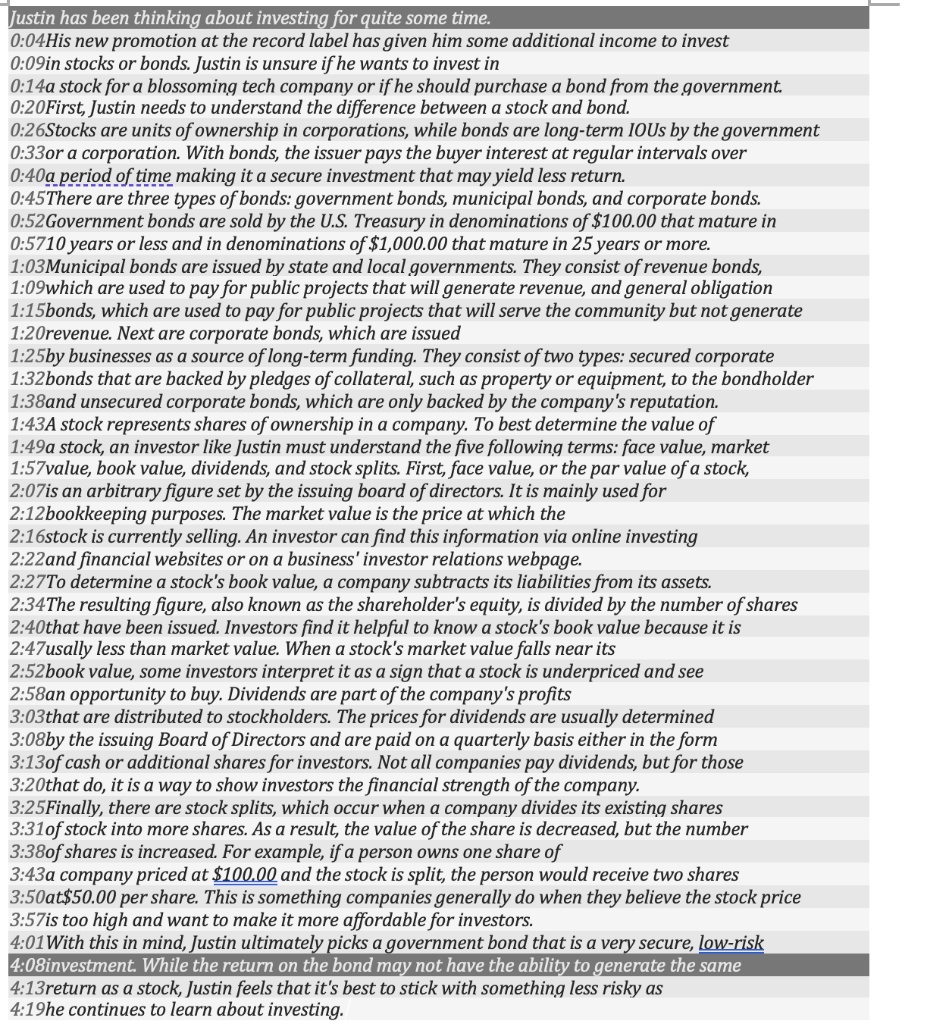
Justin has been thinking about investing for quite some time. 0:04 His new promotion at the record label has given him some additional income to invest 0:09in stocks or bonds. Justin is unsure if he wants to invest in 0:14 a stock for a blossoming tech company or if he should purchase a bond from the government. 0:20First, Justin needs to understand the difference between a stock and bond. 0:26Stocks are units of ownership in corporations, while bonds are long-term IOUs by the government 0:33 or a corporation. With bonds, the issuer pays the buyer interest at regular intervals over 0:40a period of time making it a secure investment that may yield less return. 0:45There are three types of bonds: government bonds, municipal bonds, and corporate bonds. 0:52 Government bonds are sold by the U.S. Treasury in denominations of $100.00 that mature in 0:5710 years or less and in denominations of $1,000.00 that mature in 25 years or more. 1:03Municipal bonds are issued by state and local governments. They consist of revenue bonds, 1:09 which are used to pay for public projects that will generate revenue, and general obligation 1:15bonds, which are used to pay for public projects that will serve the community but not generate 1:20revenue. Next are corporate bonds, which are issued 1:25by businesses as a source of long-term funding. They consist of two types: secured corporate 1:32bonds that are backed by pledges of collateral, such as property or equipment, to the bondholder 1:38and unsecured corporate bonds, which are only backed by the company's reputation. 1:43A stock represents shares of ownership in a company. To best determine the value of 1:49a stock, an investor like Justin must understand the five following terms: face value, market 1:57value, book value, dividends, and stock splits. First, face value, or the par value of a stock, 2:07is an arbitrary figure set by the issuing board of directors. It is mainly used for 2:12bookkeeping purposes. The market value is the price at which the 2:16stock is currently selling. An investor can find this information via online investing 2:22and financial websites or on a business' investor relations webpage. 2:27To determine a stock's book value, a company subtracts its liabilities from its assets. 2:34The resulting figure, also known as the shareholder's equity, is divided by the number of shares 2:40that have been issued. Investors find it helpful to know a stock's book value because it is 2:47usally less than market value. When a stock's market value falls near its 2:52book value, some investors interpret it as a sign that a stock is underpriced and see 2:58an opportunity to buy. Dividends are part of the company's profits 3:03that are distributed to stockholders. The prices for dividends are usually determined 3:08by the issuing Board of Directors and are paid on a quarterly basis either in the form 3:13of cash or additional shares for investors. Not all companies pay dividends, but for those 3:20that do, it is a way to show investors the financial strength of the company. 3:25Finally, there are stock splits, which occur when a company divides its existing shares 3:31of stock into more shares. As a result, the value of the share is decreased, but the number 3:38of shares is increased. For example, if a person owns one share of 3:43a company priced at $100.00 and the stock is split, the person would receive two shares 3:50at\$50.00 per share. This is something companies generally do when they believe the stock price 3:57is too high and want to make it more affordable for investors. 4:01 With this in mind, Justin ultimately picks a government bond that is a very secure, low-risk 4:08investment. While the return on the bond may not have the ability to generate the same 4:13return as a stock, Justin feels that it's best to stick with something less risky as 4:19he continues to learn about investing
Step by Step Solution
There are 3 Steps involved in it

Get step-by-step solutions from verified subject matter experts
 Study Help