







Question: based on the case study answer this question q1 Determine the type of tendering is more relevant in this case? and why? P. PROCURA Background
based on the case study answer this question q1 Determine the type of tendering is more relevant in this case? and why? 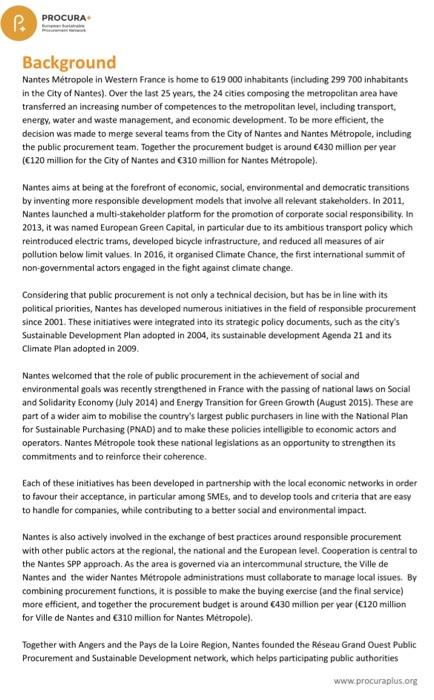
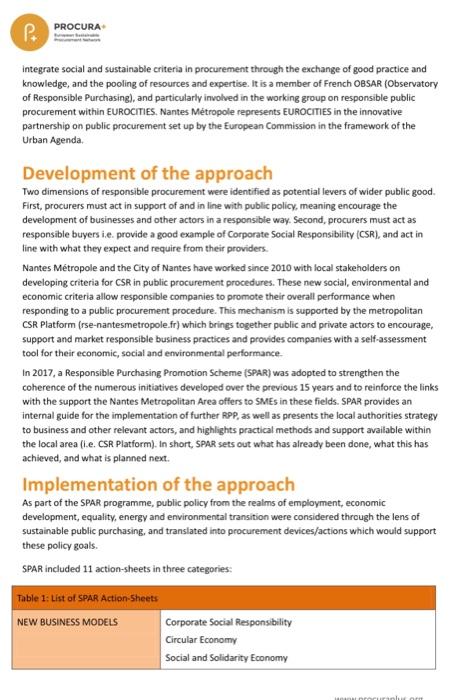
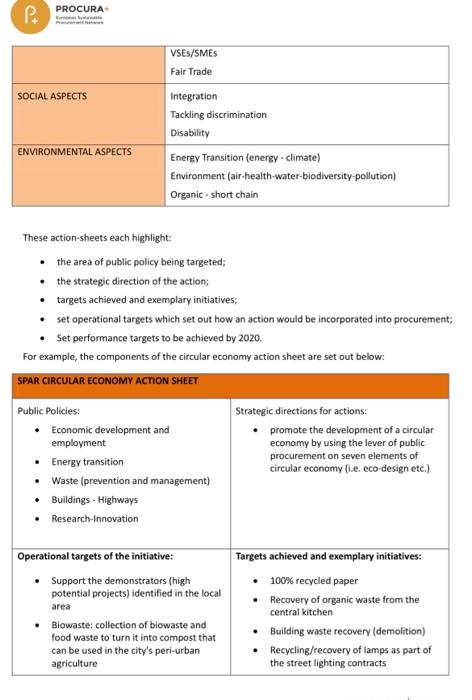
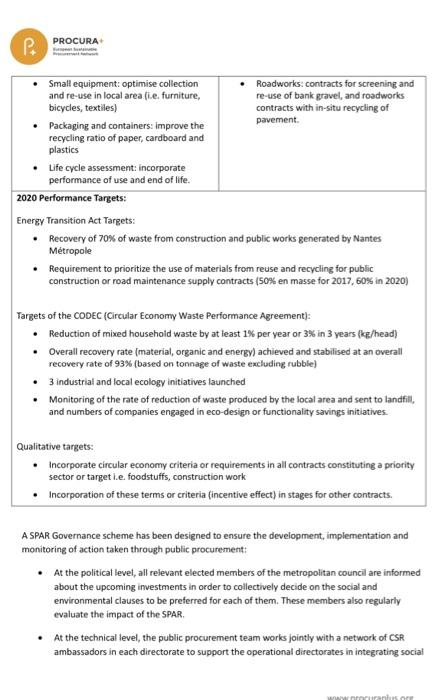
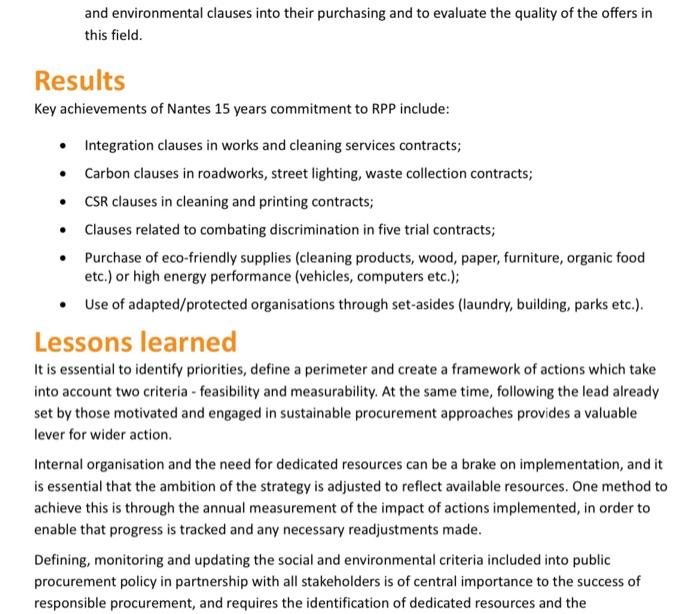
P. PROCURA Background Nantes Mtropole in Western France is home to 619 000 inhabitants (including 299 700 inhabitants in the City of Nantes). Over the last 25 years, the 24 cities composing the metropolitan area have transferred an increasing number of competences to the metropolitan level, including transport, energy, water and waste management, and economic development. To be more efficient, the decision was made to merge several teams from the City of Nantes and Nantes Mtropole, including the public procurement team. Together the procurement budget is around 430 million per year (120 million for the City of Nantes and 310 million for Nantes Mtropole). Nantes aims at being at the forefront of economic, social, environmental and democratic transitions by inventing more responsible development models that involve all relevant stakeholders. In 2011, Nantes launched a multi-stakeholder platform for the promotion of corporate social responsibility. In 2013, it was named European Green Capital, in particular due to its ambitious transport policy which reintroduced electric trams, developed bicycle infrastructure, and reduced all measures of air pollution below limit values. In 2016, it organised Climate Chance, the first international summit of non-governmental actors engaged in the fight against climate change. Considering that public procurement is not only a technical decision, but has be in line with its political priorities, Nantes has developed numerous initiatives in the field of responsible procurement since 2001. These initiatives were integrated into its strategic policy documents, such as the city's Sustainable Development Plan adopted in 2004, its sustainable development Agenda 21 and its Climate Plan adopted in 2009. Nantes welcomed that the role of public procurement in the achievement of social and environmental goals was recently strengthened in France with the passing of national laws on Social and Solidarity Economy (July 2014) and Energy Transition for Green Growth (August 2015). These are part of a wider aim to mobilise the country's largest public purchasers in line with the National Plan for Sustainable Purchasing (PNAD) and to make these policies intelligible to economic actors and operators. Nantes Mtropole took these national legislations as an opportunity to strengthen its commitments and to reinforce their coherence. Each of these initiatives has been developed in partnership with the local economic networks in order to favour their acceptance, in particular among SMEs, and to develop tools and criteria that are easy to handle for companies, while contributing to a better social and environmental impact. Nantes is also actively involved in the exchange of best practices around responsible procurement with other public actors at the regional, the national and the European level. Cooperation is central to the Nantes SPP approach. As the area is governed via an intercommunal structure, the Ville de Nantes and the wider Nantes Mtropole administrations must collaborate to manage local issues. By combining procurement functions, it is possible to make the buying exercise (and the final service) more efficient, and together the procurement budget is around 430 million per year (120 million for Ville de Nantes and 310 million for Nantes Mtropole). Together with Angers and the Pays de la Loire Region, Nantes founded the Rseau Grand Ouest Public Procurement and Sustainable Development network, which helps participating public authorities www.procuraplus.org PROCURA P. integrate social and sustainable criteria in procurement through the exchange of good practice and knowledge, and the pooling of resources and expertise. It is a member of French OBSAR (Observatory of Responsible Purchasing), and particularly involved in the working group on responsible public procurement within EUROCITIES. Nantes Mtropole represents EUROCITIES in the innovative partnership on public procurement set up by the European Commission in the framework of the Urban Agenda. Development of the approach Two dimensions of responsible procurement were identified as potential levers of wider public good. First, procurers must act in support of and in line with public policy, meaning encourage the development of businesses and other actors in a responsible way. Second, procurers must act as responsible buyers i.e. provide a good example of Corporate Social Responsibility (CSR), and act in line with what they expect and require from their providers. Nantes Mtropole and the City of Nantes have worked since 2010 with local stakeholders on developing criteria for CSR in public procurement procedures. These new social, environmental and economic criteria allow responsible companies to promote their overall performance when responding to a public procurement procedure. This mechanism is supported by the metropolitan CSR Platform (rse-nantesmetropole.fr) which brings together public and private actors to encourage, support and market responsible business practices and provides companies with a self-assessment tool for their economic, social and environmental performance. In 2017, a Responsible Purchasing Promotion Scheme (SPAR) was adopted to strengthen the coherence of the numerous initiatives developed over the previous 15 years and to reinforce the links with the support the Nantes Metropolitan Area offers to SMEs in these fields. SPAR provides an internal guide for the implementation of further RPP, as well as presents the local authorities strategy to business and other relevant actors, and highlights practical methods and support available within the local area (i.e. CSR Platform). In short, SPAR sets out what has already been done, what this has achieved, and what is planned next. Implementation of the approach As part of the SPAR programme, public policy from the realms of employment, economic development, equality, energy and environmental transition were considered through the lens of sustainable public purchasing, and translated into procurement devices/actions which would support these policy goals. SPAR included 11 action-sheets in three categories: Table 1: List of SPAR Action-Sheets NEW BUSINESS MODELS Corporate Social Responsibility Circular Economy Social and Solidarity Economy HOON procuranlur ont PROCURA Ste P. VSES/SMES Fair Trade SOCIAL ASPECTS Integration Tackling discrimination Disability ENVIRONMENTAL ASPECTS Energy Transition (energy-climate) Environment (air-health-water-biodiversity-pollution) Organic - short chain These action-sheets each highlight: the area of public policy being targeted; the strategic direction of the action; targets achieved and exemplary initiatives; set operational targets which set out how an action would be incorporated into procurement; Set performance targets to be achieved by 2020. For example, the components of the circular economy action sheet are set out below: SPAR CIRCULAR ECONOMY ACTION SHEET Public Policies: Strategic directions for actions: Economic development and employment promote the development of a circular economy by using the lever of public procurement on seven elements of circular economy (i.e. eco-design etc.) Energy transition Waste (prevention and management) Buildings - Highways Research-Innovation Operational targets of the initiative: Targets achieved and exemplary initiatives: 100% recycled paper Support the demonstrators (high potential projects) identified in the local area Recovery of organic waste from the central kitchen Biowaste: collection of biowaste and food waste to turn it into compost that can be used in the city's peri-urban agriculture Building waste recovery (demolition) Recycling/recovery of lamps as part of the street lighting contracts PROCURA+ P. Small equipment: optimise collection and re-use in local area (i.e. furniture, bicycles, textiles) Roadworks: contracts for screening and re-use of bank gravel, and roadworks contracts with in-situ recycling of pavement. Packaging and containers: improve the recycling ratio of paper, cardboard and plastics Life cycle assessment: incorporate performance of use and end of life. 2020 Performance Targets: Energy Transition Act Targets: Recovery of 70% of waste from construction and public works generated by Nantes Mtropole Requirement to prioritize the use of materials from reuse and recycling for public construction or road maintenance supply contracts (50% en masse for 2017, 60% in 2020) Targets of the CODEC (Circular Economy Waste Performance Agreement): Reduction of mixed household waste by at least 1% per year or 3% in 3 years (kg/head) Overall recovery rate (material, organic and energy) achieved and stabilised at an overall recovery rate of 93% (based on tonnage of waste excluding rubble) 3 industrial and local ecology initiatives launched Monitoring of the rate of reduction of waste produced by the local area and sent to landfill, and numbers of companies engaged in eco-design or functionality savings initiatives. Qualitative targets: Incorporate circular economy criteria or requirements in all contracts constituting a priority sector or target i.e. foodstuffs, construction work Incorporation of these terms or criteria (incentive effect) in stages for other contracts. A SPAR Governance scheme has been designed to ensure the development, implementation and monitoring of action taken through public procurement: At the political level, all relevant elected members of the metropolitan council are informed about the upcoming investments in order to collectively decide on the social and environmental clauses to be preferred for each of them. These members also regularly evaluate the impact of the SPAR. At the technical level, the public procurement team works jointly with a network of CSR ambassadors in each directorate to support the operational directorates in integrating social www.procurantus.or and environmental clauses into their purchasing and to evaluate the quality of the offers in this field. Results Key achievements of Nantes 15 years commitment to RPP include: Integration clauses in works and cleaning services contracts; Carbon clauses in roadworks, street lighting, waste collection contracts; CSR clauses in cleaning and printing contracts; Clauses related to combating discrimination in five trial contracts; . Purchase of eco-friendly supplies (cleaning products, wood, paper, furniture, organic food etc.) or high energy performance (vehicles, computers etc.); Use of adapted/protected organisations through set-asides (laundry, building, parks etc.). Lessons learned It is essential to identify priorities, define a perimeter and create a framework of actions which take into account two criteria - feasibility and measurability. At the same time, following the lead already set by those motivated and engaged in sustainable procurement approaches provides a valuable lever for wider action. Internal organisation and the need for dedicated resources can be a brake on implementation, and it is essential that the ambition of the strategy is adjusted to reflect available resources. One method to achieve this is through the annual measurement of the impact of actions implemented, in order to enable that progress is tracked and any necessary readjustments made. Defining, monitoring and updating the social and environmental criteria included into public procurement policy in partnership with all stakeholders is of central importance to the success of responsible procurement, and requires the identification of dedicated resources and the Step by Step Solution
There are 3 Steps involved in it
1 Expert Approved Answer
Step: 1 Unlock

Question Has Been Solved by an Expert!
Get step-by-step solutions from verified subject matter experts
Step: 2 Unlock
Step: 3 Unlock
 Study Help