







Question: Based on the Case Study Below: Recently, there appears to be a market trend away from outsourcing and offshoring, with a number of firms bringing
Based on the Case Study Below:
Recently, there appears to be a market trend away from outsourcing and offshoring, with a number of firms bringing supply chains back within, or at least closer to, home markets. Part of the reason is a reduction in the wage differential among countries (and the fact that those that still have very low wages might not have the distribution systems to compete), and part is likely due to other aspects of supply chains becoming more important (e.g. control, rapid response, social responsibility concerns).
How would a firm like Li & Fung be affected by this trend? What opportunities and/or threats do you see?
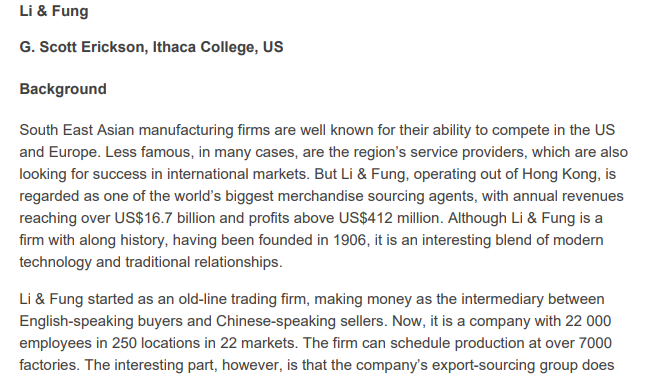
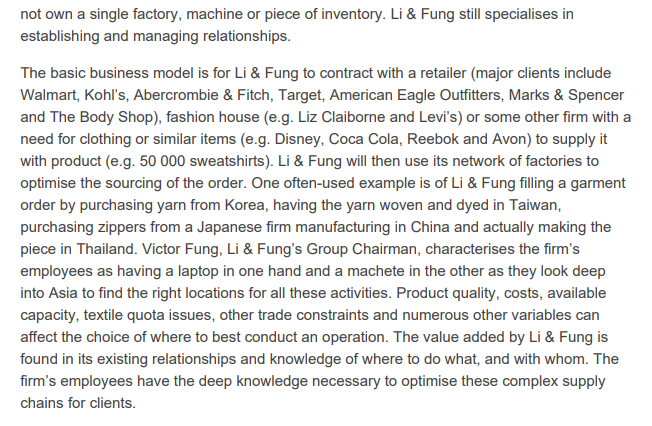
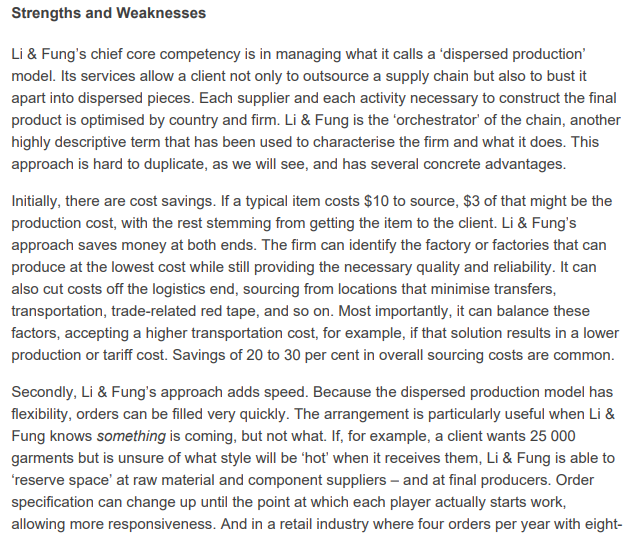
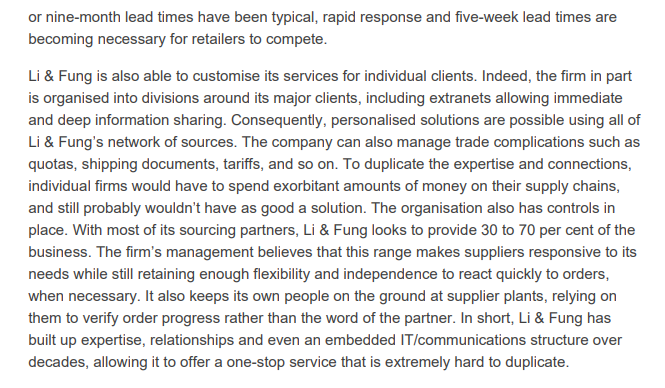
Li & Fung G. Scott Erickson, Ithaca College, US Background South East Asian manufacturing firms are well known for their ability to compete in the US and Europe. Less famous, in many cases, are the region's service providers, which are also looking for success in international markets. But Li & Fung, operating out of Hong Kong, is regarded as one of the world's biggest merchandise sourcing agents, with annual revenues reaching over US$16.7 billion and profits above US$412 million. Although Li & Fung is a firm with along history, having been founded in 1906, it is an interesting blend of modern technology and traditional relationships. Li & Fung started as an old-line trading firm, making money as the intermediary between English-speaking buyers and Chinese-speaking sellers. Now, it is a company with 22 000 employees in 250 locations in 22 markets. The firm can schedule production at over 7000 factories. The interesting part, however, is that the company's export-sourcing group does not own a single factory, machine or piece of inventory. Li & Fung still specialises in establishing and managing relationships. The basic business model is for Li & Fung to contract with a retailer (major clients include Walmart, Kohl's, Abercrombie & Fitch, Target, American Eagle Outfitters, Marks & Spencer and The Body Shop), fashion house (e.g. Liz Claiborne and Levi's) or some other firm with a need for clothing or similar items (e.g. Disney, Coca Cola, Reebok and Avon) to supply it with product (e.g. 50 000 sweatshirts). Li & Fung will then use its network of factories to optimise the sourcing of the order. One often-used example is of Li & Fung filling a garment order by purchasing yarn from Korea, having the yarn woven and dyed in Taiwan, purchasing zippers from a Japanese firm manufacturing in China and actually making the piece in Thailand. Victor Fung, Li & Fung's Group Chairman, characterises the firm's employees as having a laptop in one hand and a machete in the other as they look deep into Asia to find the right locations for all these activities. Product quality, costs, available capacity, textile quota issues, other trade constraints and numerous other variables can affect the choice of where to best conduct an operation. The value added by Li & Fung is found in its existing relationships and knowledge of where to do what, and with whom. The firm's employees have the deep knowledge necessary to optimise these complex supply chains for clients. Strengths and weaknesses Li & Fung's chief core competency is in managing what it calls a 'dispersed production' model. Its services allow a client not only to outsource a supply chain but also to bust it apart into dispersed pieces. Each supplier and each activity necessary to construct the final product is optimised by country and firm. Li & Fung is the 'orchestrator' of the chain, another highly descriptive term that has been used to characterise the firm and what it does. This approach is hard to duplicate, as we will see, and has several concrete advantages. Initially, there are cost savings. If a typical item costs $10 to source, $3 of that might be the production cost, with the rest stemming from getting the item to the client. Li & Fung's approach saves money at both ends. The firm can identify the factory or factories that can produce at the lowest cost while still providing the necessary quality and reliability. It can also cut costs off the logistics end, sourcing from locations that minimise transfers, transportation, trade-related red tape, and so on. Most importantly, it can balance these factors, accepting a higher transportation cost, for example, if that solution results in a lower production or tariff cost. Savings of 20 to 30 per cent in overall sourcing costs are common. Secondly, Li & Fung's approach adds speed. Because the dispersed production model has flexibility, orders can be filled very quickly. The arrangement is particularly useful when Li & Fung knows something is coming, but not what. If, for example, a client wants 25 000 garments but is unsure of what style will be 'hot' when it receives them, Li & Fung is able to freserve space' at raw material and component suppliers - and at final producers. Order specification can change up until the point at which each player actually starts work, allowing more responsiveness. And in a retail industry where four orders per year with eight- or nine-month lead times have been typical, rapid response and five-week lead times are becoming necessary for retailers to compete. Li & Fung is also able to customise its services for individual clients. Indeed, the firm in part is organised into divisions around its major clients, including extranets allowing immediate and deep information sharing. Consequently, personalised solutions are possible using all of Li & Fung's network of sources. The company can also manage trade complications such as quotas, shipping documents, tariffs, and so on. To duplicate the expertise and connections, individual firms would have to spend exorbitant amounts of money on their supply chains, and still probably wouldn't have as good a solution. The organisation also has controls in place. With most of its sourcing partners, Li & Fung looks to provide 30 to 70 per cent of the business. The firm's management believes that this range makes suppliers responsive to its needs while still retaining enough flexibility and independence to react quickly to orders, when necessary. It also keeps its own people on the ground at supplier plants, relying on them to verify order progress rather than the word of the partner. In short, Li & Fung has built up expertise, relationships and even an embedded IT/communications structure over decades, allowing it to offer a one-stop service that is extremely hard to duplicate. For the 15 000 manufacturers for which Li & Fung acts as a distribution partner, there are obvious attractions. These many small operations could probably never participate in transactions involving major corporations such as Walmart and Disney or brands such as Juicy Couture, Hannah Montana or Vera Wang. Having Li & Fung handle their relationships allows them to compete for such business and be tapped for contributions that put them in the best position to succeed, since they are typically chosen for reasons that have to do with their foremost competencies. But there are a few holes in the armour. Two-thirds of Li & Fung's revenues come from the US (down from 70 per cent just a few years ago). US-China trade relationships are constantly changing, and this outside threat needs to be monitored. It is expected that the company's global presence is likely to provide a buffer to any decline in revenues. Management admits that the company is weaker than it could be in supplying Europe and Japan. Perhaps even more of a concern is the process of consolidation occurring in the US retail sector. The downturn that began in 2008 cost Li & Fung a number of clients, including the now-defunct Mervyn's and KB Toys. Indeed, much like other transportation and logistics providers, Li & Fung is taken as an indicator of economic conditions. If its customers' sales are down, its sales will be down. In recent years, Li & Fung has taken some concrete steps to protect itself. One strategy is to deepen relationships with its customers, finding new opportunities and product lines to which it can contribute. Once largely a soft-goods provider, the company now obtains over a third of its sales from hard goods (toys, beauty products, etc.). The firm is also pursuing opportunities to work with companies that are looking to make their supply chains more multinational, providing multiple sources close to end markets. Victor Fung now predicts that costs will drop in importance as speed and a responsive supply chain become more important drivers of retail success
Step by Step Solution
There are 3 Steps involved in it
1 Expert Approved Answer
Step: 1 Unlock

Question Has Been Solved by an Expert!
Get step-by-step solutions from verified subject matter experts
Step: 2 Unlock
Step: 3 Unlock
 Study Help