Question: Based on the chapter 7. INTERNATIONAL STRATEGY: CREATING VALUE IN GLOBAL MARKETS please answer these questions: 1. What entry strategy has Starbucks used internationally? Should
Based on the chapter 7. INTERNATIONAL STRATEGY: CREATING VALUE IN GLOBAL MARKETS please answer these questions:
1. What entry strategy has Starbucks used internationally? Should Tata Starbucks use a strategy that is modified for the Indian market or should it pursue the same strategy it has in all other international markets?
2. What forces in the industry environment might affect Tata Starbucks' choice of strategy? And what does an internal analysis tell us about this? What intellectual assets are most important to Tata Starbucks??
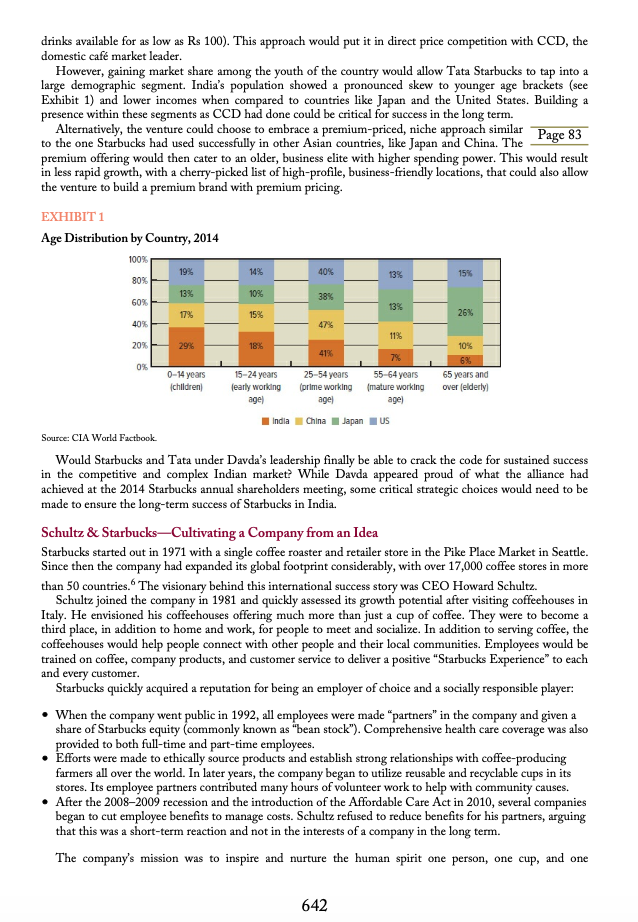
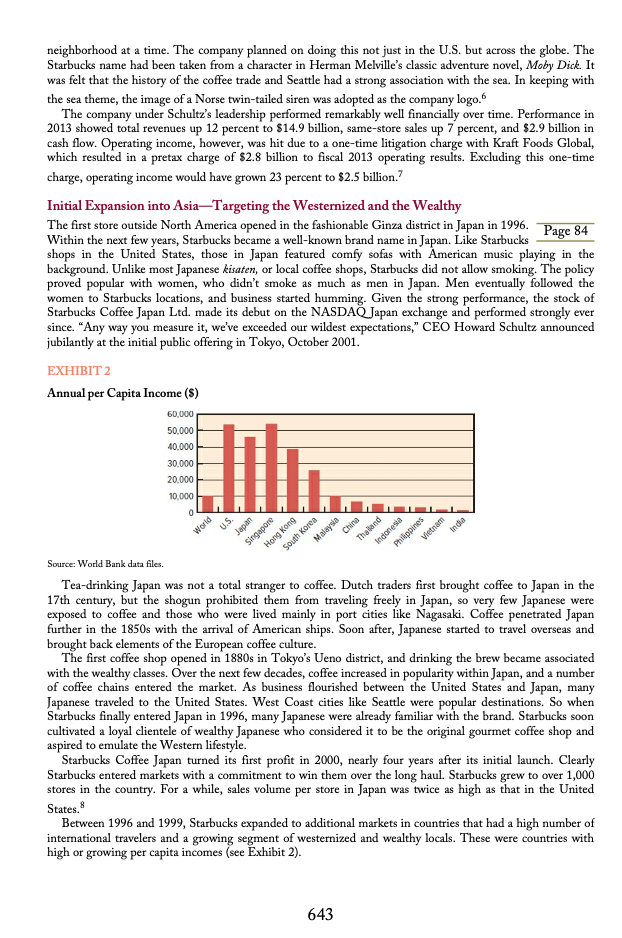
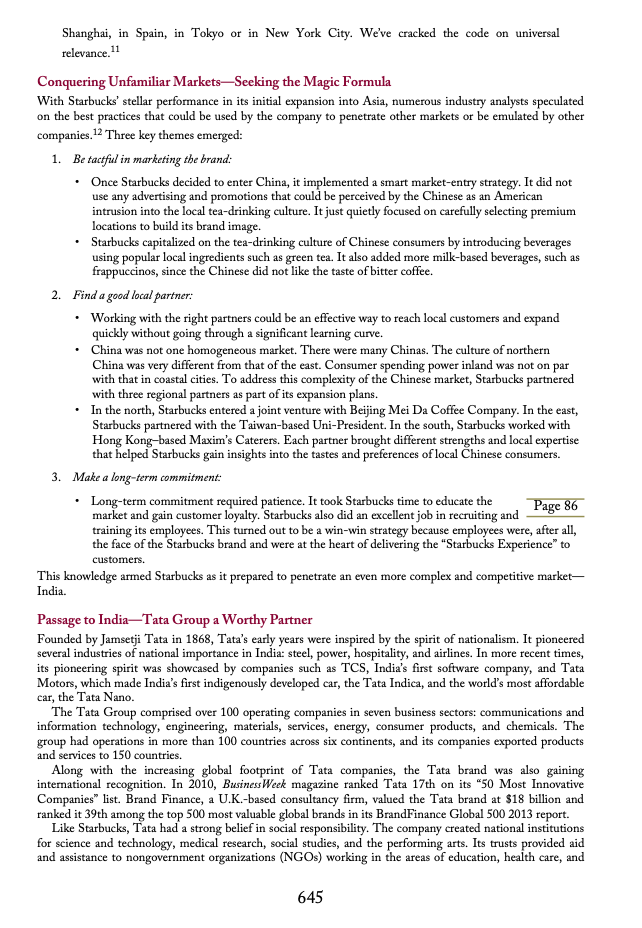
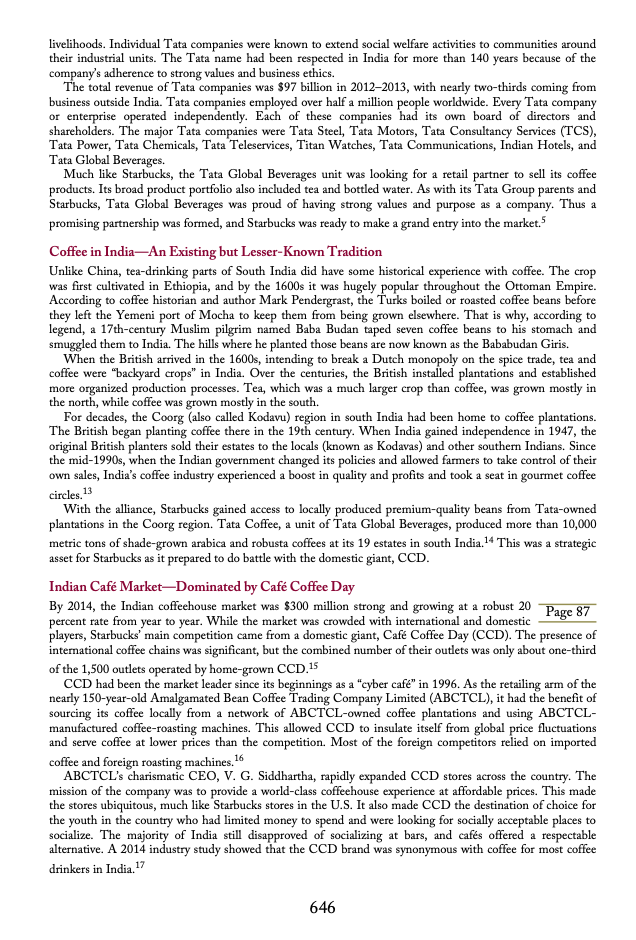
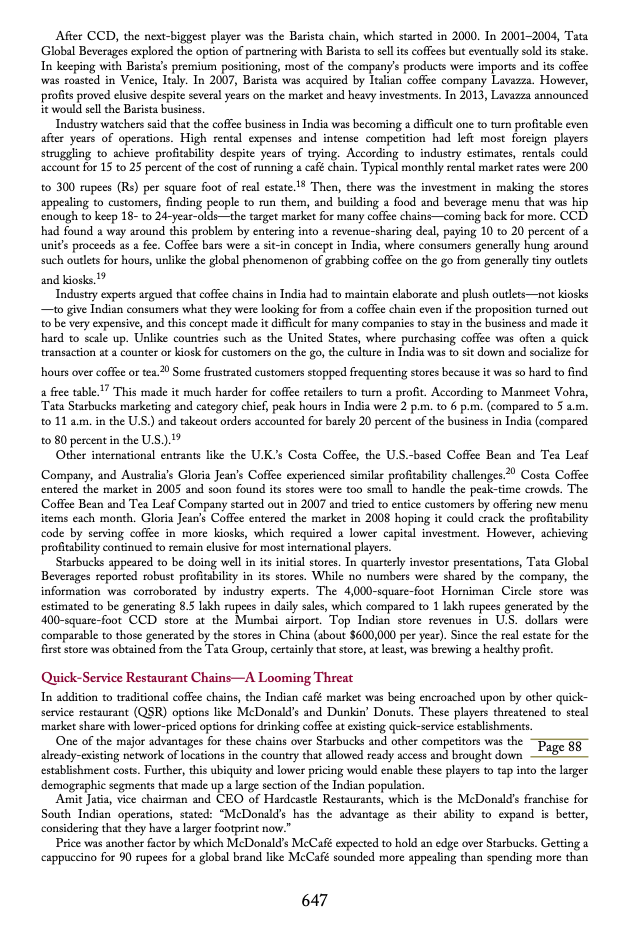
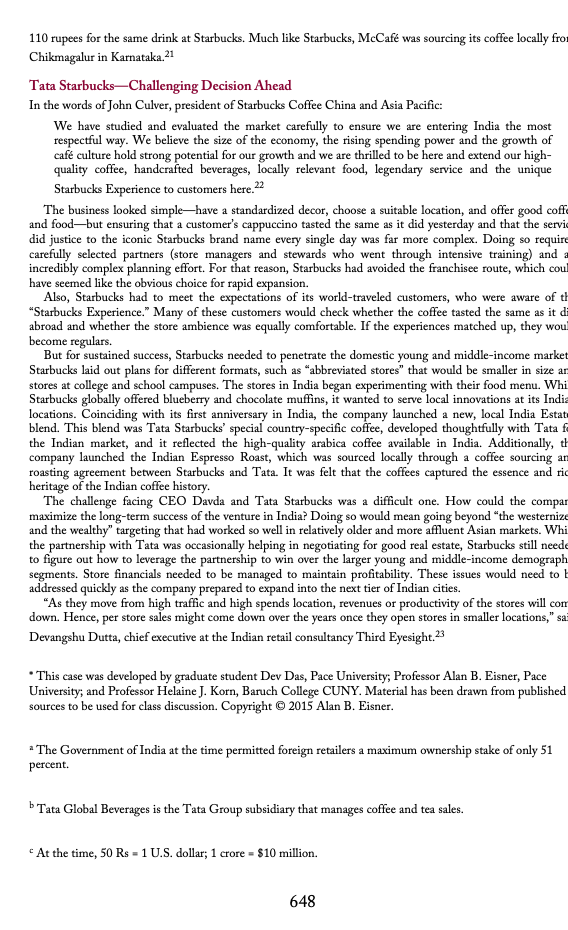
CASE 12 TATA STARBUCKS: HOW TO BREW A SUSTAINABLE BLEND FOR INDIA* In early 2015, the financial press reported that the Tata Starbucks joint venture had incurred major losses in its first full year in the Indian market. However, the company remained committed to making this venture a success over the long term. Starbucks had had its eye on the large Indian market for a while. An attempt to enter the market several years earlier had failed due to complications with the Indian government and foreign direct investment (FDI) restrictions. The company had withdrawn its application then and was an eager responder when India's esteemed Tata Group knocked on its door with a partnership opportunity. A 50-50 joint venture was formed, and Starbucks coffee was introduced to the Indian market in October 2012 with a generous initial investment of $80 million. The Tata Global Beverages board of directors expressed a lot of excitement about the potential of the newly formed joint venture between the company and Starbucks.b "Through Tata Starbucks, your company offers the legendary Starbucks coffee experience, backed by the trust of the Tata name, to the Indian consumer," announced Cyrus P. Mistry, chairman of Tata Global Beverages. The Indian caf market offered a lot of potential for the new Tata Starbucks alliance. While India was a nation known for its tea drinkers, sipping coffee and socializing at coffee shops was becoming increasingly popular. Domestic consumption of coffee had risen 80 percent in the past decade. Given these encouraging trends, Starbucks CEO, Howard Schultz, believed that India could one day rival the company's successful venture in China. With its store count exceeding 40, the Tata Starbucks joint venture had clearly come a long way since it was kicked off in January 2012, but it was too early to celebrate. Continuing to succeed in the Indian caf market would not be an easy task due to two key challenges competition and profitability. The market was intensely competitive, with multiple domestic and foreign players. The most formidable competitor was domestic giant Caf Coffee Day (CCD), which had already adopted a strategy of flooding the market with its cafs, closely mimicking what Starbucks had done in the United States. Another critical challenge companies faced was the ability to break even. High real estate costs and rental rates, along with competitive pricing pressures and India-specific cultural preferences, made it extremely difficult for coffee companies to recover their initial investments. Tata Starbucks CEO Avani Davda admitted the initial consumer experiences had been a humbling experience. Tata Starbucks had opened its first store with a lot of fanfare in the trendy Horniman Circle area of Mumbai. Despite having a high-profile local partner, Starbucks was unable to use its name to secure any discounted rates in renting real estate. The first store was located in a Tata Group-owned 4,000-square-foot site that had been vacant for a while. By 2015, Tata Starbucks appeared to have expanded to over 50 locations across the country in major metropolises like Mumbai, Delhi, Pune, and Bengaluru." Yet this was well short of the initial expectations- the target at launch had been set at 50 stores by the end of the 2012 launch year. Clearly, something had changed in management's expectations of the size or pace of growth from the venture. Quarterly earnings presentations since then had boasted of robust store profitability with no numbers provided, possibly pointing to a slower and more selective approach to expansion. However, in its first full year in the Indian market (12 months ending March 2014), Tata Starbucks reported losses of Rs 51.87 crores, more than half its total sales of 95.42 crores during the same period. 1 The joint venture appeared to be at the crossroads of an important strategic decision. It could revert to a plan to grow its store count aggressively, much like Starbucks did in the U.S. It is possible that this was the original intent. After all, the initial launch pricing had been set to be competitive with CCD's pricing (coffee drinks available for as low as Rs 100). This approach would put it in direct price competition with CCD, the domestic caf market leader. However, gaining market share among the youth of the country would allow Tata Starbucks to tap into a large demographic segment. India's population showed a pronounced skew to younger age brackets (see Exhibit 1) and lower incomes when compared to countries like Japan and the United States. Building a presence within these segments as CCD had done could be critical for success in the long term. Alternatively, the venture could choose to embrace a premium-priced, niche approach similar Pame93 to the one Starbucks had used successfully in other Asian countries, like Japan and China. The - premium offering would then cater to an older, business elite with higher spending power. This would result in less rapid growth, with a cherry-picked list of high-profile, business-friendly locations, that could also allow the venture to build a premium brand with premium pricing. EXHIBIT 1 Age Distribution by Country, 2014 10% 13% 10% 15% 47% 11% 29% 41% 7% 10% 6% 65 years and over (elderly 0-14 years children 15-24 years learly working age! 25-54 years prime working agel 55-64 years mature working agel India China Japan US Source: CIA World Factbook. Would Starbucks and Tata under Davda's leadership finally be able to crack the code for sustained success in the competitive and complex Indian market? While Davda appeared proud of what the alliance had achieved at the 2014 Starbucks annual shareholders meeting, some critical strategic choices would need to be made to ensure the long-term success of Starbucks in India. Schultz & Starbucks-Cultivating a Company from an Idea Starbucks started out in 1971 with a single coffee roaster and retailer store in the Pike Place Market in Seattle. Since then the company had expanded its global footprint considerably, with over 17,000 coffee stores in more than 50 countries. The visionary behind this international success story was CEO Howard Schultz. Schultz joined the company in 1981 and quickly assessed its growth potential after visiting coffeehouses in Italy. He envisioned his coffeehouses offering much more than just a cup of coffee. They were to become a third place, in addition to home and work, for people to meet and socialize. In addition to serving coffee, the coffeehouses would help people connect with other people and their local communities. Employees would be trained on coffee, company products, and customer service to deliver a positive "Starbucks Experience to each and every customer. Starbucks quickly acquired a reputation for being an employer of choice and a socially responsible player: When the company went public in 1992, all employees were made partners" in the company and given a share of Starbucks equity (commonly known as "bean stock"). Comprehensive health care coverage was also provided to both full-time and part-time employees. Efforts were made to ethically source products and establish strong relationships with coffee-producing farmers all over the world. In later years, the company began to utilize reusable and recyclable cups in its stores. Its employee partners contributed many hours of volunteer work to help with community After the 2008-2009 recession and the introduction of the Affordable Care Act in 2010, several companies began to cut employee benefits to manage costs. Schultz refused to reduce benefits for his partners, arguing that this was a short-term reaction and not in the interests of a company in the long term. The company's mission was to inspire and nurture the human spirit one person, one cup, and one 642 neighborhood at a time. The company planned on doing this not just in the U.S. but across the globe. The Starbucks name had been taken from a character in Herman Melville's classic adventure novel, Moby Dick. It was felt that the history of the coffee trade and Seattle had a strong association with the sea. In keeping with the sea theme, the image of a Norse twin-tailed siren was adopted as the company logo The company under Schultz's leadership performed remarkably well financially over time. Performance in 2013 showed total revenues up 12 percent to $14.9 billion, same-store sales up 7 percent, and $2.9 billion in cash flow. Operating income, however, was hit due to a one-time litigation charge with Kraft Foods Global, which resulted in a pretax charge of $2.8 billion to fiscal 2013 operating results. Excluding this one-time charge, operating income would have grown 23 percent to $2.5 billion. Initial Expansion into Asia-Targeting the Westernized and the Wealthy The first store outside North America opened in the fashionable Ginza district in Japan in 1996. Par Within the next few years, Starbucks became a well-known brand name in Japan. Like Starbucks shops in the United States, those in Japan featured comfy sofas with American music playing in the background. Unlike most Japanese kisaten, or local coffee shops, Starbucks did not allow smoking. The policy popular with women, who didn't smoke as much as men in Japan. Men eventually followed the women to Starbucks locations, and business started humming. Given the strong performance, the stock of Starbucks Coffee Japan Ltd. made its debut on the NASDAQ Japan exchange and performed strongly ever since. "Any way you measure it, we've exceeded our wildest expectations," CEO Howard Schultz announced jubilantly at the initial public offering in Tokyo, October 2001. EXHIBIT 2 Annual per Capita Income () 60,000 50,000 40,000 30,000 20.000 10,000 World Vietnam Japan h Singapore Hong Kong South Korea Malaysia China Thailand Indonesia Philippines Source: World Bank data files. Tea-drinking Japan was not a total stranger to coffee. Dutch traders first brought coffee to Japan in the 17th century, but the shogun prohibited them from traveling freely in Japan, so very few Japanese were exposed to coffee and those who were lived mainly in port cities like Nagasaki. Coffee penetrated Japan further in the 1850s with the arrival of American ships. Soon after, Japanese started to travel overseas and brought back elements of the European coffee culture. The first coffee shop opened in 1880s in Tokyo's Ueno district, and drinking the brew became associated with the wealthy classes. Over the next few decades, coffee increased in popularity within Japan, and a number of coffee chains entered the market. As business flourished between the United States and Japan, many Japanese traveled to the United States. West Coast cities like Seattle were popular destinations. So when Starbucks finally entered Japan in 1996, many Japanese were already familiar with the brand. Starbucks soon cultivated a loyal clientele of wealthy Japanese who considered it to be the original gourmet coffee shop and aspired to emulate the Western lifestyle. Starbucks Coffee Japan turned its first profit in 2000, nearly four years after its initial launch. Clearly Starbucks entered markets with a commitment to win them over the long haul. Starbucks grew to over 1,000 stores in the country. For a while, sales volume per store in Japan was twice as high as that in the United States. Between 1996 and 1999, Starbucks expanded to additional markets in countries that had a high number of international travelers and a growing segment of westernized and wealthy locals. These were countries with high or growing per capita incomes (see Exhibit 2). 643 Starbucks Singapore opened its first store in December 1996 at Liat Towers, strategically located along the nation's renowned Orchard Road shopping belt. Starbucks then entered the Philippines (1997), Taiwan, Thailand, and Malaysia (1998), and South Korea (1999), once again selecting premium locations frequented by the country's growing westernized, affluent classes and international travelers.6 Happy with its initial successes, Starbucks began planning expansions into countries with more entrenched cultures and large, diverse populations. Next Expansion Wave-Cracking the Cultural Codes Unlike Japan, tea-drinking China had little prior experience with coffee. In addition, the emerging superpower had deeply entrenched cultural traditions with regard to food and drink. Succeeding in China would be a critical challenge and opportunity for Starbucks. Cracking the cultural code there could facilitate conquering other emerging markets like India. Starbucks opened its first store in Beijing in 1999. The company recognized there was a universal need among individuals to be respected for their differences and to feel connected with others. Starbucks catered to this need by applying its culture and values in a way that was conducive to local values and tastes. Within China, instant coffee accounted for upward of 80 percent of all coffee consumption Pace 85 Given the average Chinese consumer's limited prior exposure to coffee, instant coffee had proved to be a highly effective and affordable way of expanding consumption. Starbucks took a different approach and targeted affluent Chinese consumers with beverages priced up to 50 percent higher than the prices at its U.S. stores. Most Starbucks beverages in China cost upward of 30 renminbi (RMB), or about US$5. In contrast, Nestle's Nescaf instant coffee could cost as little as RMB1.5 (US$0.10) per packet. Fueled by Starbucks, the wealthy commercial capital Shanghai quickly became the coffee culture capital of China. The owner of Shanghai-based Caf del Volcn, one of Shanghai's popular coffee retail outlets, noticed an interesting phenomenon in the initial days after opening his cafe. The prices had not yet been displayed, yet most customers ordered their beverages without inquiring about prices. Clearly the Shanghai elite were not price-sensitive. Much like Starbucks, the caf then began to focus primarily on achieving the highest level of quality and service. In 2011, a Starbucks outlet in China averaged US$600,000 in annual revenues. The strategy proved to be successful, with Starbucks' Chinese outlets becoming more profitable than those in the U.S. market. China/Asia Pacific operating margins in the last quarter of 2012 were 33.7 percent in comparison to 20.8 percent in the United States. "It's no doubt that one day China will become our second largest market after the United States, and it's possible that, over many years, potentially the largest one," mused Starbucks CEO Howard Schultz in an interview with China Daily While Nestl and Starbucks had radically different methods for getting the Chinese to drink coffee, both succeeded. This success in part can be attributed to segmenting the market and recognizing the Chinese as unique consumers with different tastes and habits than those of American consumers. For instance, Chinese consumers did not like the bitter taste associated with black coffee or espresso, so both players tailored their beverages accordingly. Nestle's Nescaf packets included sugar and powdered milk, while Starbucks emphasized milk-based drinks like frappuccinos, lattes, and mochas in its stores. Starbucks' Chinese menus also added some local flavor, with customized choices like green tea tiramisu and Chinese moon cakes. In addition, Starbucks localized its outlets by offering large seating areas, since Chinese tend to not like to take their drinks off-site. Local Chinese customers began to enjoy the "Starbucks Experience while sitting with friends and having something to munch on along with their coffee. Further, "family forums" were introduced to explain to parents the merits of having their children work at Starbucks. Large lounges with couches were provided at stores to accommodate working customers' need to relax for a bit during afternoons. Menus were modified to include foods that were tailored to local tastes, for example, a Hainan Chicken sandwich and a Thai-style Prawn wrap." By the end of 2013, Starbucks had opened its 1,000th store in the country. It was this success in China that made Schultz particularly eager to venture into India. Like China, India was another large market with culturally entrenched tastes 10 In a press interview, CEO Howard Schultz later reminisced: Our stores, domestically and around the world, have become the third place for customers between home and work. The environment, the store design, the free Wi-Fi-everything we've been able to do has created this primary destination. That is the same in Honshu (China), in Beijing, in 644 Shanghai, in Spain, in Tokyo or in New York City. We've cracked the code on universal relevance.11 Conquering Unfamiliar Markets-Seeking the Magic Formula With Starbucks' stellar performance in its initial expansion into Asia, numerous industry analysts speculated on the best practices that could be used by the company to penetrate other markets or be emulated by other companies. 12 Three key themes emerged: 1. Be tactful in marketing the brand: Once Starbucks decided to enter China, it implemented a smart market-entry strategy. It did not use any advertising and promotions that could be perceived by the Chinese as an American intrusion into the local tea-drinking culture. It just quietly focused on carefully selecting premium locations to build its brand image. Starbucks capitalized on the tea-drinking culture of Chinese consumers by introducing beverages using popular local ingredients such as green tea. It also added more milk-based beverages, such as frappuccinos, since the Chinese did not like the taste of bitter coffee. 2. Find a good local partner: Working with the right partners could be an effective way to reach local customers and expand quickly without going through a significant learning curve. China was not one homogeneous market. There were many Chinas. The culture of northern China was very different from that of the east. Consumer spending power inland was not on par in coastal cities. To address this complexity of the Chinese market, Starbucks partnered with three regional partners as part of its expansion plans. In the north, Starbucks entered a joint venture with Beijing Mei Da Coffee Company. In the east, Starbucks partnered with the Taiwan-based Uni-President. In the south, Starbucks worked with Hong Kong-based Maxim's Caterers. Each partner brought different strengths and local expertise that helped Starbucks gain insights into the tastes and preferences of local Chinese consumers. 3. Make a long-term commitment: Long-term commitment required patience. It took Starbucks time to educate the Page 86 market and gain customer loyalty. Starbucks also did an excellent job in recruiting and training its employees. This turned out to be a win-win strategy because employees were, after all, the face of the Starbucks brand and were at the heart of delivering the "Starbucks Experience to customers. This knowledge armed Starbucks as it prepared to penetrate an even more complex and competitive market- India. Passage to India-Tata Group a Worthy Partner Founded by Jamsetji Tata in 1868, Tata's early years were inspired by the spirit of nationalism. It pioneered several industries of national importance in India: steel, power, hospitality, and airlines. In more recent times, its pioneering spirit was showcased by companies such as TCS, India's first software company, and Tata Motors, which made India's first indigenously developed car, the Tata Indica, and the world's most affordable car, the Tata Nano. The Tata Group comprised over 100 operating companies in seven business sectors: communications and information technology, engineering, materials, services, energy, consumer products, and chemicals. The group had operations in more than 100 countries across six continents, and its companies exported products and services to 150 countries. Along with the increasing global footprint of Tata companies, the Tata brand was also gaining international recognition. In 2010, Business Week magazine ranked Tata 17th on its 50 Most Innovative Companies" list. Brand Finance, a U.K.-based consultancy firm, valued the Tata brand at $18 billion and ranked it 39th among the top 500 most valuable global brands in its BrandFinance Global 500 2013 report. Like Starbucks, Tata had a strong belief in social responsibility. The company created national institutions for science and technology, medical research, social studies, and the performing arts. Its trusts provided aid and assistance to nongovernment organizations (NGOs) working in the areas of education, health care, and 645 After CCD, the next-biggest player was the Barista chain, which started in 2000. In 2001-2004, Tata Global Beverages explored the option of partnering with Barista to sell its coffees but eventually sold its stake. In keeping with Barista's premium positioning, most of the company's products were imports and its coffee was roasted in Venice, Italy. In 2007, Barista was acquired by Italian coffee company Lavazza. However, profits proved elusive despite several years on the market and heavy investments. In 2013, Lavazza announced it would sell the Barista business. Industry watchers said that the coffee business in India was becoming a difficult a after years of operations. High rental expenses and intense competition had left most foreign players struggling to achieve profitability despite years of trying. According to industry estimates, rentals could account for 15 to 25 percent of the cost of running a caf chain. Typical monthly rental market rates were 200 to 300 rupees (Rs) per square foot of real estate.18 Then, there was the investment in making the stores appealing to customers, finding people to run them, and building a food and beverage menu that was hip enough to keep 18- to 24-year-oldsthe target market for many coffee chains-coming back for more. CCD had found a way around this problem by entering into a revenue-sharing deal, paying 10 to 20 percent of a unit's proceeds as a fee. Coffee bars were a sit-in concept in India, where consumers generally hung around such outlets for hours, unlike the global phenomenon of grabbing coffee on the go from generally tiny outlets and kiosks. 19 Industry experts argued that coffee chains in India had to maintain elaborate and plush outlets-not kiosks -to give Indian consumers what they were looking for from a coffee chain even if the proposition turned out to be very expensive, and this concept made it difficult for many companies to stay in the business and made it hard to scale up. Unlike countries such as the United States, where purchasing coffee was often a quick transaction at a counter or kiosk for customers on the go, the culture in India was to sit down and socialize for hours over coffee or tea.20 Some frustrated customers stopped frequenting stores because it was so hard to find a free table.17 This made it much harder for coffee retailers to turn a profit. According to Manmeet Vohra, Tata Starbucks marketing and category chief, peak hours in India were 2 p.m. to 6 p.m. (compared to 5 a.m. to 11 a.m. in the U.S.) and takeout orders accounted for barely 20 percent of the business in India (compared to 80 percent in the U.S.).19 Other international entrants like the U.K's Costa Coffee, the U.S.-based Coffee Bean and Tea Leaf Company, and Australia's Gloria Jean's Coffee experienced similar profitability challenges.20 Costa Coffee entered the market in 2005 and soon found its stores were too small to handle the peak-time crowds. The Coffee Bean and Tea Leaf Company started out in 2007 and tried to entice customers by offering new menu items each month. Gloria Jean's Coffee entered the market in 2008 hoping it could crack the profitability code by serving coffee in more kiosks, which required a lower capital investment. However, achieving profitability continued to remain elusive for most international players. Starbucks appeared to be doing well in its initial stores. In quarterly investor presentations, Tata Global Beverages reported robust profitability in its stores. While no numbers were shared by the company, the information was corroborated by industry experts. The 4,000-square-foot Horniman Circle store was estimated to be generating 8.5 lakh rupees in daily sales, which compared to 1 lakh rupees generated by the 400-square-foot CCD store at the Mumbai airport. Top Indian store revenues in U.S. dollars were comparable to those generated by the stores in China (about $600,000 per year). Since the real estate for the first store was obtained from the Tata Group, certainly that store, at least, was brewing a healthy profit. Quick-Service Restaurant Chains-A Looming Threat In addition to traditional coffee chains, the Indian caf market was being encroached upon by other quick- service restaurant (QSR) options like McDonald's and Dunkin' Donuts. These players threatened to steal market share with lower-priced options for drinking coffee at existing quick-service establishments. One of the major advantages for these chains over Starbucks and other competitors was the Paregg already-existing network of locations in the country that allowed ready access and brought down - establishment costs. Further, this ubiquity and lower pricing would enable these players to tap into the larger demographic segments that made up a large section of the Indian population Amit Jatia, vice chairman and CEO of Hardcastle Restaurants, which is the McDonald's franchise for South Indian operations, stated: McDonald's has the advantage as their ability to expand is better, considering that they have a larger footprint now." Price was another factor by which McDonald's McCaf expected to hold an edge over Starbucks. Getting a cappuccino for 90 rupees for a global brand like McCaf sounded more appealing than spending more than 647 110 rupees for the same drink at Starbucks. Much like Starbucks, McCaf was sourcing its coffee locally from Chikmagalur in Karnataka.21 Tata Starbucks-Challenging Decision Ahead In the words of John Culver, president of Starbucks Coffee China and Asia Pacific We have studied and evaluated the market carefully to ensure we are entering India the most respectful way. We believe the size of the economy, the rising spending power and the growth of caf culture hold strong potential for our growth and we are thrilled to be here and extend our high- quality coffee, handcrafted beverages, locally relevant food, legendary service and the unique Starbucks Experience to customers here 22 The business looked simplehave a standardized decor, choose a suitable location, and offer good coffe and foodbut ensuring that a customer's cappuccino tasted the same as it did yesterday and that the servic did justice to the iconic Starbucks brand name every single day was far more complex. Doing so require carefully selected partners (store managers and stewards who went through intensive training) and a incredibly complex planning effort. For that reason, Starbucks had avoided the franchisee route, which coul have seemed like the obvious choice for rapid expansion. Also, Starbucks had to meet the expectations of its world-traveled customers, who were aware of th "Starbucks Experience. Many of these customers would check whether the coffee tasted the same as it di abroad and whether the store ambience was equally comfortable. If the experiences matched up, they woul become regulars. But for sustained success, Starbucks needed to penetrate the domestic young and middle-income market Starbucks laid out plans for different formats, such as "abbreviated stores" that would be smaller in size an stores at college and school campuses. The stores in India began experimenting with their food menu. Whi Starbucks globally offered blueberry and chocolate muffins, it wanted to serve local innovations at its India locations. Coinciding with its first anniversary in India, the company launched a new, local India Estate blend. This blend was Tata Starbucks' special country-specific coffee, developed thoughtfully with Tata fe the Indian market, and it reflected the high-quality arabica coffee available in India. Additionally, th company launched the Indian Espresso Roast, which was sourced locally through a coffee sourcing at roasting agreement between Starbucks and Tata. It was felt that the coffees captured the essence and ric heritage of the Indian coffee history. The challenge facing CEO Davda and Tata Starbucks was a difficult one. How could the compar ong-term success of the venture in India? Doing so would mean going beyond the westernize and the wealthy" targeting that had worked so well in relatively older and more affluent Asian markets. Whi the partnership with Tata was occasionally helping in negotiating for good real estate, Starbucks still neede to figure out how to leverage the partnership to win over the larger young and middle-income demograph segments. Store financials needed to be managed to maintain profitability. These issues would need to b addressed quickly as the company prepared to expand into the next tier of Indian cities. "As they move from high traffic and high spends location, revenues down. Hence, per store sales might come down over the years once they open stores in smaller locations," sai Devangshu Dutta, chief executive at the Indian retail consultancy Third Eyesight.23 * This case was developed by graduate student Dev Das, Pace University; Professor Alan B. Eisner, Pace University; and Professor Helaine J. Korn, Baruch College CUNY. Material has been drawn from published sources to be used for class discussion. Copyright 2015 Alan B. Eisner. * The Government of India at the time permitted foreign retailers a maximum ownership stake of only 51 percent. b Tata Global Beverages is the Tata Group subsidiary that manages coffee and tea sales. At the time, 50 Rs = 1 U.S. dollar; 1 crore - $10 million. 648









 Study Help