







Question: Based on the data provided in page 5 under Sales Force Expansion and using workload calculation, what is the recommended number of PSOs should MRL
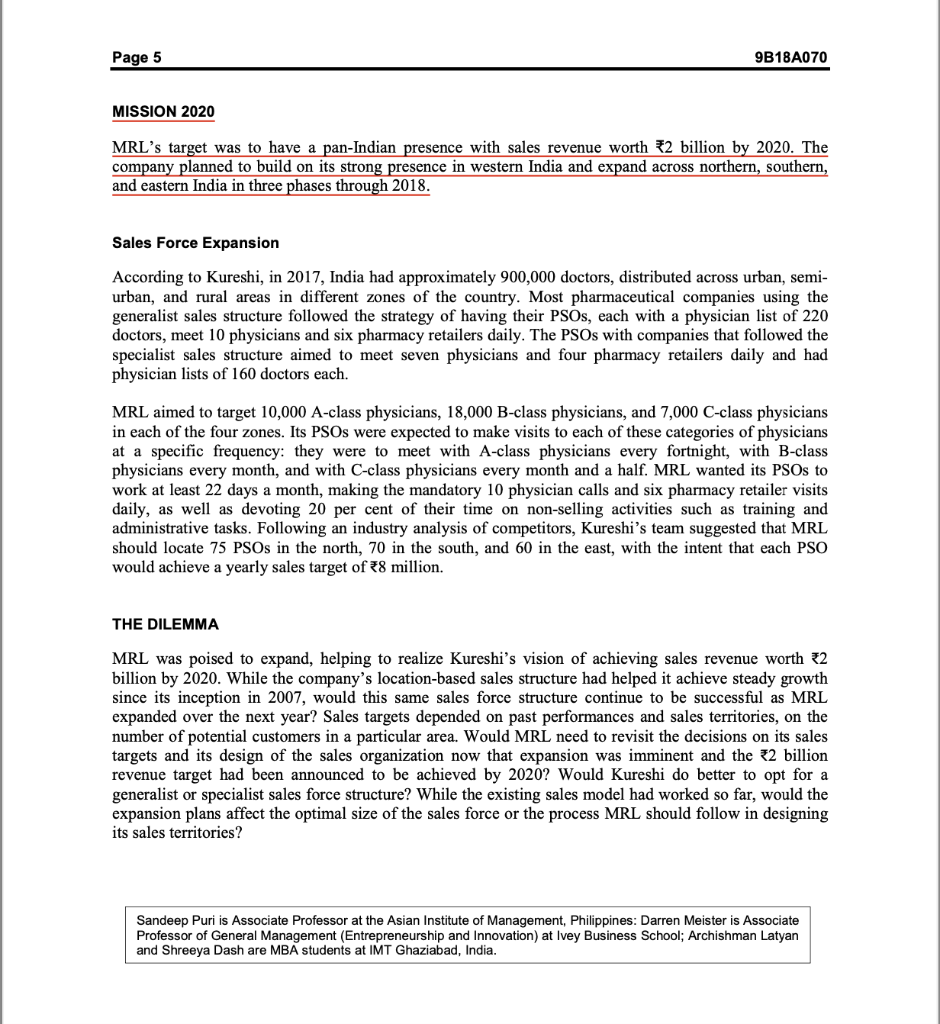
Based on the data provided in page 5 under Sales Force Expansion and using workload calculation, what is the recommended number of PSOs should MRL employ?
MISSION 2020 MRL's target was to have a pan-Indian presence with sales revenue worth 2 billion by 2020. The company planned to build on its strong presence in western India and expand across northern, southern, and eastern India in three phases through 2018. Sales Force Expansion According to Kureshi, in 2017, India had approximately 900,000 doctors, distributed across urban, semiurban, and rural areas in different zones of the country. Most pharmaceutical companies using the generalist sales structure followed the strategy of having their PSOs, each with a physician list of 220 doctors, meet 10 physicians and six pharmacy retailers daily. The PSOs with companies that followed the specialist sales structure aimed to meet seven physicians and four pharmacy retailers daily and had physician lists of 160 doctors each. MRL aimed to target 10,000 A-class physicians, 18,000 B-class physicians, and 7,000 C-class physicians in each of the four zones. Its PSOs were expected to make visits to each of these categories of physicians at a specific frequency: they were to meet with A-class physicians every fortnight, with B-class physicians every month, and with C-class physicians every month and a half. MRL wanted its PSOs to work at least 22 days a month, making the mandatory 10 physician calls and six pharmacy retailer visits daily, as well as devoting 20 per cent of their time on non-selling activities such as training and administrative tasks. Following an industry analysis of competitors, Kureshi's team suggested that MRL should locate 75 PSOs in the north, 70 in the south, and 60 in the east, with the intent that each PSO would achieve a yearly sales target of 8 million. THE DILEMMA MRL was poised to expand, helping to realize Kureshi's vision of achieving sales revenue worth 2 billion by 2020 . While the company's location-based sales structure had helped it achieve steady growth since its inception in 2007, would this same sales force structure continue to be successful as MRL expanded over the next year? Sales targets depended on past performances and sales territories, on the number of potential customers in a particular area. Would MRL need to revisit the decisions on its sales targets and its design of the sales organization now that expansion was imminent and the 2 billion revenue target had been announced to be achieved by 2020 ? Would Kureshi do better to opt for a generalist or specialist sales force structure? While the existing sales model had worked so far, would the expansion plans affect the optimal size of the sales force or the process MRL should follow in designing its sales territories? Sandeep Puri is Associate Professor at the Asian Institute of Management, Philippines: Darren Meister is Associate Professor of General Management (Entrepreneurship and Innovation) at Ivey Business School; Archishman Latyan and Shreeya Dash are MBA students at IMT Ghaziabad, IndiaStep by Step Solution
There are 3 Steps involved in it
1 Expert Approved Answer
Step: 1 Unlock

Question Has Been Solved by an Expert!
Get step-by-step solutions from verified subject matter experts
Step: 2 Unlock
Step: 3 Unlock
 Study Help