







Question: Please solve the Resources and Capabilities section Instructions and Questions to discuss the KFC case Study KFC, a food chain restaurant has been a significant
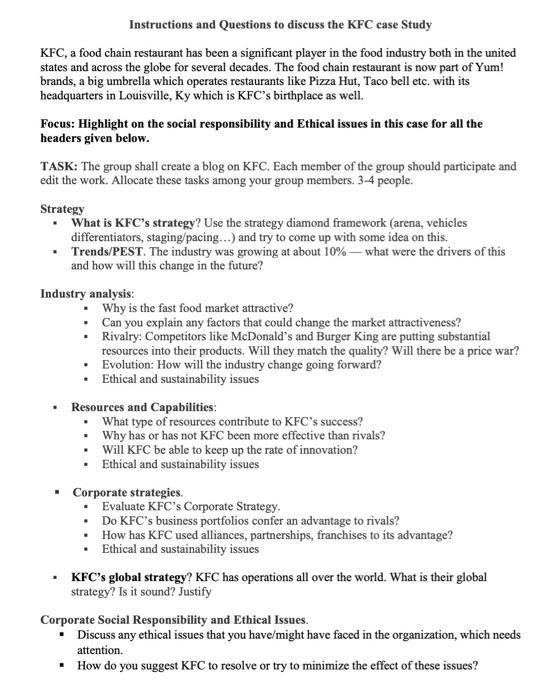
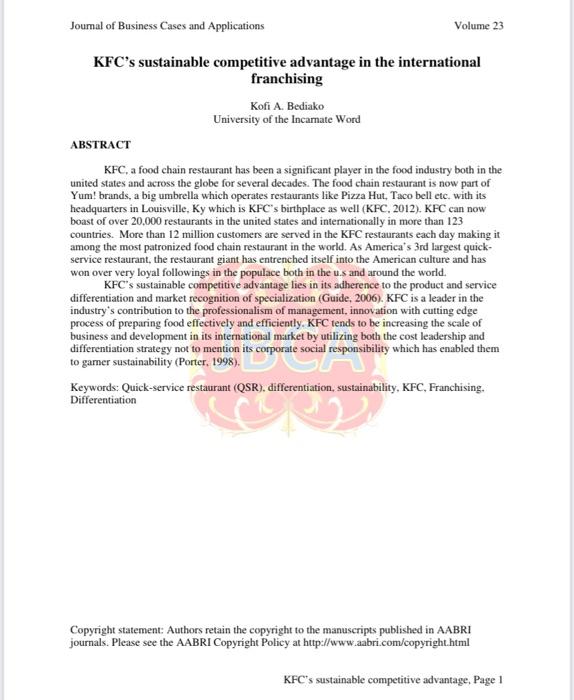
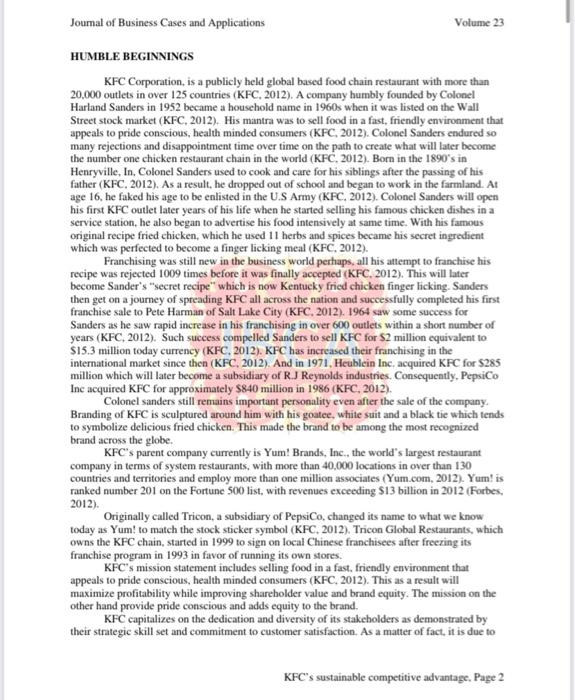
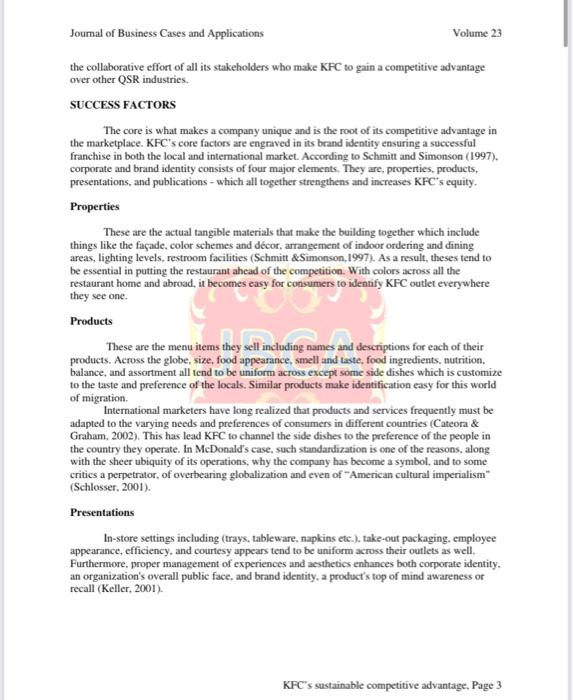
Instructions and Questions to discuss the KFC case Study KFC, a food chain restaurant has been a significant player in the food industry both in the united states and across the globe for several decades. The food chain restaurant is now part of Yum! brands, a big umbrella which operates restaurants like Pizza Hut, Taco bell etc. with its headquarters in Louisville, Ky which is KFC's birthplace as well. Focus: Highlight on the social responsibility and Ethical issues in this case for all the headers given below. TASK: The group shall create a blog on KFC. Each member of the group should participate and edit the work. Allocate these tasks among your group members. 3-4 people. Strategy - What is KFC's strategy? Use the strategy diamond framework (arena, vehicles differentiators, staging/pacing...) and try to come up with some idea on this. - Trends/PEST. The industry was growing at about 10% - what were the drivers of this and how will this change in the future? Industry analysis: - Why is the fast food market attractive? - Can you explain any factors that could change the market attractiveness? - Rivalry: Competitors like McDonald's and Burger King are putting substantial resources into their products. Will they match the quality? Will there be a price war? - Evolution: How will the industry change going forward? - Ethical and sustainability issues - Resources and Capabilities: - What type of resources contribute to KFC's success? - Why has or has not KFC been more effective than rivals? - Will KFC be able to keep up the rate of innovation? - Ethical and sustainability issues - Corporate strategies. - Evaluate KFC's Corporate Strategy. - Do KFC's business portfolios confer an advantage to rivals? - How has KFC used alliances, partnerships, franchises to its advantage? - Ethical and sustainability issues - KFC's global strategy? KFC has operations all over the world. What is their global strategy? Is it sound? Justify Corporate Social Responsibility and Ethical Issues. - Discuss any ethical issues that you have/might have faced in the organization, which needs attention. - How do you suggest KFC to resolve or try to minimize the effect of these issues? ABSTRACT KFC, a food chain restaurant has been a significant player in the food industry both in the united states and across the globe for several decades. The food chain restaurant is now part of Yum! brunds, a big umbrella which operates restaurants like Pizza Hut, Taco bell etc. with its headquarters in Louisville, Ky which is KFC 's birthplace as well ( KFC, 2012). KFC can now boast of over 20,000 restaurants in the united states and intemationally in more than 123 countries. More than 12 million customers are served in the KFC restaurants each day making it among the most patronized food chain restaurant in the world. As America's 3rd largest quickservice restaurant, the restaurant giant has entrenched itself into the American culture and has won over very loyal followings in the populace both in the u.s and around the world. KFC's sustainable competitive advantage lies in its adherence to the product and service differentiation and market recognition of specialization (Guide, 2006). KFC is a leader in the industry's contribution to the professionalism of management, innovation with cutting edge process of preparing food effectively and efficiently. KFC tends to be increasing the scale of business and development in its international market by utilizing both the cost leadership and differentiation strategy not to mention its corporate social responsibility which has enabled them to gamer sustainability (Porter, 1998). Keywords: Quick-service restaurant (QSR). differentiation, sustainability, KFC. Franchising. Differentiation Copyright statement: Authors retain the copyright to the manuscripts published in AABRI journals. Please see the AABRI Copyright Policy at http://www.aabri.com/copyright.html KFC's sustainable competitive advantage, Page I HUMBLE BEGINNINGS KFC Corporation, is a publicly held global based food chain restaurant with more than 20,000 outlets in over 125 countries (KFC, 2012). A company humbly founded by Colonel Harland Sanders in 1952 became a household name in 1960s when it was listed on the Wall Street stock market (KFC, 2012). His mantra was to sell food in a fast, friendly environment that appeals to pride conscious, health minded consumers (KFC, 2012). Colonel Sanders endured so many rejections and disappointment time over time on the path to create what will later become the number one chicken restaurant chain in the world (KFC. 2012). Born in the 1890 's in Henryville, In, Colonel Sanders used to cook and care for his siblings after the passing of his father (KFC, 2012). As a result, he dropped out of school and began to work in the farmland. At age 16, he faked his age to be enlisted in the U.S Army (KPC. 2012). Colonel Sanders will open his first KFC outlet later years of his life when he started selling his famous chicken dishes in a service station, he also began to advertise his food intensively at same time. With his famous original recipe fried chicken, which he used 11 herbs and spices became his secret ingredient which was perfected to become a finger licking meal (KFC, 2012). Franchising was still new it the business world perhaps, all his attempt to franchise his recipe was rejected 1009 times before it was finally accepted (KFC. 2012). This will later become Sander's "secret recipe" which is now Kentucky fried chicken finger licking. Sanders then get on a journey of spreading KFC all across the nation and successfully completed his first franchise sale to Pete Harman of Salt Lake City (KFC. 2012). 1964 saw some success for Sanders as he saw rapid increase in his franchising in over 600 outlets within a short number of years (KFC, 2012). Such success compelled Sanders to sell KFC for $2 million equivalent to \$15.3 million today currency (KFC, 2012). KFC has increased their franchising in the international market since then (KFC, 2012). And in 1971, Heublcin Inc, acquired KFC for $285 million which will later become a subsidiary of R.J Reynolds industries. Consequently. PepsiCo Inc acquired KFC for approximately $840 million in 1986 (KFC, 2012). Colonel sanders still remains important personality even after the sale of the company. Branding of KFC is sculptured around him with his goatee, white suit and a black tie which tends to symbolize delicious fried chicken. This made the brand to be among the most recognized brand across the globe. KFC's parent company currently is Yum! Brands, Inc., the world's largest restaurant company in terms of system restaurants, with more than 40,000 locations in over than 130 countries and territories and employ more than one million associates (Yum.com, 2012). Yum! is ranked number 201 on the Fortune 500 list, with revenues exceeding $13 billion in 2012 (Forbes. 2012). Originally called Tricon, a subsidiary of PepsiCo, changed its name to what we know today as Yum! to match the stock sticker symbol (KFC, 2012). Tricon Global Restaurants, which owns the KFC chain, started in 1999 to sign on local Chinese franchisees after freering its franchise program in 1993 in favor of running its own stores. KFC 's mission statement includes selling food in a fast, friendly environment that appeals to pride conscious, health minded consumers (KFC, 2012). This as a result will maximize profitability while improving shareholder value and brand equity. The mission on the other hand provide pride conscious and adds equity to the brand. KFC capitalizes on the dedication and diversity of its stakeholders as demonstrated by their strategic skill set and commitment to customer satisfaction. As a matter of fact, it is due to KFC's sustainable competitive advantage, Page 2 Joumal of Business Cases and Applications Volume 23 the collaborative effort of all its stakeholders who make KFC to gain a competitive advantage over other QSR industries. SUCCESS FACTORS The core is what makes a company unique and is the root of its competitive advantage in the marketplace. KFC 's core factors are engraved in its brand identity ensuring a successful franchise in both the local and international market. According to Schmitt and Simonson (1997). corporate and brand identity consists of four major elements. They are, properties, products, presentations, and publications - which all together strengthens and increases KFC s equity. Properties These are the actual tangible materials that make the building together which include things like the facade, color schemes and decor, arrangement of indoor ordering and dining areas, lighting levels, restroom facilities (Schmitt \&Simonson, 1997). As a result, theses tend to be essential in putting the restaurant ahead of the competition. With colors across all the restaurant home and abroad, it becomes easy for consumers to identify KFC outlet everywhere they see one. Products These are the menu items they sell including names and descriptions for each of their products. Across the globe, size, food appearance, smell and taste, food ingredients, nutrition. balance, and assorment all tend to be uniform across except some side dishes which is customize to the taste and preference of the locals. Similar products make identification easy for this world of migration. International marketers have long realized that products and services frequently must be adapted to the varying needs and preferences of consumers in different countries (Cateora \& Graham, 2002). This has lead KFC to channel the side dishes to the preference of the people in the country they operate. In McDonald's case, such standardization is one of the reasons, along with the sheer ubiquity of its operations, why the company has become a symbol, and to some critics a perpetrator, of overbearing globalization and even of "American cultural imperialism" (Schlosser, 2001). Presentations In-store settings including (trays, tableware, napkins ete.), take-out packaging, employee appearance, efficiency, and courtesy appears tend to be uniform across their outlets as well. Furthermore, proper management of experiences and aesthetics enhances both corporate identity. an organization's overall public face, and brand identity, a product's top of mind awareness or recall (Keller, 2001). KFC's sustainable competitive advantage, Page 3 Joumal of Business Cases and Applications Volume 23 Publications This include advertising: web pages; outdoor signage; trade characters. All publication tends to be same across board no matter where they are located. Ordinary service interactions become experiences when customers are engaged in a personal, memorable way (Pine \& Gilmore, 1998). Schmitt and Simonson (1997) contend that good aesthetics management also creates customer loyalty, allows for premium pricing. cuts through information clutter, affords protection from competitive attacks, saves costs through standardization, and, as an internal marketing tool, motivates employees. STRATEGIC PILL.ARS KFC s sustainable competitive advantage and success factors are grounded on four strategic pillars. They are 1. Service 2. Quality 3. Cleanliness 4. Value (KFC, 2012). These allow KFC to get more advantage over the competition. Despite the fact that MacDonald's increased its stores to over 37000 globally. KFC's overall market share has increased drastically to due to proper implementation of these strategic pillars. Services KFC introduces "freshly cooked meal" concept giving consumers a perspective of quality and freshness unlike their competitors which tases microwave to warm already prepared meals. At KFC, "we make our chicken the hard way" tends to be among the most popular slogans by colonel Sanders (KFC, 2012). According to Colonel Sanders (KFC, 2012), each fresh batch of the world's best chicken starts with our cools inspecting each individual piece. This tends to show service to be crucial part of the company even at the preparation of their meal. With detailed attention place on service each customer receives, KFC ensures customers has the ability to complete an online survcy each time you visit one of their outlet. Such information are used in future improvement in the customer service. Been a local or foreign outlet, KFC ensures service provided to customers doesn't differ thereby, same experience for the customer everywhere (KFC. 2012). Quality According to the British standard institute, quality is the basic character or nature of something. In the food industry, the specification and taste of a meal will determine if it warranted for five-star or not. This supports Juran's definition of quality which according to him. "fitness for purpose or use" (Juran, 1979). A product's ability to satisfy stated or implied needs. Furthermore, stated or implied needs also invoke an element of customer expectation by expanding on the definition of quality (Feigenbaum, 1985). KFC tends to be cooking their food served to the consumers unlike what other QSR does. Other QSR tend to be serving meals cooked in a central kitchen, frozen and then reheat for the consumer. KFC on the other hand are making the food which tends to be more quality than their competitors. The general view is exemplified by Peters (1989), who urges: "provide top quality, as perceived by the customer". Specifically, in the hospitality industry. Pickworth (1987) Joumal of Business Cases and Applications Volume 23 recommends that: quality should be defined in terms of consumer expectations". However, Pirsig (1999) gives some idea of the problems involved in actually doing this: "Quality is a characteristic of thought and statement that is recognized by a non-thinking process,.quality cannot be defined"(Pirsig, 1999). Among things used to capture quality of restaurants include the originality of the menu, style of service, attributes of staff. Operations With KFC's strategic franchising, they have partnered with Rostik which is a strategic alliance formed in 2005 between Rostik Group and Yum! Brands. This strategic alliance has increased KFC 's presence in u.s and other part of the world they operate. KFC Asia With the growing of the American pop culture and the influx of globalization, KFC's expansion in Asia started in the early 1980 s with its first building in the capital city of Beijing. China. This become a suceess for the QSR's entry into the southeast Asian market. KFC translates in the popular Mandarin language as Ken De Jin became popular among the people due partly to the ease of the translation. To fully gamer the market and utilize the growing western pop culture, KFC opened its china's first drive through in 2002 as middle class swelled translating to the purchase of more private vehicles. With its attention to customer service and effective market strategy, KFC had twice as many outlets in china than its biggest competitor. McDonald's, in 2008(KFC,2014). Furthermore, strategic franchising lead to a sustainable competitive advantage with its involvement of some Taiwan-born u.s educated executives who helped with the initial stage of KFC moving to china. With knowledge of both Chinese and American culture, strong partnerships were formed with the locals to customize their menus and business strategies (Romualdez, 2017). KFC Europe In 1965, KFC opened its first European outlet in the United Kingdom at the Preston, Lancashire (KFC, 2012). KFC then went on franchising in Germany, Spain and other parts of Europe due to the success they received with their first entry. Currently. Europe is KFC's 3 biggest market. In Russia, KFC's menu is mostly familiar with the locals and due to chicken been popular throughout the world comparing to hamburger, the menu became normal with few tweaks. Rostik Group is a leading QSR chain in Russia and in 2005, a strategic alliance was formed with Yum! brands to franchise more KFC outlets. This alliance not helped foster KFC's growth but its competitive advantage as well (Yum, 2010). With these alliance, franchising has skyrocketed for KFC in the European market making them popular in most households. KFC Africa Although KFC's presence in Africa is not as huge compare to that of Europe and Asia. they have plans to expand with more outlets. Currently. Africa has the youngest population in the word with 200 million aged between 15 and 24 years (Ighobor, 2013). This creates an avenue KFC's sustainable competitive advantage, Page 5 Journal of Business Cases and Applications Volume 23 for KFC to continue its progressive growth as the continent develops. KFC still has first mover advantage in most of the African countries they operate. McDonalds, its biggest competitor is center in the southern part of Africa while KFC focuses on all part of Africa. Add on services like free Wi-Fi and reliable air condition tends to attract the locals and this as a result has been a tool for differentiation for KFC in Africa. Consequently, KFC has over 1000 outlets compare to under 500 outlets for its competitor, McDonald's. BUIIDING A COMPETTTIVE ADVANTAGE McDonalds is perhaps the biggest and longtime competitor with KFC. Ever since Ray Kroc took on the operations in 1954, he turned the chain into a global franchise making it the most successful quick service restaurant in the world (McDonalds, 2014). This has created a huge competition enabling innovations from both KFC and McDonalds. All differences between companies in cost or price derive from the hundreds of activities required to create, product, sell and deliver their products or services (Porter, 1996). Cost is generated by performing activities, and advantages arise from doing it more efficiently than competitors (Porter, 1996). Despite the fact that McDonalds don't sell the same exact menu that of KFC's, both still tends to engage in price war one way or the other aiming to aftract more customers to their outlets. Customer experience tends to be a differentiation process they tend to use in the competition war due to pricing strategy alone will not be a viable in the long sustainability for KFC to continue to garner the market. Evidently. KFC's strategy is to focus on the international franchising by dominating the global market. Focus was placed on how their meals can meet the ever-changing laste and preferences of the market they serve. The gain here is that, they can capture the global QSR market. With their alliance with local suppliers of their raw materials, it helped strengthens KFC's community to the community which results in a competitive advantage. KFC need stronger connection with the millennials and the Gen Z who tends to be more inclined with the fast food industry. Taste and service appears to be number one concern for the young consumers and to capture these demographics, more emphasis been placed on these pressing concems. A\&W was the very first QSR to be opened in the united states. It was founded on June 1919. in Lodi, California by Roy Allen and Frank Wright. At some point in time. A\&W was owned by Yum! brands, the parent company of KFC. and appeared that some of the operation style of A \&W was adapted by KFC (Yum, 2010). KFC focused on international expansion after been dominant in the u.s market. By providing specifically for the market they found their selves, KFC carved out a niche and eventually drove other competitors out. With the penetration of the u s culture and food in the international market, this has given KFC the competitive advantage of selecting a segment of the market where rival miss out on this strategy. This strategy is first mover advantage. According Porter (1996), for a company to gain competitive advantage against its rivals, one must know the layout of the situation and the strengths of the competition (Porter, 1996). This is very true in market where many differently placed QSRs are vying for market share. "As rivals imitate one another's improvements in quality, cycle times, or supplier partnerships, strategies converge and competition becomes a series of races down identical paths that no one can win" (Porter, 1996). Consequently, differences between a company's cost are derived from all the activities required to create, produce, sell and deliver their products or services; the cost KFC's sustainable competitive advantage, Page 6 Joumal of Business Cases and Applications Volume 23 advantage arises from performing particular activities more efficiently than competitors (Porter. 1996). With the strategic framework, KFC would have mone competitive advantage with its customer centric while also leveraging on corporate social responsibility to sustain their competitive advantage. CORPORATE SOCIAL. RESPONSIBIIIIY Corporate social responsibility (CSR) is driving force of how a company is perceived both local and international in their community. This is one of the key strategy KFC has leveraged to sustain its competitive advantage. The definition of CSR tends to be complex due to the nature and context of the problem at hand. However, the basic contest is whether CSR is simply " greenwash" (Greer \& Bruno, 2000)-i.e. merely businesses claiming environmental credentials and other social contributions while continuing to generate excessive harms such as social costs, i.e. "business as usual" (KPMG and UNEP 2006: OECD 1999, 2003; UNEP 2000; Palarro \& Richter, 2005). Corporate Social Responsibility (CSR) is aftracting increasing scholarly interest among researchers who study multinational enterprises (MNEs) (Rodriguez et al. 2006). In ideal terms, stakeholder engagement could be interpreted as a mutually beneficial and just scheme of co- operation which takes the form of a "moral partnership of equals' (Phillips, 1997). In the turn of the decade, interest in the behavior of furms and large companies has been ignited as a consequence of numerous scandals coming to light from financial firms to production companies etc. Consequently. companies has been diligent in oversecing and ensuring these concems and are incorporated in the day to day operation of their businesses. These developments have triggered the very real challenge for business managers of deciding how, on a day-to-day practical basis, to operationalize CSR and manage their firm's obligations to their various stakeholders (O'Riordan \& Fairbriss, 2012a, b). KFC has a rich history of generosity which was inspired by its founder Colonel Harland Sanders (KFC, 2012). Evidently, there is a KFC foundation which provide assistance to more than 4500 students and KFC employees by helping them go to college and earming a GED. The foundation has provided $17 million. As noted, these contributions come from their franchisees and the KFC corporation. At the same time, enterprises are expected to solve the problems they cause by acting responsibly and by taking the consequences of their business activities for society and for specific stakeholders into account in their decisions (Hopkins, 1997). CSR has increased tremendously in Europe during the last decade (Zwetsloot \& Marrewijk, 2004). KFC's CSR programs focus on all its market but not only in the u.s and the major emerging economies ( ic. Brazil, Russia, India, China). These countries tend to have more emphasis on corporate governance and has become major focus with India's amendments to company laws and introduction of new regulatory mechanisms (Srinivasan, 2011). Consumer value is a highly complex concept in that it integrates an array of possible product quality attributes, process-related attributes and less tangible sources of value, in particular, brand image (Schroder, 2003). CSR and how is implemented in KFC is divided into 4 categories. Among them are: 1. Food 2. People 3. Community 4. Environment. KFCs sustainable competitive advantage, Page 7 Food KFC holds a believe that food is part of a balanced lifestyle with moderation of exercise. As a result, 3 pillars has been created to ensure consistent progress is made with their food. 1 . More choice 2. Improving the ingredients and 3. More transparency. With these pillars, Yum! has a commitment to reach 20 percent of its meals at one third of the recommended daily allowance (RDA), a goal ideal for all the QSR food industries (KFC, 2012). Introduction of meals lower in calories and fat tends to showcase their commitment to healthy meals to the consumer (KFC, 2012). Evidently, KFC (Yum!) was the first company to call on congress to enact uniform nation menu labeling as well as one of the first in the world to eliminate artificial trans-fat (KFC. 2012). This is an avid example of its commitment to corporate social responsibility (CSR). People It's noted that people are the most valuable asset of every organization. People drives innovations which tends to be not different from KFCs" perspective. As a results, career and learning opportunities are made accessible to more than Yum!'s 1 million associates across the globe (KFC 2012). In the u.s, tuition reimbursement is made accessible to all salaried associates as a way to build and develop human capital. Furthermore, approximately 2500 scholarships has been awarded through Yuml's Andy Pearson scholarship program which was established to strengthen the company"s CSR (Yum, 2010). Community CSR without incorporation of the community tends to have few impact and perception in the society. As a result, Yum! has taken on a journey to be more prevalent in the community by making food accessible to the less fortunate (Yum, 2010). This has compelled them to partner with U.N World food program through its initiative of World Hunger relief in 2007 . This initiative has raised more than $600 million and provided 2.4 billion meals ( KFC, 2012). KFC tends to donate more than 173 million pounds of food to those in need. Furthermore, scholarships are given out annually to deserving individuals in the community (KFC. 2012). Giving back is not something new to KFC and it started with a college student who Colonel sanders gave a ride and full scholarship (KFC, 2012). This act of kindness is what will inspire KFC to create a foundation which will provide over $14 million in scholarships to 2600 students with some been KFC s employees ( KFC,2012). With their community developing, KFC's primary focus are on 4 key areas. These are 1. World hunger relief 2. Volunteerism and Local Community Engagement 4. Harvest food Donation. World Hunger Relief The goal for this initiative is to mobilize all stakeholders including customers to help alleviate hunger through volunteerism. Awareness and Fundraising (yum, 2010). Since the introduction of this initiatives, incredible results have been achieved which includes the following: Journal of Business Cases and Applications Volume 23 1. Provided over 140 million meals 2. Has raised more than $35 million in cash and food donations 3. Y um! brand as a corporate entity has provided nearly 2.6 billion meals to hunger relief agencies in countries of greatest needs. 4. Raised funds to support emergency operations and mother-child health and nutrition programs with most focus in countries of greatest needs. From the onset of KFC. Colonel Sanders has engrained the culture of giving back in KFC's DNA. This has led to numerous contribution and the path to fight global hunger through Add Hope and hunger initiatives etc. most recent report shows in 2015,$11 million in cash and food donations were provided for hunger organizations and over 44 million meals has been provided to women and children across the globe (KFC, 2016). Volunteerism and Local Community engagement This is also one of the core strategies KFC has been utilizing to gain competitive advantage in the heavily saturated food industry. Most recent report from 2015 shows employees from 20 countries clocked over 40,000 volunteer hours through local charity group to impact community projects ( KFC,2015). Community engagement is among the bases for competitive advantage and way to showcase its activity in the community, Around the globe KFC focus on having deeply rooted community engage wherever they have an outlet, In south Africa. KFC has been a proud sponsor of the mini-cricket program since 2009. This is to promote balanced lifestyles and active living for children (KFC. 2015). Recently, Yum! Brands provided relief efforts for the 7.8 magnitude earthquake that hit Nepal killing over 8000 people leaving more than 21000 people injured (KFC,2016). Harvest Food Donation The goal is to be a global QSR leader in wholesome and surplus food donations (KFC. 2015). This is additional contribution to the food giving out to the needy. Since KFC's mission is to have freshly prepared food to its customer (KFC, 2012), surplus are giving out to food banks and other charitable organizations for distribution rather than discarding them to the landfills. Just on this surplus alone, a fair market value of over $860 million in surplus meals has been giving out to the charitable organizations ( KFC,2015 ). Yum! brand as an organization is a member of the food waste reduction Alliance which is a coalition of manufacturing retail and food service industry leaders taking on the challenge of distributing surplus of their meals rather than discarding (KFC. 2015). Evidently, there is a partnership with local charities who does weekly surplus food pickups for feeding local huagry people around the corner. Discarding surplus in the landfill quickly becomes a significant source of methane which is a potent greenhouse gas which is 21 times more than the global warming emission of carbon dioxide. This appears to be an innovative way to put resources to the benefit of both the community and the company as a whole ( KFC, 2015). This program is not just seen in the united states alone but across the globe where they operate and has been taking incremental steps to combat this initiative. KFC s sustainable competitive advantage, Page 9 Journal of Business Cases and Applications Volume 23 Environment This is one of the most discussed aspect of CSR and KFC as a company tends to take this serious. Initiatives ranges from energy and water conservation, environmentally friendly packaging, oil and cardboard recycling etc. Among all their restaurants, they have over 4200 LEED certified, a number that tends to be astronomical in the restaurant industry (KFC, 2015). This initiative helps reduce CO2 transmission and was estimated to 1.2 million metric ton reduction equivalent to removing 225000 cars off the road (KFC, 2015). CHALLENGE KFC has gain more competitive advantage with the strategic use of their resources. However, more need to be done in the ever-changing business world where more is required from companies. Currently, KFC serve their food in a paper bucket for their chicken and also uses a Styrofoam box for other side dishes. Packaging can be reconsidered by using alternative biodegradable products that are more environmental friendly. More and more consumers tend to be conscious about the environment day in and day out. This tends to be a concern which when solved, will be in KFC's interest in gaining more customer's trust in the QSR world. To continue gaining more recognition and popularity in the international market, it is imperative for Constance innovation through research and development in the international market. Taste and preferences differ from the local market so expectation is for KFC to set R\&D specifically for each country they have an outlet. As a result, they can come out with different products channeled to the local market. It is understandable for their core products to be the same across the globe so customers can have the same experience when visiting an outlet other than their local store. For KFC to continue to sustain competitive advantage, the following is recommended in other to keep their position in the saturated QSR industry: 1. More recipe to suite the local taste. 2. Introduction of more healthier recipes 3. Continue to use service quality as a differentiation 4. Transition from "fried" ideology to "healthy" mindset 5. Continue to open more outlets in rural locations 6. Be more engage in the animal protection activities Also, in today's business dynamics, the ability of a company to add value to customer's experience is considered to be a key component in the customer's decision in choosing your company over others. For KFC to sustain this competitive advantage, innovative ways such as incentives to customer can to implemented. Such incentives will improve customer satisfaction. Lastly, one challenge most of the QSR industry is dealing with currently is the belief to increase minimum wages which KFC is not immune to that either. This is a concem in other part of the world where KFC is prominent and not just u.s alone. This is pressing concern, it will be more efficient for the QSRs to replace employees with cheap robotic arm to complete most of the task currently done by human. This is another way other competitors are exploring despite the fact that is destructive yet still they see it to be a way to get ahead of the competition. KFC's sustainable competitive advantage, Page 10 Instructions and Questions to discuss the KFC case Study KFC, a food chain restaurant has been a significant player in the food industry both in the united states and across the globe for several decades. The food chain restaurant is now part of Yum! brands, a big umbrella which operates restaurants like Pizza Hut, Taco bell etc. with its headquarters in Louisville, Ky which is KFC's birthplace as well. Focus: Highlight on the social responsibility and Ethical issues in this case for all the headers given below. TASK: The group shall create a blog on KFC. Each member of the group should participate and edit the work. Allocate these tasks among your group members. 3-4 people. Strategy - What is KFC's strategy? Use the strategy diamond framework (arena, vehicles differentiators, staging/pacing...) and try to come up with some idea on this. - Trends/PEST. The industry was growing at about 10% - what were the drivers of this and how will this change in the future? Industry analysis: - Why is the fast food market attractive? - Can you explain any factors that could change the market attractiveness? - Rivalry: Competitors like McDonald's and Burger King are putting substantial resources into their products. Will they match the quality? Will there be a price war? - Evolution: How will the industry change going forward? - Ethical and sustainability issues - Resources and Capabilities: - What type of resources contribute to KFC's success? - Why has or has not KFC been more effective than rivals? - Will KFC be able to keep up the rate of innovation? - Ethical and sustainability issues - Corporate strategies. - Evaluate KFC's Corporate Strategy. - Do KFC's business portfolios confer an advantage to rivals? - How has KFC used alliances, partnerships, franchises to its advantage? - Ethical and sustainability issues - KFC's global strategy? KFC has operations all over the world. What is their global strategy? Is it sound? Justify Corporate Social Responsibility and Ethical Issues. - Discuss any ethical issues that you have/might have faced in the organization, which needs attention. - How do you suggest KFC to resolve or try to minimize the effect of these issues? ABSTRACT KFC, a food chain restaurant has been a significant player in the food industry both in the united states and across the globe for several decades. The food chain restaurant is now part of Yum! brunds, a big umbrella which operates restaurants like Pizza Hut, Taco bell etc. with its headquarters in Louisville, Ky which is KFC 's birthplace as well ( KFC, 2012). KFC can now boast of over 20,000 restaurants in the united states and intemationally in more than 123 countries. More than 12 million customers are served in the KFC restaurants each day making it among the most patronized food chain restaurant in the world. As America's 3rd largest quickservice restaurant, the restaurant giant has entrenched itself into the American culture and has won over very loyal followings in the populace both in the u.s and around the world. KFC's sustainable competitive advantage lies in its adherence to the product and service differentiation and market recognition of specialization (Guide, 2006). KFC is a leader in the industry's contribution to the professionalism of management, innovation with cutting edge process of preparing food effectively and efficiently. KFC tends to be increasing the scale of business and development in its international market by utilizing both the cost leadership and differentiation strategy not to mention its corporate social responsibility which has enabled them to gamer sustainability (Porter, 1998). Keywords: Quick-service restaurant (QSR). differentiation, sustainability, KFC. Franchising. Differentiation Copyright statement: Authors retain the copyright to the manuscripts published in AABRI journals. Please see the AABRI Copyright Policy at http://www.aabri.com/copyright.html KFC's sustainable competitive advantage, Page I HUMBLE BEGINNINGS KFC Corporation, is a publicly held global based food chain restaurant with more than 20,000 outlets in over 125 countries (KFC, 2012). A company humbly founded by Colonel Harland Sanders in 1952 became a household name in 1960s when it was listed on the Wall Street stock market (KFC, 2012). His mantra was to sell food in a fast, friendly environment that appeals to pride conscious, health minded consumers (KFC, 2012). Colonel Sanders endured so many rejections and disappointment time over time on the path to create what will later become the number one chicken restaurant chain in the world (KFC. 2012). Born in the 1890 's in Henryville, In, Colonel Sanders used to cook and care for his siblings after the passing of his father (KFC, 2012). As a result, he dropped out of school and began to work in the farmland. At age 16, he faked his age to be enlisted in the U.S Army (KPC. 2012). Colonel Sanders will open his first KFC outlet later years of his life when he started selling his famous chicken dishes in a service station, he also began to advertise his food intensively at same time. With his famous original recipe fried chicken, which he used 11 herbs and spices became his secret ingredient which was perfected to become a finger licking meal (KFC, 2012). Franchising was still new it the business world perhaps, all his attempt to franchise his recipe was rejected 1009 times before it was finally accepted (KFC. 2012). This will later become Sander's "secret recipe" which is now Kentucky fried chicken finger licking. Sanders then get on a journey of spreading KFC all across the nation and successfully completed his first franchise sale to Pete Harman of Salt Lake City (KFC. 2012). 1964 saw some success for Sanders as he saw rapid increase in his franchising in over 600 outlets within a short number of years (KFC, 2012). Such success compelled Sanders to sell KFC for $2 million equivalent to \$15.3 million today currency (KFC, 2012). KFC has increased their franchising in the international market since then (KFC, 2012). And in 1971, Heublcin Inc, acquired KFC for $285 million which will later become a subsidiary of R.J Reynolds industries. Consequently. PepsiCo Inc acquired KFC for approximately $840 million in 1986 (KFC, 2012). Colonel sanders still remains important personality even after the sale of the company. Branding of KFC is sculptured around him with his goatee, white suit and a black tie which tends to symbolize delicious fried chicken. This made the brand to be among the most recognized brand across the globe. KFC's parent company currently is Yum! Brands, Inc., the world's largest restaurant company in terms of system restaurants, with more than 40,000 locations in over than 130 countries and territories and employ more than one million associates (Yum.com, 2012). Yum! is ranked number 201 on the Fortune 500 list, with revenues exceeding $13 billion in 2012 (Forbes. 2012). Originally called Tricon, a subsidiary of PepsiCo, changed its name to what we know today as Yum! to match the stock sticker symbol (KFC, 2012). Tricon Global Restaurants, which owns the KFC chain, started in 1999 to sign on local Chinese franchisees after freering its franchise program in 1993 in favor of running its own stores. KFC 's mission statement includes selling food in a fast, friendly environment that appeals to pride conscious, health minded consumers (KFC, 2012). This as a result will maximize profitability while improving shareholder value and brand equity. The mission on the other hand provide pride conscious and adds equity to the brand. KFC capitalizes on the dedication and diversity of its stakeholders as demonstrated by their strategic skill set and commitment to customer satisfaction. As a matter of fact, it is due to KFC's sustainable competitive advantage, Page 2 Joumal of Business Cases and Applications Volume 23 the collaborative effort of all its stakeholders who make KFC to gain a competitive advantage over other QSR industries. SUCCESS FACTORS The core is what makes a company unique and is the root of its competitive advantage in the marketplace. KFC 's core factors are engraved in its brand identity ensuring a successful franchise in both the local and international market. According to Schmitt and Simonson (1997). corporate and brand identity consists of four major elements. They are, properties, products, presentations, and publications - which all together strengthens and increases KFC s equity. Properties These are the actual tangible materials that make the building together which include things like the facade, color schemes and decor, arrangement of indoor ordering and dining areas, lighting levels, restroom facilities (Schmitt \&Simonson, 1997). As a result, theses tend to be essential in putting the restaurant ahead of the competition. With colors across all the restaurant home and abroad, it becomes easy for consumers to identify KFC outlet everywhere they see one. Products These are the menu items they sell including names and descriptions for each of their products. Across the globe, size, food appearance, smell and taste, food ingredients, nutrition. balance, and assorment all tend to be uniform across except some side dishes which is customize to the taste and preference of the locals. Similar products make identification easy for this world of migration. International marketers have long realized that products and services frequently must be adapted to the varying needs and preferences of consumers in different countries (Cateora \& Graham, 2002). This has lead KFC to channel the side dishes to the preference of the people in the country they operate. In McDonald's case, such standardization is one of the reasons, along with the sheer ubiquity of its operations, why the company has become a symbol, and to some critics a perpetrator, of overbearing globalization and even of "American cultural imperialism" (Schlosser, 2001). Presentations In-store settings including (trays, tableware, napkins ete.), take-out packaging, employee appearance, efficiency, and courtesy appears tend to be uniform across their outlets as well. Furthermore, proper management of experiences and aesthetics enhances both corporate identity. an organization's overall public face, and brand identity, a product's top of mind awareness or recall (Keller, 2001). KFC's sustainable competitive advantage, Page 3 Joumal of Business Cases and Applications Volume 23 Publications This include advertising: web pages; outdoor signage; trade characters. All publication tends to be same across board no matter where they are located. Ordinary service interactions become experiences when customers are engaged in a personal, memorable way (Pine \& Gilmore, 1998). Schmitt and Simonson (1997) contend that good aesthetics management also creates customer loyalty, allows for premium pricing. cuts through information clutter, affords protection from competitive attacks, saves costs through standardization, and, as an internal marketing tool, motivates employees. STRATEGIC PILL.ARS KFC s sustainable competitive advantage and success factors are grounded on four strategic pillars. They are 1. Service 2. Quality 3. Cleanliness 4. Value (KFC, 2012). These allow KFC to get more advantage over the competition. Despite the fact that MacDonald's increased its stores to over 37000 globally. KFC's overall market share has increased drastically to due to proper implementation of these strategic pillars. Services KFC introduces "freshly cooked meal" concept giving consumers a perspective of quality and freshness unlike their competitors which tases microwave to warm already prepared meals. At KFC, "we make our chicken the hard way" tends to be among the most popular slogans by colonel Sanders (KFC, 2012). According to Colonel Sanders (KFC, 2012), each fresh batch of the world's best chicken starts with our cools inspecting each individual piece. This tends to show service to be crucial part of the company even at the preparation of their meal. With detailed attention place on service each customer receives, KFC ensures customers has the ability to complete an online survcy each time you visit one of their outlet. Such information are used in future improvement in the customer service. Been a local or foreign outlet, KFC ensures service provided to customers doesn't differ thereby, same experience for the customer everywhere (KFC. 2012). Quality According to the British standard institute, quality is the basic character or nature of something. In the food industry, the specification and taste of a meal will determine if it warranted for five-star or not. This supports Juran's definition of quality which according to him. "fitness for purpose or use" (Juran, 1979). A product's ability to satisfy stated or implied needs. Furthermore, stated or implied needs also invoke an element of customer expectation by expanding on the definition of quality (Feigenbaum, 1985). KFC tends to be cooking their food served to the consumers unlike what other QSR does. Other QSR tend to be serving meals cooked in a central kitchen, frozen and then reheat for the consumer. KFC on the other hand are making the food which tends to be more quality than their competitors. The general view is exemplified by Peters (1989), who urges: "provide top quality, as perceived by the customer". Specifically, in the hospitality industry. Pickworth (1987) Joumal of Business Cases and Applications Volume 23 recommends that: quality should be defined in terms of consumer expectations". However, Pirsig (1999) gives some idea of the problems involved in actually doing this: "Quality is a characteristic of thought and statement that is recognized by a non-thinking process,.quality cannot be defined"(Pirsig, 1999). Among things used to capture quality of restaurants include the originality of the menu, style of service, attributes of staff. Operations With KFC's strategic franchising, they have partnered with Rostik which is a strategic alliance formed in 2005 between Rostik Group and Yum! Brands. This strategic alliance has increased KFC 's presence in u.s and other part of the world they operate. KFC Asia With the growing of the American pop culture and the influx of globalization, KFC's expansion in Asia started in the early 1980 s with its first building in the capital city of Beijing. China. This become a suceess for the QSR's entry into the southeast Asian market. KFC translates in the popular Mandarin language as Ken De Jin became popular among the people due partly to the ease of the translation. To fully gamer the market and utilize the growing western pop culture, KFC opened its china's first drive through in 2002 as middle class swelled translating to the purchase of more private vehicles. With its attention to customer service and effective market strategy, KFC had twice as many outlets in china than its biggest competitor. McDonald's, in 2008(KFC,2014). Furthermore, strategic franchising lead to a sustainable competitive advantage with its involvement of some Taiwan-born u.s educated executives who helped with the initial stage of KFC moving to china. With knowledge of both Chinese and American culture, strong partnerships were formed with the locals to customize their menus and business strategies (Romualdez, 2017). KFC Europe In 1965, KFC opened its first European outlet in the United Kingdom at the Preston, Lancashire (KFC, 2012). KFC then went on franchising in Germany, Spain and other parts of Europe due to the success they received with their first entry. Currently. Europe is KFC's 3 biggest market. In Russia, KFC's menu is mostly familiar with the locals and due to chicken been popular throughout the world comparing to hamburger, the menu became normal with few tweaks. Rostik Group is a leading QSR chain in Russia and in 2005, a strategic alliance was formed with Yum! brands to franchise more KFC outlets. This alliance not helped foster KFC's growth but its competitive advantage as well (Yum, 2010). With these alliance, franchising has skyrocketed for KFC in the European market making them popular in most households. KFC Africa Although KFC's presence in Africa is not as huge compare to that of Europe and Asia. they have plans to expand with more outlets. Currently. Africa has the youngest population in the word with 200 million aged between 15 and 24 years (Ighobor, 2013). This creates an avenue KFC's sustainable competitive advantage, Page 5 Journal of Business Cases and Applications Volume 23 for KFC to continue its progressive growth as the continent develops. KFC still has first mover advantage in most of the African countries they operate. McDonalds, its biggest competitor is center in the southern part of Africa while KFC focuses on all part of Africa. Add on services like free Wi-Fi and reliable air condition tends to attract the locals and this as a result has been a tool for differentiation for KFC in Africa. Consequently, KFC has over 1000 outlets compare to under 500 outlets for its competitor, McDonald's. BUIIDING A COMPETTTIVE ADVANTAGE McDonalds is perhaps the biggest and longtime competitor with KFC. Ever since Ray Kroc took on the operations in 1954, he turned the chain into a global franchise making it the most successful quick service restaurant in the world (McDonalds, 2014). This has created a huge competition enabling innovations from both KFC and McDonalds. All differences between companies in cost or price derive from the hundreds of activities required to create, product, sell and deliver their products or services (Porter, 1996). Cost is generated by performing activities, and advantages arise from doing it more efficiently than competitors (Porter, 1996). Despite the fact that McDonalds don't sell the same exact menu that of KFC's, both still tends to engage in price war one way or the other aiming to aftract more customers to their outlets. Customer experience tends to be a differentiation process they tend to use in the competition war due to pricing strategy alone will not be a viable in the long sustainability for KFC to continue to garner the market. Evidently. KFC's strategy is to focus on the international franchising by dominating the global market. Focus was placed on how their meals can meet the ever-changing laste and preferences of the market they serve. The gain here is that, they can capture the global QSR market. With their alliance with local suppliers of their raw materials, it helped strengthens KFC's community to the community which results in a competitive advantage. KFC need stronger connection with the millennials and the Gen Z who tends to be more inclined with the fast food industry. Taste and service appears to be number one concern for the young consumers and to capture these demographics, more emphasis been placed on these pressing concems. A\&W was the very first QSR to be opened in the united states. It was founded on June 1919. in Lodi, California by Roy Allen and Frank Wright. At some point in time. A\&W was owned by Yum! brands, the parent company of KFC. and appeared that some of the operation style of A \&W was adapted by KFC (Yum, 2010). KFC focused on international expansion after been dominant in the u.s market. By providing specifically for the market they found their selves, KFC carved out a niche and eventually drove other competitors out. With the penetration of the u s culture and food in the international market, this has given KFC the competitive advantage of selecting a segment of the market where rival miss out on this strategy. This strategy is first mover advantage. According Porter (1996), for a company to gain competitive advantage against its rivals, one must know the layout of the situation and the strengths of the competition (Porter, 1996). This is very true in market where many differently placed QSRs are vying for market share. "As rivals imitate one another's improvements in quality, cycle times, or supplier partnerships, strategies converge and competition becomes a series of races down identical paths that no one can win" (Porter, 1996). Consequently, differences between a company's cost are derived from all the activities required to create, produce, sell and deliver their products or services; the cost KFC's sustainable competitive advantage, Page 6 Joumal of Business Cases and Applications Volume 23 advantage arises from performing particular activities more efficiently than competitors (Porter. 1996). With the strategic framework, KFC would have mone competitive advantage with its customer centric while also leveraging on corporate social responsibility to sustain their competitive advantage. CORPORATE SOCIAL. RESPONSIBIIIIY Corporate social responsibility (CSR) is driving force of how a company is perceived both local and international in their community. This is one of the key strategy KFC has leveraged to sustain its competitive advantage. The definition of CSR tends to be complex due to the nature and context of the problem at hand. However, the basic contest is whether CSR is simply " greenwash" (Greer \& Bruno, 2000)-i.e. merely businesses claiming environmental credentials and other social contributions while continuing to generate excessive harms such as social costs, i.e. "business as usual" (KPMG and UNEP 2006: OECD 1999, 2003; UNEP 2000; Palarro \& Richter, 2005). Corporate Social Responsibility (CSR) is aftracting increasing scholarly interest among researchers who study multinational enterprises (MNEs) (Rodriguez et al. 2006). In ideal terms, stakeholder engagement could be interpreted as a mutually beneficial and just scheme of co- operation which takes the form of a "moral partnership of equals' (Phillips, 1997). In the turn of the decade, interest in the behavior of furms and large companies has been ignited as a consequence of numerous scandals coming to light from financial firms to production companies etc. Consequently. companies has been diligent in oversecing and ensuring these concems and are incorporated in the day to day operation of their businesses. These developments have triggered the very real challenge for business managers of deciding how, on a day-to-day practical basis, to operationalize CSR and manage their firm's obligations to their various stakeholders (O'Riordan \& Fairbriss, 2012a, b). KFC has a rich history of generosity which was inspired by its founder Colonel Harland Sanders (KFC, 2012). Evidently, there is a KFC foundation which provide assistance to more than 4500 students and KFC employees by helping them go to college and earming a GED. The foundation has provided $17 million. As noted, these contributions come from their franchisees and the KFC corporation. At the same time, enterprises are expected to solve the problems they cause by acting responsibly and by taking the consequences of their business activities for society and for specific stakeholders into account in their decisions (Hopkins, 1997). CSR has increased tremendously in Europe during the last decade (Zwetsloot \& Marrewijk, 2004). KFC's CSR programs focus on all its market but not only in the u.s and the major emerging economies ( ic. Brazil, Russia, India, China). These countries tend to have more emphasis on corporate governance and has become major focus with India's amendments to company laws and introduction of new regulatory mechanisms (Srinivasan, 2011). Consumer value is a highly complex concept in that it integrates an array of possible product quality attributes, process-related attributes and less tangible sources of value, in particular, brand image (Schroder, 2003). CSR and how is implemented in KFC is divided into 4 categories. Among them are: 1. Food 2. People 3. Community 4. Environment. KFCs sustainable competitive advantage, Page 7 Food KFC holds a believe that food is part of a balanced lifestyle with moderation of exercise. As a result, 3 pillars has been created to ensure consistent progress is made with their food. 1 . More choice 2. Improving the ingredients and 3. More transparency. With these pillars, Yum! has a commitment to reach 20 percent of its meals at one third of the recommended daily allowance (RDA), a goal ideal for all the QSR food industries (KFC, 2012). Introduction of meals lower in calories and fat tends to showcase their commitment to healthy meals to the consumer (KFC, 2012). Evidently, KFC (Yum!) was the first company to call on congress to enact uniform nation menu labeling as well as one of the first in the world to eliminate artificial trans-fat (KFC. 2012). This is an avid example of its commitment to corporate social responsibility (CSR). People It's noted that people are the most valuable asset of every organization. People drives innovations which tends to be not different from KFCs" perspective. As a results, career and learning opportunities are made accessible to more than Yum!'s 1 million associates across the globe (KFC 2012). In the u.s, tuition reimbursement is made accessible to all salaried associates as a way to build and develop human capital. Furthermore, approximately 2500 scholarships has been awarded through Yuml's Andy Pearson scholarship program which was established to strengthen the company"s CSR (Yum, 2010). Community CSR without incorporation of the community tends to have few impact and perception in the society. As a result, Yum! has taken on a journey to be more prevalent in the community by making food accessible to the less fortunate (Yum, 2010). This has compelled them to partner with U.N World food program through its initiative of World Hunger relief in 2007 . This initiative has raised more than $600 million and provided 2.4 billion meals ( KFC, 2012). KFC tends to donate more than 173 million pounds of food to those in need. Furthermore, scholarships are given out annually to deserving individuals in the community (KFC. 2012). Giving back is not something new to KFC and it started with a college student who Colonel sanders gave a ride and full scholarship (KFC, 2012). This act of kindness is what will inspire KFC to create a foundation which will provide over $14 million in scholarships to 2600 students with some been KFC s employees ( KFC,2012). With their community developing, KFC's primary focus are on 4 key areas. These are 1. World hunger relief 2. Volunteerism and Local Community Engagement 4. Harvest food Donation. World Hunger Relief The goal for this initiative is to mobilize all stakeholders including customers to help alleviate hunger through volunteerism. Awareness and Fundraising (yum, 2010). Since the introduction of this initiatives, incredible results have been achieved which includes the following: Journal of Business Cases and Applications Volume 23 1. Provided over 140 million meals 2. Has raised more than $35 million in cash and food donations 3. Y um! brand as a corporate entity has provided nearly 2.6 billion meals to hunger relief agencies in countries of greatest needs. 4. Raised funds to support emergency operations and mother-child health and nutrition programs with most focus in countries of greatest needs. From the onset of KFC. Colonel Sanders has engrained the culture of giving back in KFC's DNA. This has led to numerous contribution and the path to fight global hunger through Add Hope and hunger initiatives etc. most recent report shows in 2015,$11 million in cash and food donations were provided for hunger organizations and over 44 million meals has been provided to women and children across the globe (KFC, 2016). Volunteerism and Local Community engagement This is also one of the core strategies KFC has been utilizing to gain competitive advantage in the heavily saturated food industry. Most recent report from 2015 shows employees from 20 countries clocked over 40,000 volunteer hours through local charity group to impact community projects ( KFC,2015). Community engagement is among the bases for competitive advantage and way to showcase its activity in the community, Around the globe KFC focus on having deeply rooted community engage wherever they have an outlet, In south Africa. KFC has been a proud sponsor of the mini-cricket program since 2009. This is to promote balanced lifestyles and active living for children (KFC. 2015). Recently, Yum! Brands provided relief efforts for the 7.8 magnitude earthquake that hit Nepal killing over 8000 people leaving more than 21000 people injured (KFC,2016). Harvest Food Donation The goal is to be a global QSR leader in wholesome and surplus food donations (KFC. 2015). This is additional contribution to the food giving out to the needy. Since KFC's mission is to have freshly prepared food to its customer (KFC, 2012), surplus are giving out to food banks and other charitable organizations for distribution rather than discarding them to the landfills. Just on this surplus alone, a fair market value of over $860 million in surplus meals has been giving out to the charitable organizations ( KFC,2015 ). Yum! brand as an organization is a member of the food waste reduction Alliance which is a coalition of manufacturing retail and food service industry leaders taking on the challenge of distributing surplus of their meals rather than discarding (KFC. 2015). Evidently, there is a partnership with local charities who does weekly surplus food pickups for feeding local huagry people around the corner. Discarding surplus in the landfill quickly becomes a significant source of methane which is a potent greenhouse gas which is 21 times more than the global warming emission of carbon dioxide. This appears to be an innovative way to put resources to the benefit of both the community and the company as a whole ( KFC, 2015). This program is not just seen in the united states alone but across the globe where they operate and has been taking incremental steps to combat this initiative. KFC s sustainable competitive advantage, Page 9 Journal of Business Cases and Applications Volume 23 Environment This is one of the most discussed aspect of CSR and KFC as a company tends to take this serious. Initiatives ranges from energy and water conservation, environmentally friendly packaging, oil and cardboard recycling etc. Among all their restaurants, they have o
Step by Step Solution
There are 3 Steps involved in it

Get step-by-step solutions from verified subject matter experts
 Study Help